ADAU1701JSTZ-RL
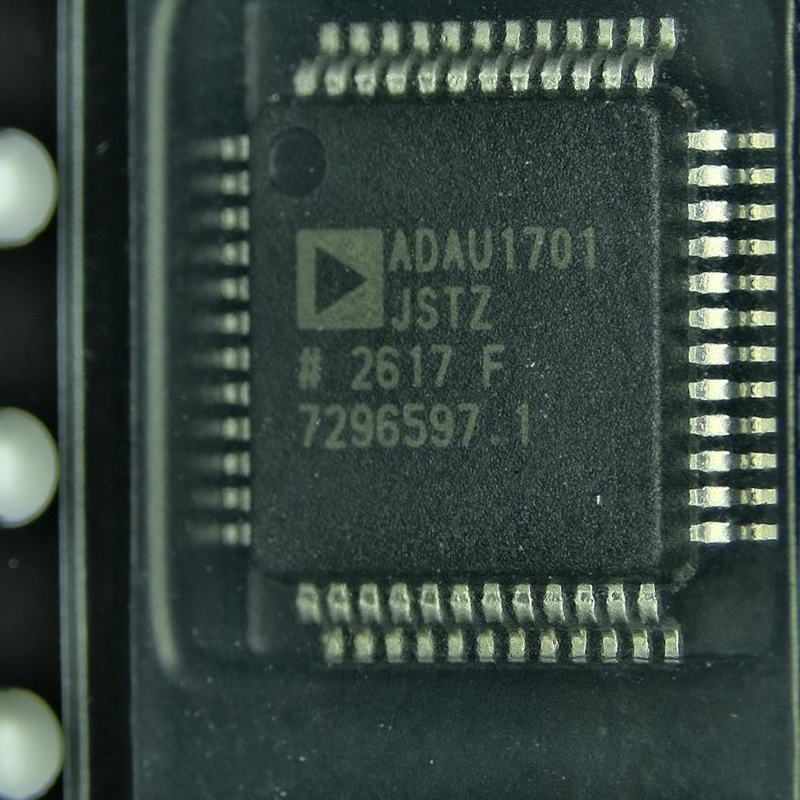
ADAU1701JSTZ-RL is an Analog Devices 28/56-bit SigmaDSP audio processor featuring 2 ADCs, 4 DACs, 50 MIPS processing, SigmaStudio programming, I2C/SPI control and EEPROM self-boot support.
Your reliable partner for semiconductor solutions. Flychip supports customers from R&D to mass production with electronic component supply, BOM sourcing, PCB, SMT and PCBA services.
- 20+
- Years Component Supply
- BOM
- Multi-Part Sourcing
- PCBA
- PCB / SMT Support
- Part No.:
- ADAU1701JSTZ-RL
- Manufacturer:
- Analog Devices Inc.
- Category:
- DSP (Digital Signal Processors)
- Package:
- 48-LQFP
- Datasheet:
- ADAU1701JSTZ-RL.pdf
- Description:
- ADAU1701JSTZ-RL is an Analog Devices 28/56-bit SigmaDSP audio processor featuring 2 ADCs, 4 DACs, 50 MIPS processing, SigmaStudio programming, I2C/SPI control and EEPROM self-boot support.
- Quantity:


-
Quality Control
Supplier review, channel management and product verification before delivery.
-
Global Channels
International chip manufacturer and well-known distributor sourcing network.
-
BOM to Production
Component supply support from R&D prototype to mass production.
-
PCB / SMT / PCBA
Integrated manufacturing support to accelerate product development and delivery.
Product Details
ADAU1701JSTZ-RL SigmaDSP Audio Processor Procurement & Engineering Review
This engineering and procurement review evaluates the Analog Devices ADAU1701JSTZ-RL SigmaDSP audio processor. The device integrates a 28-/56-bit audio DSP core, two ADC channels, four DAC channels and flexible digital audio interfaces. The review focuses on audio signal processing, clock configuration, power architecture, SigmaStudio programming, package verification and supply-chain consistency.
Product Identity and Reference Configuration
ADAU1701JSTZ-RL is a programmable digital audio signal processor manufactured by Analog Devices, Inc. and belongs to the SigmaDSP product family.
The ADAU1701 combines a 28-/56-bit DSP core, two high-performance stereo ADC channels, four DAC output channels and flexible digital audio interfaces in one integrated device. It is designed to handle audio processing tasks such as equalization, crossover filtering, bass enhancement, multiband dynamics, delay compensation and speaker correction.
Unlike a general-purpose microcontroller, ADAU1701 is optimized for audio signal processing. Its graphical SigmaStudio development environment allows engineers to build signal-processing flows using functional blocks rather than writing every audio algorithm from scratch.
- DSP Core
- 28 / 56 Bit
- Processing
- 50 MIPS
- Analog Conversion
- 2 ADC / 4 DAC
- Package
- LQFP-48
Product Identification and Key Specifications
| Manufacturer | Analog Devices, Inc. |
|---|---|
| Full Part Number | ADAU1701JSTZ-RL |
| Product Family | SigmaDSP |
| Device Category | Programmable Digital Audio Signal Processor |
| DSP Architecture | 28-bit processing with 56-bit double-precision accumulator architecture |
| Processing Performance | 50 MIPS SigmaDSP core |
| ADC Channels | 2-channel stereo ADC, 24-bit resolution |
| DAC Channels | 4-channel DAC, 24-bit resolution |
| ADC SNR | 100 dB typical, A-weighted |
| DAC SNR | 104 dB typical, A-weighted |
| ADC THD+N | -83 dB typical |
| DAC THD+N | -90 dB typical |
| Sampling Rate | Supports audio sampling rates up to 192 kHz, subject to interface mode limitations |
| Control Interface | I2C and 4-wire SPI |
| Programming Tool | Analog Devices SigmaStudio |
| Self-Boot | External serial EEPROM supported |
| Package | 48-Lead Low-Profile Quad Flat Package (LQFP) |
| Package Body | 7mm × 7mm nominal body size |
| Lead Pitch | 0.50mm |
| Operating Temperature | 0°C to +70°C ambient |
| Package Option | ST-48 |
| Packaging | 13-inch Tape and Reel |
| RoHS | RoHS Compliant |
| Product Lifecycle | Production |
ADAU1701JSTZ-RL is an audio DSP with integrated ADC and DAC functions. It is not a standalone power amplifier and does not directly replace a speaker power-stage IC.
Quality Review Before Quotation
ADAU1701JSTZ-RL is a fine-pitch 48-lead surface-mount device. For procurement and incoming inspection, the complete ordering code, package dimensions, lead condition, moisture handling and lot traceability should be reviewed before production use.
Confirm Analog Devices as the manufacturer and verify the complete ADAU1701JSTZ-RL orderable part number.
Check package marking, orientation, pin-1 identification and consistency with the manufacturer's marking and package information.
Inspect all 48 leads for oxidation, deformation, contamination, coplanarity and visible mechanical damage.
Confirm reel labels, quantity records, moisture-barrier packaging and ESD-safe transportation controls.
Quality and Handling Review
| Device Manufacturer | Analog Devices |
|---|---|
| Package Type | 48-Lead LQFP |
| Package Option | ST-48 |
| Lead Pitch | 0.50mm |
| RoHS Status | RoHS Compliant according to ordering information |
| ESD Handling | Use ESD-protected handling and storage procedures |
| Incoming Inspection | Verify package, marking, terminal condition and lot documentation |
Visual inspection alone cannot establish semiconductor authenticity. For higher-risk procurement, combine supplier traceability, packaging review, documentation and appropriate electrical testing.
SigmaDSP Architecture and Audio Processing
The ADAU1701 integrates a dedicated SigmaDSP processing core designed for real-time digital audio applications. Its architecture combines signal-processing instructions, parameter memory, audio conversion and control interfaces in one device.
The 28-bit data path and 56-bit accumulator support double-precision signal-processing operations. This architecture is useful for filter coefficients, equalization and other precision-sensitive audio functions.
Core Processing Capabilities
| Equalization | Parametric EQ, tone adjustment and frequency-response correction. |
|---|---|
| Crossover Filtering | Frequency-band separation for multi-way speaker systems. |
| Bass Enhancement | Low-frequency processing and bass-management functions. |
| Dynamics Processing | Multiband dynamics, level management and signal conditioning. |
| Delay Compensation | Audio-path delay adjustment and timing alignment. |
| Speaker Compensation | Signal correction for speaker response characteristics. |
| Stereo Image Processing | Stereo image widening and related audio enhancement. |
50 MIPS Processing Considerations
The 50 MIPS processing capacity is associated with the SigmaDSP core. The available processing budget is shared by all programmed functions. Complex filters, dynamics algorithms, additional routing and higher sample rates should therefore be considered together when designing an audio signal-processing flow.
Estimate the instruction requirements of the complete SigmaStudio program before finalizing the audio design.
Use appropriate fixed-point scaling and coefficient ranges to prevent clipping and numerical overflow.
Plan ADC, digital input, DSP processing and DAC routing as one complete signal chain.
Use supported parameter-update and safeload mechanisms to reduce unwanted audio artifacts.
A 50 MIPS specification does not guarantee that every combination of filters, processing blocks and sample rates can run simultaneously. Validate the complete program in SigmaStudio.
ADC, DAC and Audio Signal Performance
One of the main advantages of ADAU1701 is its integrated analog audio conversion. Two stereo ADC channels accept analog audio signals, while four DAC channels provide processed analog outputs.
This arrangement allows the device to implement stereo audio processing, multi-output speaker systems and configurable analog signal paths without requiring separate external converters for every channel.
ADC and DAC Specification Comparison
| Parameter | ADC | DAC |
|---|---|---|
| Channel Count | 2 Channels | 4 Channels |
| Resolution | 24-bit | 24-bit |
| SNR | 100 dB typical | 104 dB typical |
| THD+N | -83 dB typical | -90 dB typical |
| Dynamic Range | 100 dB typical, A-weighted | 104 dB typical, A-weighted |
| Full-Scale Level | 2V RMS analog input under specified external input network conditions | 0.9V RMS / 2.5V p-p typical |
Analog Input Design
The ADC input network must be designed according to the recommended input resistance and full-scale conditions. External input resistors and signal conditioning components influence the actual input range.
- Confirm the analog input amplitude before connecting external audio sources.
- Follow the recommended input resistor configuration and ADC reference network.
- Keep analog input traces away from switching regulators and noisy digital clocks.
- Provide appropriate grounding and filtering for low-noise audio performance.
Four-Channel DAC Output Design
The four DAC outputs support flexible analog audio routing. Each output should be connected to an appropriate reconstruction filter and subsequent amplifier or line-level interface.
A passive low-pass filter can be used to attenuate out-of-band DAC noise.
An active filter can provide steeper roll-off and improved stop-band attenuation.
The ADAU1701 DAC pins provide analog signal-level outputs. They require suitable downstream amplification before driving passive loudspeakers.
Clock Configuration and Sampling-Rate Design
The ADAU1701 uses an internal PLL to generate the SigmaDSP core clock. The MCLKI input must receive a valid clock during power-up and initialization.
The device supports several master-clock ratios relative to the audio sampling frequency. The correct PLL mode must be selected according to the clock source and system sample rate.
Supported Master Clock Ratios
| Clock Ratio | PLL_MODE0 | PLL_MODE1 |
|---|---|---|
| 64 × fS | 0 | 0 |
| 256 × fS | 0 | 1 |
| 384 × fS | 1 | 0 |
| 512 × fS | 1 | 1 |
Sampling Rate and Interface Considerations
| 44.1 kHz | Common audio sample rate for music playback and consumer audio systems. |
|---|---|
| 48 kHz | Common sample rate for multimedia, audio equipment and embedded sound systems. |
| 96 kHz | Supported higher-rate audio operation with corresponding clock and DSP configuration. |
| 192 kHz | Maximum supported sampling-rate class. Some TDM master/slave combinations are restricted; 192 kHz TDM output is slave-only. |
Clock Design Checklist
- Select a crystal or external master clock compatible with the intended sampling rate.
- Verify PLL_MODE0 and PLL_MODE1 configuration.
- Ensure a valid MCLKI signal is available during device initialization.
- Check clock stability, jitter and interference from adjacent digital circuits.
- Verify the master/slave configuration of serial audio interfaces.
Supporting 192 kHz does not mean every serial audio interface mode can operate as a master at that rate. Verify the specific mode in the official timing and serial-port tables.
Power Supply, Thermal and PCB Layout Review
ADAU1701 uses separate analog, digital, PLL and I/O supply domains. Correct power sequencing, local decoupling and ground management are important for reliable operation and audio quality.
Power Supply Architecture
| AVDD | 3.3V typical analog supply. |
|---|---|
| DVDD | 1.8V typical digital core supply. |
| PVDD | 3.3V typical converter-related supply domain. |
| IOVDD | 3.3V typical digital I/O supply. |
| Internal Regulator | Supports the 1.8V digital supply architecture using the recommended regulator implementation. |
| Typical Power Dissipation | 286.5mW under the datasheet's stated operating test conditions, excluding IOVDD load-dependent power. |
Power Design Considerations
Use low-noise regulation and suitable filtering to reduce supply-related audio interference.
Verify the 1.8V DVDD rail and follow the recommended external regulator implementation.
Place bypass capacitors close to their corresponding supply pins.
Follow the recommended AGND, DGND and PGND layout strategy and avoid uncontrolled return paths.
Thermal Reference
| Operating Temperature | 0°C to +70°C ambient |
|---|---|
| Package | 48-Lead LQFP |
| Junction-to-Ambient Thermal Resistance | 72°C/W, datasheet package thermal reference |
| Junction-to-Case Thermal Resistance | 19.5°C/W, datasheet package thermal reference |
PCB Layout Priorities
- Separate sensitive analog signal routing from high-speed digital clock paths.
- Place analog input conditioning components close to the ADC input pins.
- Keep clock and PLL filter components close to their designated pins.
- Follow the recommended regulator and decoupling circuit.
- Provide suitable ground return paths for analog and digital sections.
- Use appropriate DAC output filtering before downstream amplification.
The 3.3V analog and I/O domains and the 1.8V digital core domain have different requirements. Follow the official supply and regulator circuit rather than applying one voltage indiscriminately to every supply pin.
SigmaStudio Programming, Control Interface and Self-Boot
ADAU1701 supports graphical audio programming through Analog Devices SigmaStudio. Engineers can configure audio-processing blocks, route signals, adjust parameters and generate the program data required by the DSP.
SigmaStudio Development Workflow
- 1
-
Audio Design
Build the signal-processing flow using SigmaStudio blocks.
- 2
-
Parameter Setup
Configure filters, gain, routing and processing coefficients.
- 3
-
Hardware Connection
Connect the DSP through the supported control interface and development hardware.
- 4
-
Program Validation
Test audio behavior and verify the complete configuration before production.
Control Interface Comparison
| Interface | Function | Application |
|---|---|---|
| I2C | Two-wire control interface | Register access, parameter programming and EEPROM self-boot communication |
| SPI | Four-wire control interface | External controller programming and memory access |
| Self-Boot | EEPROM-based startup | Loads DSP program, parameters and configuration without a host MCU at startup |
EEPROM Self-Boot Configuration
The ADAU1701 can load its program, parameters and register configuration from an external serial EEPROM during power-up. This makes it suitable for standalone audio products where a separate microcontroller is not required for normal DSP startup.
- Confirm the external EEPROM capacity against the actual DSP program and parameter data.
- Verify SELFBOOT, WP and RESET pin states during power-up.
- Check the EEPROM I2C address and bus pull-up implementation.
- Prevent other bus masters from interfering during self-boot or writeback.
- Validate parameter restoration and writeback behavior when settings must be retained.
The ADAU1701 self-boot mechanism uses the external EEPROM through I2C. It does not self-boot in SPI mode. The hardware mode-selection pins must be configured according to the selected startup architecture.
BOM Sourcing and Package Ordering Review
The complete manufacturer orderable number is important when specifying ADAU1701 for automated manufacturing. The RL suffix identifies the tape-and-reel version of the device.
Ordering Code Comparison
| Part Number | Package | Packaging Description |
|---|---|---|
| ADAU1701JSTZ | 48-Lead LQFP | Standard orderable package option |
| ADAU1701JSTZ-RL | 48-Lead LQFP | 13-inch Tape and Reel |
Both order codes refer to the ADAU1701 device in the same ST-48 package option. The key documented distinction for ADAU1701JSTZ-RL is its 13-inch tape-and-reel packaging.
Package Mechanical Reference
| Package Type | Low-Profile Quad Flat Package (LQFP) |
|---|---|
| Number of Leads | 48 |
| Nominal Body Size | 7.0mm × 7.0mm |
| Lead Pitch | 0.50mm |
| Package Option | ST-48 |
| Package Standard | JEDEC MS-026-BBC |
BOM Approval Workflow
- 1
-
MPN Verification
Confirm the complete ADAU1701JSTZ-RL ordering code.
- 2
-
Footprint Review
Verify 48-lead LQFP and 0.50mm lead pitch.
- 3
-
Carrier Review
Confirm 13-inch tape-and-reel requirements.
- 4
-
Production Release
Approve documentation, sample and supplier traceability.
Engineering Selection and Procurement Risk
When selecting an alternative audio DSP, matching the package alone is not sufficient. The processing architecture, ADC/DAC configuration, clock system, programming environment and control interfaces must all be evaluated.
Key Replacement Evaluation Criteria
| DSP Architecture | Compare data width, processing capability, program memory and algorithm compatibility. |
|---|---|
| ADC Configuration | Compare channel count, resolution, SNR, THD+N and analog input conditions. |
| DAC Configuration | Compare output channel count, resolution, signal level and reconstruction requirements. |
| Sampling Rate | Verify sample-rate support and serial-interface operating limitations. |
| Programming Environment | Check SigmaStudio compatibility, programming workflow and software migration requirements. |
| Control Interface | Verify I2C, SPI, GPIO and EEPROM self-boot functionality. |
| Power Architecture | Compare analog, digital, PLL and I/O supply requirements. |
| Package Compatibility | Check pin mapping, LQFP footprint, lead pitch and mechanical dimensions. |
A different SigmaDSP or audio processor may require a different firmware project, clock configuration, power network, analog input circuit or PCB footprint. Direct replacement must be confirmed by datasheet comparison and engineering validation.
Application Suitability
Digital audio equalizers, speaker crossovers, multimedia audio systems and embedded audio processing.
Studio monitors, MP3 speaker docks, digital televisions and musical instrument effects processors.
Speaker power amplification, external EEPROM for self-boot and additional audio interfaces where required.
General-purpose MCU, standalone speaker power amplifier or high-power audio output stage.
Supply Chain, SMT and PCBA Support
For production projects using ADAU1701JSTZ-RL, component procurement should be coordinated with the approved PCB footprint, audio circuit design, EEPROM selection and programming requirements.
Supply Chain Review
| Supplier Verification | Review supplier identity, sourcing route and order execution history. |
|---|---|
| Manufacturer Documentation | Use Analog Devices datasheet, package information and product documentation. |
| Order Code Control | Maintain ADAU1701JSTZ-RL as the approved manufacturer part number. |
| Package Verification | Check 48-lead LQFP package and reel packaging information. |
| Incoming Inspection | Inspect package condition, leads, markings and lot documentation. |
| Repeat Order Control | Maintain the approved MPN and packaging specification across purchase orders. |
PCB, SMT and PCBA Project Support
Component Sourcing
Support the procurement of ADAU1701JSTZ-RL and related audio circuit components.
PCB Engineering
Review audio signal routing, power domains, clock networks and analog grounding.
SMT Assembly
Coordinate fine-pitch LQFP placement, soldering and assembly inspection.
PCBA Integration
Coordinate DSP, EEPROM, audio converters and external amplifier interfaces.
Recommended Production Testing
- Verify all supply rails and power-up sequence.
- Confirm DSP clock and PLL lock behavior.
- Check SigmaStudio program loading and parameter configuration.
- Verify I2C and SPI control communication.
- Test ADC input channels and DAC output channels.
- Measure audio noise, distortion and channel balance under defined conditions.
- Verify EEPROM self-boot and parameter retention where implemented.
- Inspect LQFP solder joints and PCB assembly quality.
Actual inventory, date code, lead time and commercial availability should be confirmed through a current supplier quotation. Product lifecycle status alone does not guarantee immediate stock availability.
Purchase Decision Flow and Product FAQ
Before purchasing ADAU1701JSTZ-RL for a production project, engineering and procurement teams should confirm the required audio channels, DSP program, supply architecture, master clock, package and startup configuration.
Frequently Asked Questions
1. What is ADAU1701JSTZ-RL?
2. What is the difference between ADAU1701 and ADAU1701JSTZ-RL?
3. How many ADC and DAC channels does ADAU1701 have?
4. What is the DSP processing capability?
5. What is the maximum sampling rate?
6. Which software is used to program ADAU1701?
7. Does ADAU1701 support I2C and SPI?
8. Can ADAU1701 work without an external MCU?
9. What package does ADAU1701JSTZ-RL use?
10. What is the operating temperature range?
11. Can ADAU1701 directly drive a speaker?
12. Can another SigmaDSP replace ADAU1701 directly?
Review Notice and Technical Reference
This content is prepared for component sourcing, engineering selection and procurement evaluation. Electrical characteristics, operating limits, package dimensions and interface requirements should be verified against the official manufacturer documentation before design release.
From Component Sourcing to Production Delivery
Flychip has been providing electronic components to global customers for 20 years. We combine component supply, BOM services, PCB, SMT and PCBA support to help customers accelerate product development and delivery.
-
R&D Support
Fast sourcing support for prototype development, sample validation and early-stage engineering needs.
-
BOM Services
Multi-line BOM matching with component supply, alternative suggestions and procurement follow-up.
-
Mass Production
Stable supply coordination for production preparation, batch delivery and long-term purchasing needs.
-
Experienced Team
Over 15 years of channel management, quality control, sales management and organization management experience.
ADAU1701JSTZ-RL Technical Information
- Specifications
- FAQ
- Hot Sale
- Related Products
Specifications
- Product Attributes
- Attribute Value
- Manufacturer:
- Analog Devices Inc.
- Series:
- SigmaDSP®
- Package/Case:
- 48-LQFP
- Packaging:
- Tape & Reel (TR)
- Product Status:
- Active
- Type:
- Sigma
- Interface:
- I2C, SPI
- Clock Rate:
- 50MHz
- Non-Volatile Memory:
- -
- On-Chip RAM:
- 12kB
- Voltage - I/O:
- 3.30V
- Voltage - Core:
- 1.80V
- Operating Temperature:
- 0°C ~ 70°C (TA)
- Grade:
- -
- Qualification:
- -
- Mounting Type:
- Surface Mount
- Supplier Device Package:
- 48-LQFP (7x7)
FAQ
1. How to order ADAU1701JSTZ-RL on Flychip?
You can submit an RFQ directly on this page. Our sales team will review your quantity, delivery requirements and target price, then reply with a quotation as soon as possible.
2. How does Flychip verify the quality of ADAU1701JSTZ-RL?
We work with qualified channels including international chip manufacturers and well-known distributors. Our team pays close attention to supplier review, traceability, product condition and quality control.
3. Are the price and inventory of ADAU1701JSTZ-RL updated in real time?
Inventory and prices of electronic components may fluctuate frequently. The displayed data is for reference, and the final quotation will be confirmed by our sales team.
4. What payment methods are accepted?
Wire Transfer, PayPal, Alipay, WeChat, Credit Card, Western Union, MoneyGram and Escrow may be supported depending on the order and region.
5. How is shipping arranged?
We can arrange international shipping through DHL, UPS, FedEx, TNT and other logistics channels. Tracking information will be provided after shipment.
6. What is the return or replacement process for ADAU1701JSTZ-RL?
Please contact our sales team within the specified period if there are quantity differences, wrong items, or clear external defects. The product should remain unused and in its original packaging.
7. Can I request technical support for ADAU1701JSTZ-RL?
Yes. You can contact us for datasheet, package details, pin information and sourcing assistance related to ADAU1701JSTZ-RL.
Hot Sale
Related Products
-

-
TMS320C5535AZAY10
Texas Instruments
-

-
TMS320VC5501PGF300
Texas Instruments
-

-
ADSP-BF592KCPZ
Analog Devices Inc.
-

-
ADAU1463WBCPZ150
Analog Devices Inc.
-

-
TMS320VC5402PGE100
Texas Instruments
-
-
ADAU1701JSTZ-RL
Analog Devices Inc.
-

-
ADAU1701JSTZ
Analog Devices Inc.
-
-
TMS320VC5502PGF300
Texas Instruments
-
-
ADAU1462WBCPZ300RL
Analog Devices Inc.
-
-
ADAU1452KCPZRL
Analog Devices Inc.
-
-
ADAU1452WBCPZ-RL
Analog Devices Inc.
-

-
TMS320C6747DZKB3
Texas Instruments
ADAU1701JSTZ-RL Sourcing & Technical Support
ADAU1701JSTZ-RL is supplied by Analog Devices Inc.. This page provides key purchasing information including manufacturer, package, datasheet, stock reference, price reference and RFQ support.
As your reliable partner for semiconductor solutions, Flychip supports customers from research and development to mass production with electronic component supply, BOM sourcing, PCB, SMT and PCBA solutions.
Our sourcing partners include international chip manufacturers and well-known distributors. With rich experience in channel management, quality control and sales management, Flychip helps customers accelerate product development and delivery.
- Part Number
- ADAU1701JSTZ-RL
- Manufacturer
- Analog Devices Inc.
- Package
- 48-LQFP
- Category
- DSP (Digital Signal Processors)
Quick RFQ Send your inquiry and our sales team will respond quickly.
Tips
Please check your information and try again.