

FT61EC21A-RB 8-Bit MCU: Specifications, Pinout and Applications
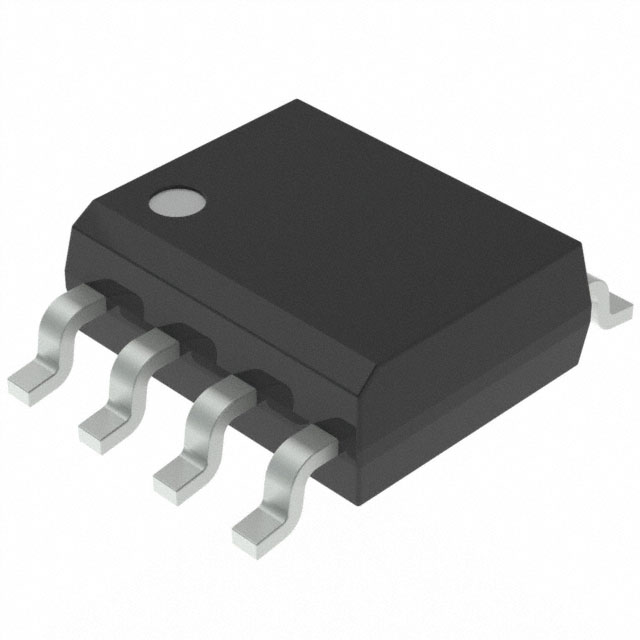
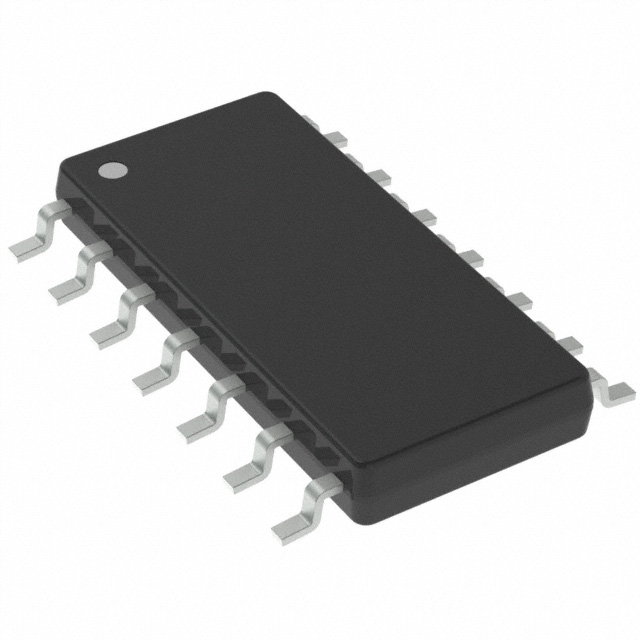
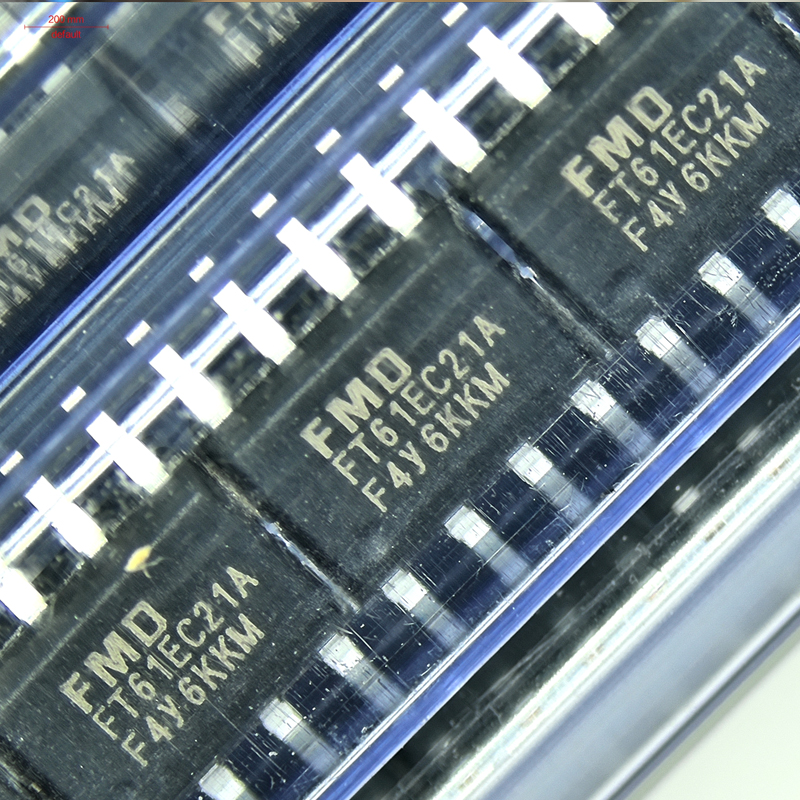
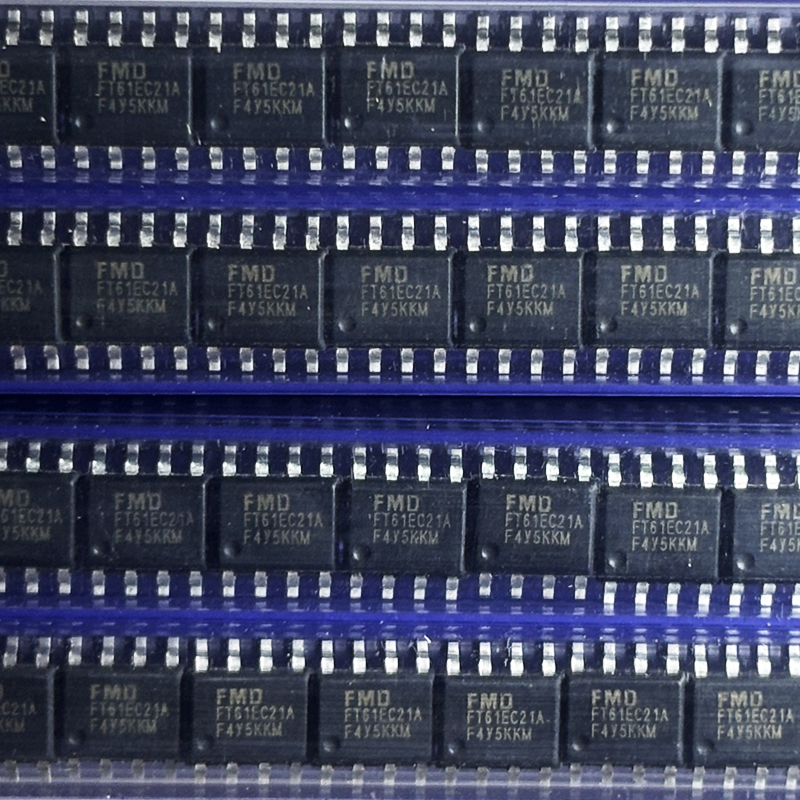
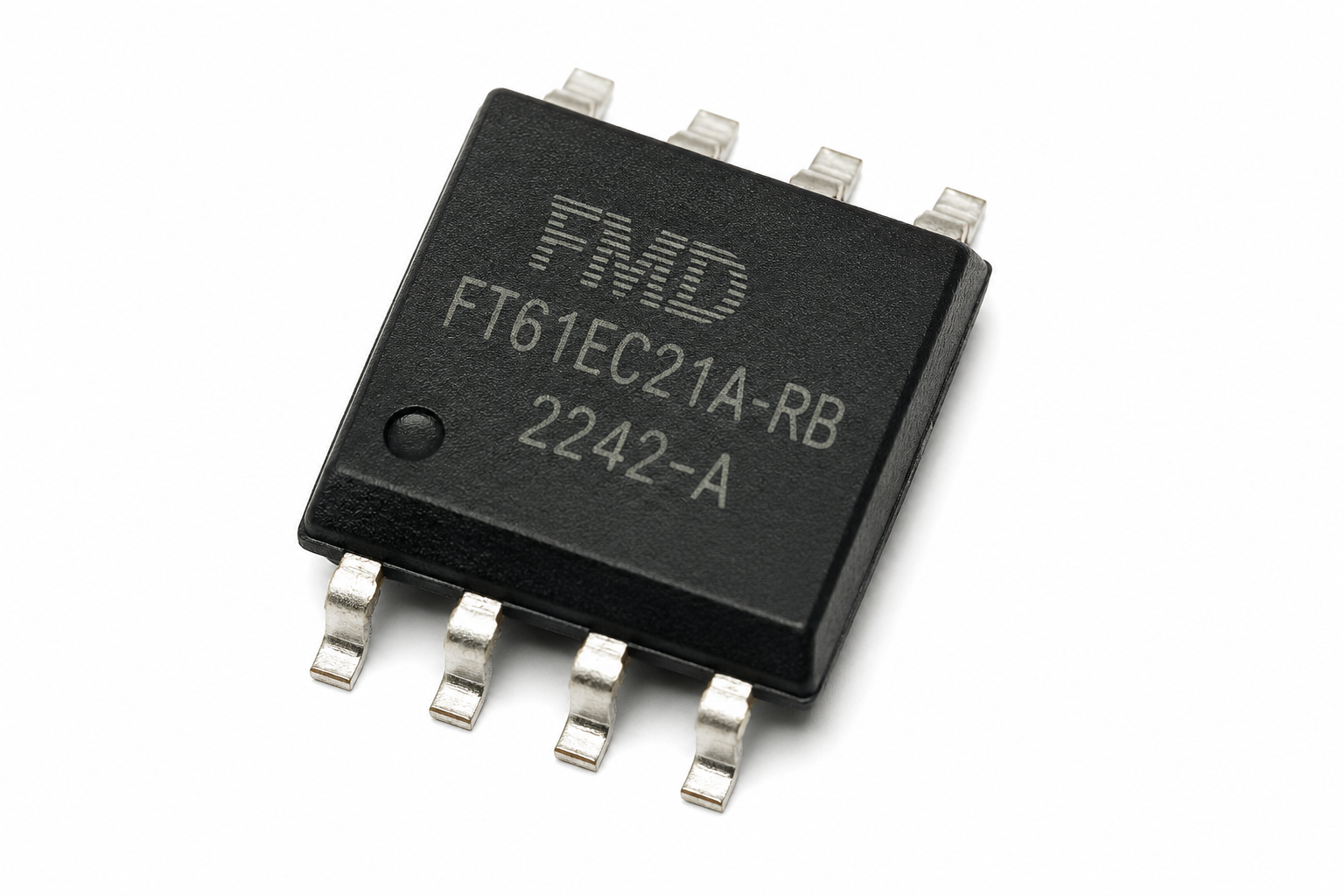
The FT61EC21A-RB is a compact 8-bit RISC microcontroller from Fremont Micro Devices (FMD), designed for embedded systems that need reliable control without the cost and board space of a larger MCU. Supplied in an SOP-8 package, the device combines program memory, RAM, data EEPROM, a 10-bit ADC, PWM, timers, analog comparison and internal clock resources in one small IC. This combination makes FT61EC21A-RB especially useful for sensor controllers, LED products, household appliances, alarms, small instruments and cost-sensitive electronic control boards.
What Is FT61EC21A-RB?
The FT61EC21A-RB microcontroller belongs to the FT61EC2x family of embedded controllers developed by Fremont Micro Devices. It is intended for products where the control task is relatively focused: read several inputs, process simple logic, store operating parameters and control one or more outputs.
The important point is integration. A small electronic product often needs more than a CPU. It may also require analog signal measurement, timing, non-volatile data storage and waveform generation. FT61EC21A-RB places these capabilities inside one compact device, helping designers reduce the number of external ICs required around the controller.
This makes the device particularly relevant to high-volume electronics. When thousands or hundreds of thousands of units are manufactured, reducing one external memory IC, oscillator or analog component can influence PCB area, assembly time, sourcing complexity and total production cost.
FT61EC21A-RB Key Specifications at a Glance
| Feature | FT61EC21A-RB | Why It Matters |
|---|---|---|
| MCU Architecture | 8-bit RISC | Efficient for dedicated embedded control tasks |
| Program Memory | 2K x 14-bit | Stores application firmware |
| RAM | 128 x 8-bit | Stores variables and temporary data |
| Data EEPROM | 256 x 8-bit | Retains settings after power is removed |
| Instruction Set | Compact RISC instruction architecture | Supports efficient embedded firmware |
| Internal Clock | High-speed internal oscillator resources | Can reduce external timing components |
| ADC | 10-bit | Reads analog sensors and voltage signals |
| PWM | Hardware PWM capability | Useful for LEDs, motors and waveform control |
| Timers | Integrated hardware timing resources | Supports counting, delays and periodic events |
| Analog Comparator | Integrated | Useful for voltage and threshold detection |
| Package | SOP-8 | Suitable for compact PCB layouts |
FT61EC21A-RB Pinout and SOP-8 Package
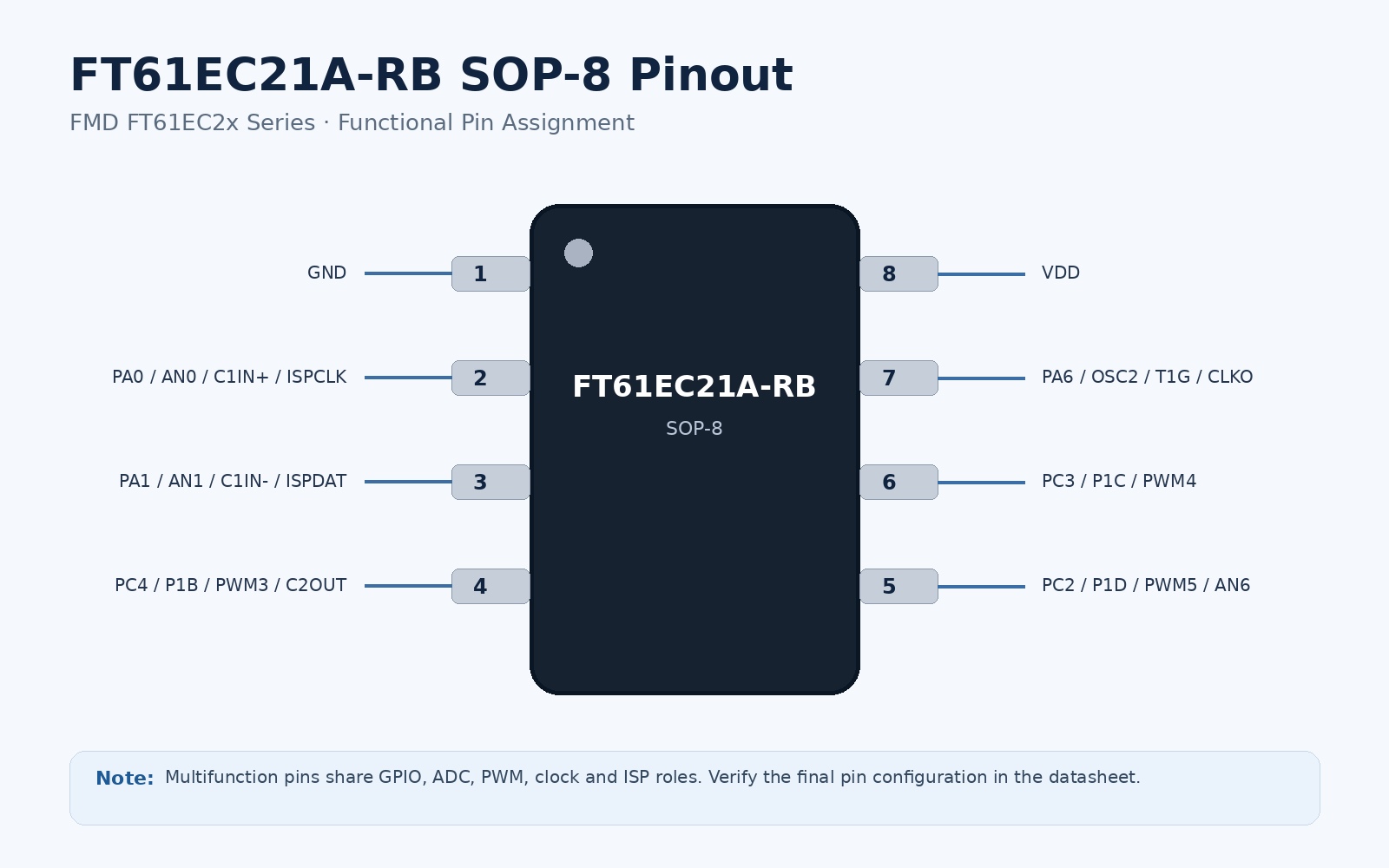
The FT61EC21A-RB SOP-8 pinout is one of the most important details to verify before schematic design. Although the package has only eight physical pins, several pins support multiple functions including GPIO, ADC input, PWM, oscillator functions and in-system programming.
This multiplexed design gives engineers flexibility but also makes early pin planning important. A pin required for ADC measurement, for example, may also provide another peripheral function. Designers should therefore assign all required functions before completing the PCB routing.
Why an 8-Bit RISC MCU Still Makes Sense
Modern electronics often promote 32-bit processors, but a higher bit count does not automatically create a better product. Many embedded devices have a simple job: read a sensor, detect a switch, compare a value, update a timer and activate an output.
For those applications, a compact 8-bit MCU such as FT61EC21A-RB may be more appropriate than a larger processor with many unused interfaces.
A dedicated 8-bit design can offer several practical advantages. Firmware can remain relatively small, system behavior can be predictable, PCB routing can be simpler and the total number of components can remain low.
Instead of asking whether an 8-bit architecture is new or old, engineers should ask a more useful question: does the MCU provide the resources required by the application?
If the application mainly uses ADC measurements, GPIO, timers, PWM, threshold detection and basic state-machine logic, FT61EC21A-RB can be a well-matched control platform.
Memory Architecture: Program Memory, RAM and EEPROM
A useful way to understand FT61EC21A-RB is to separate its three main memory roles.
Program Memory
Program memory stores the firmware that determines how the product behaves. The available program space is intended for compact embedded applications rather than large operating systems or software frameworks.
Typical firmware can include initialization, input scanning, ADC sampling, button detection, timer routines, PWM control, safety logic and output management.
RAM
RAM holds temporary information while the microcontroller is operating. This may include ADC results, flags, counters, timer values, operating states and intermediate calculations.
Because the RAM capacity is designed for lightweight embedded control, developers should avoid unnecessary large arrays and data buffers.
Data EEPROM
The integrated data EEPROM is particularly valuable because information stored there can remain available after power is removed.
Typical EEPROM data can include:
- User-selected operating modes
- LED brightness settings
- Calibration coefficients
- Sensor correction values
- Alarm thresholds
- Factory configuration values
- Last operating state
In a suitable design, this means an external EEPROM IC may no longer be required.
10-Bit ADC for Sensor and Analog Signal Measurement
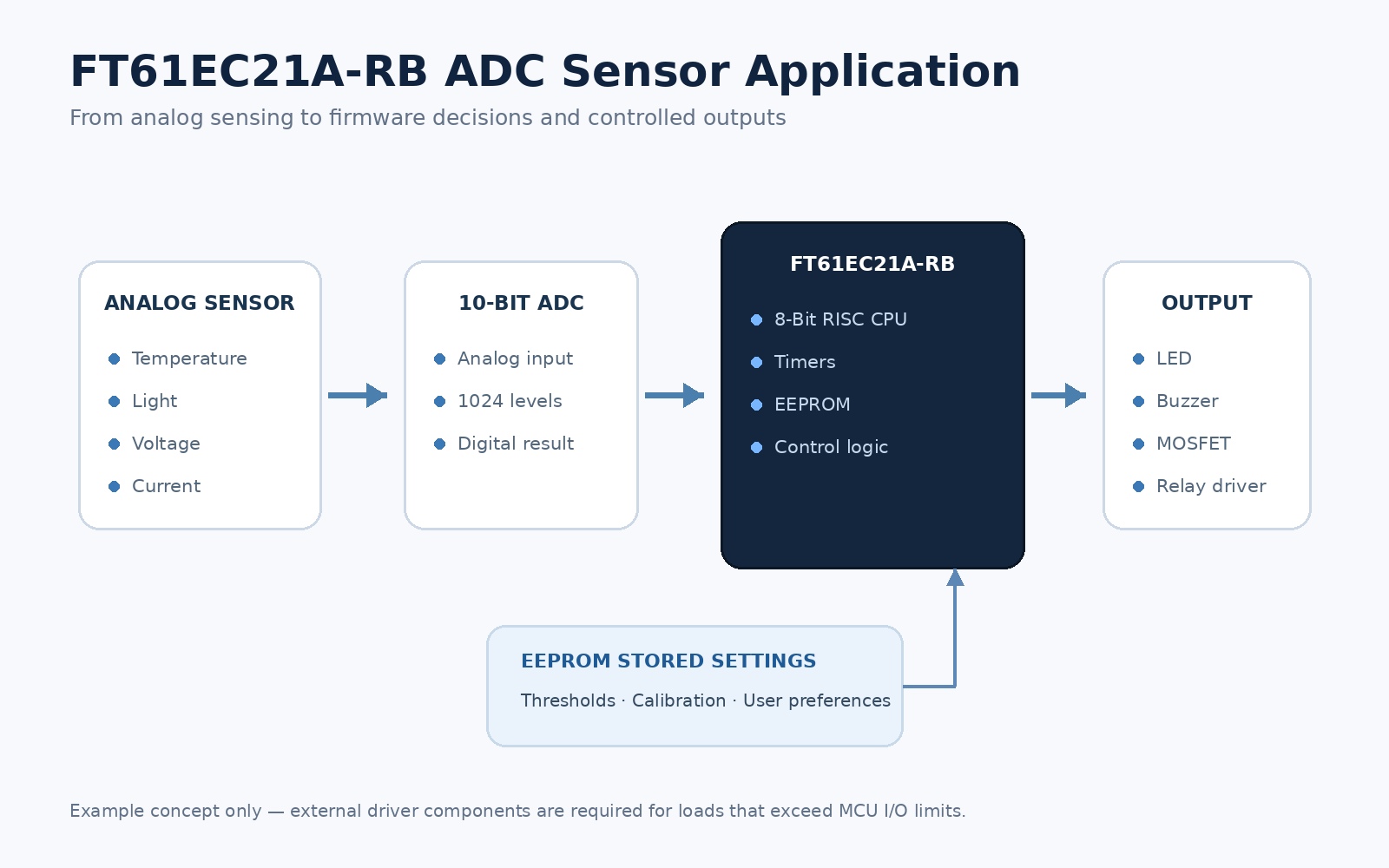
One of the most useful integrated functions of the FT61EC21A-RB family architecture is its 10-bit analog-to-digital converter.
An ADC converts an analog voltage into a digital value that firmware can process. A 10-bit converter provides 1024 possible digital levels across its measurement range.
For many control applications, this resolution is sufficient for monitoring slowly changing analog signals.
Potential sources include:
- Temperature sensing circuits
- Light sensors
- Potentiometers
- Battery voltage dividers
- Current-sense circuits
- Pressure sensors
- Position sensing circuits
- Other analog-output sensors
The MCU can sample the signal, compare the result with programmed or stored thresholds and then take an action. That action might be changing an LED, activating a buzzer, switching a transistor or adjusting PWM output.
How PWM Expands FT61EC21A-RB Applications
Pulse-width modulation (PWM) creates a controlled digital waveform whose duty cycle can be adjusted by software. It is one of the most useful peripheral functions in small embedded electronics.
LED Brightness Control
PWM allows LEDs to operate at different apparent brightness levels rather than only switching between fully on and fully off states.
This is useful in indicator systems, decorative lighting, small lamps, backlights and user-interface products.
Motor or Fan Speed Control
When combined with a suitable transistor or MOSFET driver stage, PWM can control the average power supplied to a small DC motor or fan.
Buzzer and Tone Generation
Timers and PWM can generate periodic signals for buzzers, alarms and other audible indicators.
Power and Switching Control
Depending on the external circuit, PWM can also participate in simple switching and power-control functions.
Timers: Small Features That Do a Lot of Work
Hardware timers are sometimes overlooked when comparing microcontrollers, but they are essential in practical embedded design.
Timer resources can support:
- Button debounce
- Periodic ADC sampling
- LED flashing
- Pulse generation
- Motor operating intervals
- Timeout detection
- Frequency measurement
- Event counting
- PWM generation
- Simple firmware scheduling
Using hardware timing reduces reliance on software delay loops and can make the system more predictable.
Internal Clock Resources Help Simplify the PCB
The FT61EC2x MCU architecture provides internal clock resources that can support many ordinary embedded-control applications without requiring a separate crystal oscillator.
If the internal oscillator offers sufficient accuracy for the application, removing an external crystal can reduce component count and save PCB space.
This can mean:
- Lower bill-of-material cost
- Fewer PCB traces
- Fewer assembly placements
- A smaller overall PCB
- Fewer potential component failure points
Applications that demand very precise timing should still evaluate clock accuracy carefully before eliminating an external reference.
Where Is FT61EC21A-RB Used?
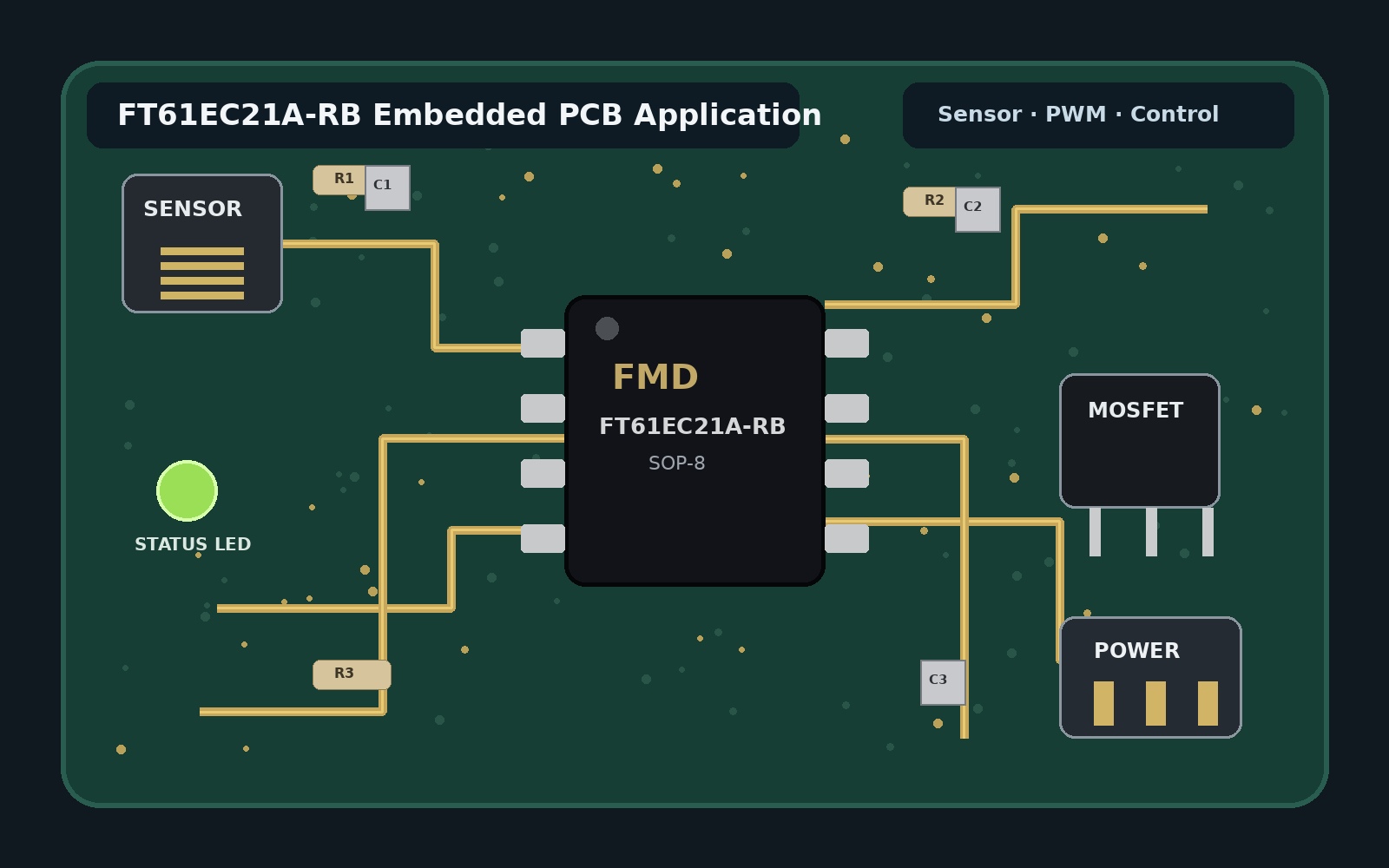
The FT61EC21A-RB is best suited to focused embedded systems where a small MCU needs to sense, decide and control.
Sensor Controllers
ADC inputs can acquire analog sensor values while firmware applies threshold, timing or calibration logic.
LED and Lighting Products
PWM and timer resources can support dimming, flashing sequences and multiple operating modes.
Household Appliances
The MCU can scan switches, monitor sensors, control indicators and drive external relay or MOSFET stages.
Alarm Systems
Input monitoring, threshold detection and timer functions can be combined to control buzzers and warning outputs.
Electronic Switches
Compact switching products can use simple firmware state machines and timing logic without requiring a large processor.
Small Instruments
ADC acquisition, calibration and threshold comparison make the MCU useful in basic measurement electronics.
Why the SOP-8 Package Can Be an Advantage
The SOP-8 package gives FT61EC21A-RB a clear position in compact electronics.
A product that uses one or two sensor inputs, several status outputs and only a few control signals may gain little from using a 32-pin or 48-pin microcontroller.
With careful pin planning, an eight-pin device can provide enough functionality while occupying significantly less PCB area.
However, limited pin count is also a design constraint. If a product needs many buttons, LEDs, sensors and communication interfaces, a larger microcontroller may be more suitable.
FT61EC21A-RB vs a Larger 32-Bit MCU
| Design Requirement | FT61EC21A-RB | Larger 32-Bit MCU |
|---|---|---|
| Simple control logic | Strong fit | Often more performance than required |
| Compact PCB | Strong advantage | Package dependent |
| Analog sensor input | Supported | Usually supported |
| Basic PWM control | Supported | Supported |
| EEPROM-style parameter storage | Integrated data EEPROM | Architecture dependent |
| Large software framework | Limited | Better choice |
| Large communication buffers | Limited | Better choice |
| High computing performance | Not the design priority | Strong advantage |
The comparison shows why MCU selection should begin with the system requirement rather than CPU size.
If a product only needs to read several analog or digital signals, execute control logic and drive several outputs, the FMD FT61EC21A-RB can be more appropriately sized than a larger microcontroller.
How FT61EC21A-RB Can Reduce Total System Cost
The unit price of a microcontroller is only one part of the real cost of an electronic design.
A more useful comparison considers the complete circuit surrounding the MCU.
By integrating memory, EEPROM, ADC, timers, PWM, comparators and clock resources, the FT61EC21A-RB may allow engineers to eliminate external components that would otherwise perform some of these functions.
Reducing component count can lower:
- PCB area
- Assembly placements
- Solder-joint count
- Component sourcing workload
- Inventory complexity
- Potential failure points
- Manufacturing test complexity
FT61EC21A-RB PCB Design Considerations
Place Power Decoupling Close to the MCU
A suitable bypass capacitor should normally be placed near the MCU power pins to improve local power stability and reduce supply noise.
Keep Analog Signals Away From Noisy Switching Nodes
When the ADC is used for sensor measurement, good routing and grounding can improve measurement consistency. Sensitive analog traces should be kept away from high-current switching signals where practical.
Plan Programming Access Before PCB Production
If the MCU will be programmed after board assembly, provide appropriate access to the required programming signals using pads, test points or a production fixture.
Use External Drivers for High-Current Loads
MCU pins should not directly power motors, relays, high-power LEDs or other loads that exceed the permitted I/O current. Use an appropriate transistor, MOSFET or driver circuit.
Plan Multifunction Pins Early
Because FT61EC21A-RB uses an eight-pin package, ADC, PWM, GPIO, clock and programming requirements should be mapped before the final PCB layout is completed.
What Should You Check Before Choosing FT61EC21A-RB?
Before selecting the device for a new project, check the following design requirements carefully.
- Required number of GPIO pins
- Number of analog inputs
- Required PWM outputs
- Firmware program size
- RAM consumption
- EEPROM storage requirements
- Clock accuracy requirements
- Programming tools and production process
- Supply-voltage requirements
- Exact package and pin assignment
This assessment is especially important when replacing an existing MCU. Two SOP-8 microcontrollers are not automatically interchangeable simply because their physical packages look similar.
Pin assignments, peripheral architecture, electrical specifications, programming method and firmware compatibility must all be verified.
Is FT61EC21A-RB Suitable for New Embedded Designs?
FT61EC21A-RB can be a practical choice when the project needs a compact controller rather than a high-performance computing platform.
It is particularly attractive when the design needs:
- A small SOP-8 MCU
- Simple 8-bit embedded processing
- Analog sensor acquisition
- Hardware PWM
- Timer functions
- Internal non-volatile data storage
- Low external component count
- Compact firmware
A larger MCU should be considered when the design requires extensive communications, large memory buffers, a graphical user interface, complex algorithms or many external I/O connections.
Buying FT61EC21A-RB: What Procurement Teams Should Verify
Purchasing an electronic component involves more than matching a similar part-number label.
Before ordering FT61EC21A-RB, procurement teams and engineers should confirm:
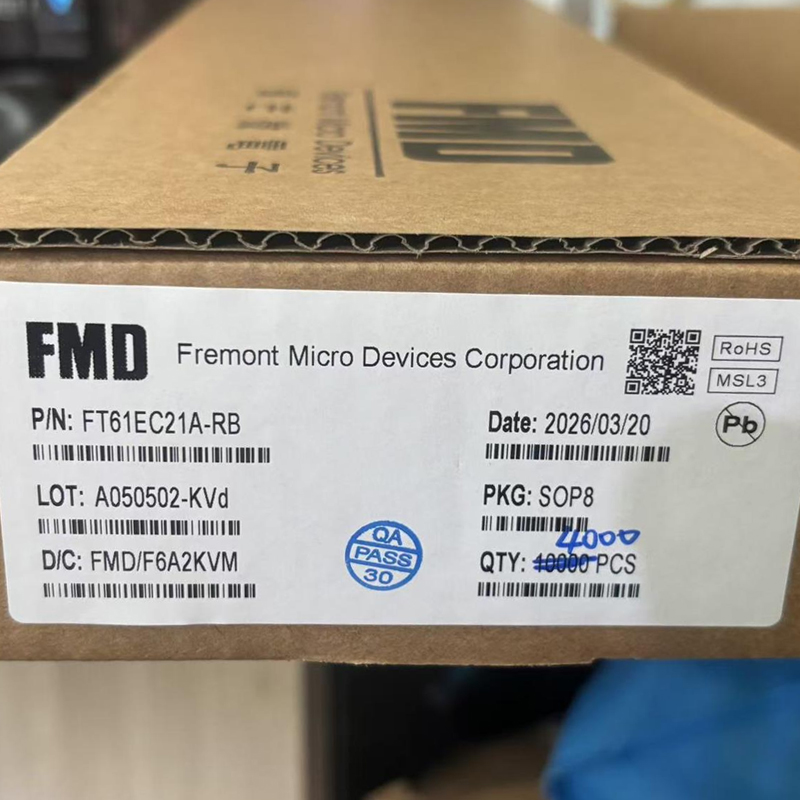
- Exact manufacturer part number: FT61EC21A-RB
- Manufacturer: Fremont Micro Devices / FMD
- SOP-8 package requirement
- Pinout compatibility
- Production date code requirements
- Traceability requirements
- Environmental compliance requirements
- Programming compatibility
- Packaging method
- Required order quantity
- Supplier stock and lead time
For production designs, sample verification before a large-volume order is also a sensible step, especially when changing suppliers or replacing an existing component.
Frequently Asked Questions About FT61EC21A-RB
What is FT61EC21A-RB?
FT61EC21A-RB is an FMD 8-bit RISC microcontroller in an SOP-8 package. It integrates processing, memory, data EEPROM and embedded peripherals for compact electronic-control applications.
Who manufactures FT61EC21A-RB?
FT61EC21A-RB belongs to the microcontroller portfolio of Fremont Micro Devices, commonly abbreviated as FMD.
Is FT61EC21A-RB an EEPROM IC?
No. FT61EC21A-RB is a complete microcontroller. Data EEPROM is one integrated part of the device and can be used to retain settings and calibration values after power is removed.
What package does FT61EC21A-RB use?
FT61EC21A-RB uses an SOP-8 surface-mount package, making it suitable for compact PCB layouts and space-constrained embedded electronics.
Does FT61EC21A-RB include an ADC?
Yes. The FT61EC2x architecture includes a 10-bit ADC that can be used for analog sensor acquisition and voltage measurement.
Does FT61EC21A-RB support PWM?
Yes. PWM and timer functions can support LED dimming, waveform generation and control of suitable external driver circuits.
What is FT61EC21A-RB used for?
Typical applications include sensor controllers, lighting electronics, household appliance controls, alarms, electronic switches, compact instruments and other small embedded-control products.
Can another SOP-8 MCU directly replace FT61EC21A-RB?
Not necessarily. Engineers must compare pinout, operating conditions, memory, peripherals, programming architecture and firmware compatibility before selecting an alternative.
Final Assessment: Why FT61EC21A-RB Remains Practical
The FT61EC21A-RB represents an important class of microcontrollers designed around a simple engineering principle: use the right amount of processing for the job.
Its combination of an 8-bit RISC architecture, program memory, RAM, data EEPROM, 10-bit ADC, timers, PWM, analog functions and a compact SOP-8 package makes it suitable for dedicated electronic-control applications where board space and component count matter.
For engineers, the main benefit is not a single headline specification. The value comes from integration. A controller that can measure a sensor, process logic, store settings, manage timing and produce PWM output can replace several individual circuit functions.
For procurement teams and electronic-component distributors, FT61EC21A-RB should therefore be categorized as an 8-bit microcontroller / embedded MCU, rather than as a standalone memory device.
When its available I/O, program memory, RAM and peripheral resources match the system requirements, FMD FT61EC21A-RB can provide a compact, economical and straightforward foundation for sensor products, lighting controllers, appliance electronics, alarms and other cost-sensitive embedded designs.