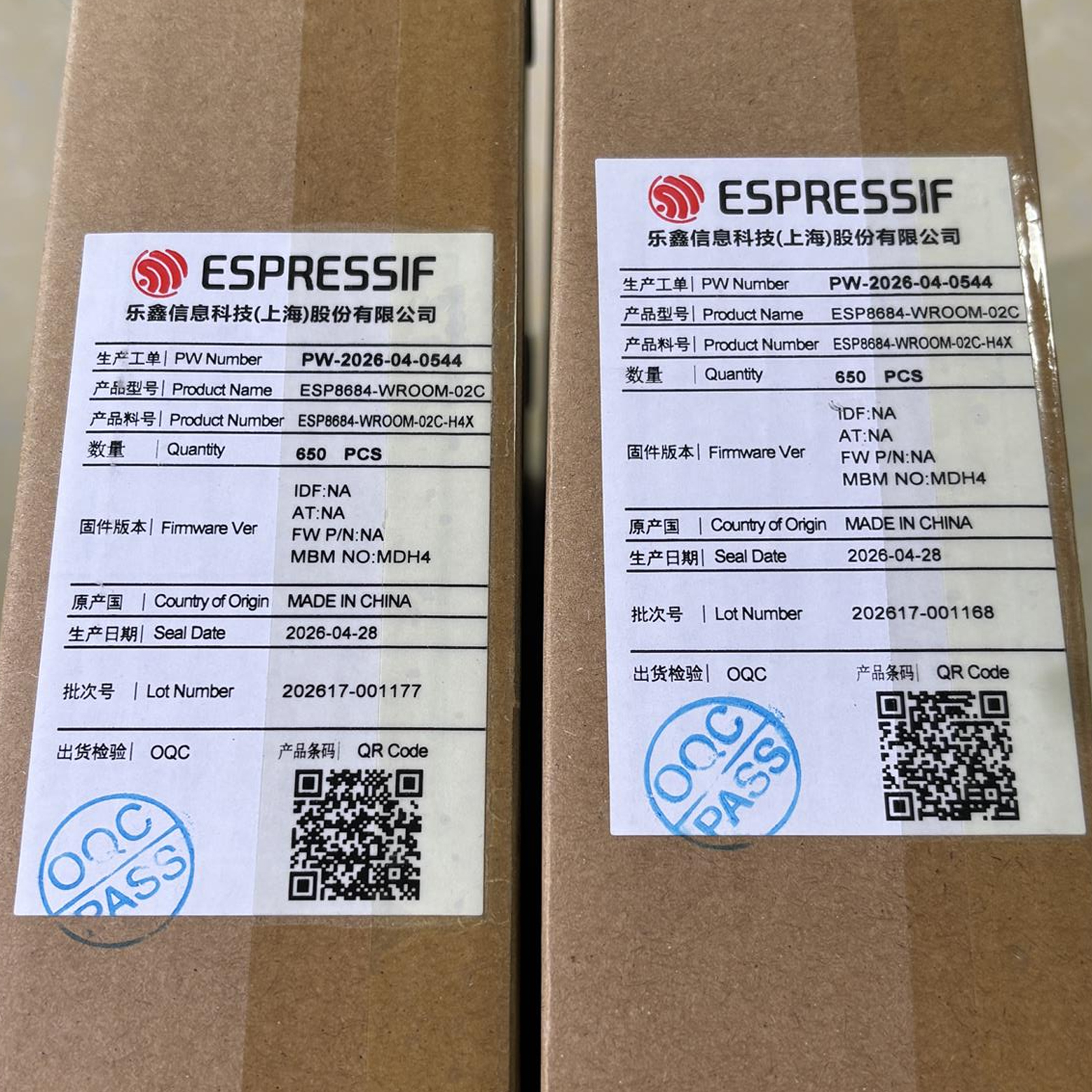


ESP8684-WROOM-02C-H4X Product Overview
The ESP8684-WROOM-02C-H4X is an Espressif Wi-Fi and Bluetooth Low Energy module intended for embedded connected devices that require a compact radio subsystem, integrated flash memory and an on-board antenna.
This specific ordering code belongs to the ESP8684-WROOM-02C family and integrates the ESP8684H4X device with 4 MB of in-package flash. The 02C version uses an integrated PCB antenna, which is an important selection point: applications requiring an external RF antenna should not automatically substitute the similarly named 02UC version without reviewing mechanical layout, antenna connection and certification requirements.
ESP8684-WROOM-02C-H4X Key Specifications
| Parameter | ESP8684-WROOM-02C-H4X | Engineering Relevance |
|---|---|---|
| Manufacturer | Espressif Systems | Match the approved manufacturer and full ordering code during BOM release and incoming inspection. |
| Module Family | ESP8684-WROOM-02C | PCB-antenna version of the ESP8684-WROOM-02C/02UC family. |
| Ordering Code | ESP8684-WROOM-02C-H4X | Use the complete suffix in purchasing documentation to avoid confusion with H2X or external-antenna variants. |
| Integrated SoC | ESP8684H4X | Current H4X module variant is associated with the 4 MB flash configuration. |
| Chip Revision | v2.0 | Revision identity matters for firmware qualification, change control and approved-vendor documentation. |
| CPU | 32-bit RISC-V single core, up to 120 MHz | Suitable for connected control, sensing, protocol handling and compact IoT applications. |
| ROM | 576 KB | Manufacturer-published on-chip memory resource. |
| SRAM | 272 KB, including 16 KB for cache | Firmware memory budgeting should account for protocol stacks, buffers and application workload. |
| Flash | 4 MB in-package flash | Important distinction from the H2X 2 MB version. |
| Wi-Fi Standard | IEEE 802.11 b/g/n, 2.4 GHz | Designed for 2.4 GHz networks; it is not a dual-band 2.4/5 GHz Wi-Fi module. |
| Wi-Fi Bandwidth | 20 MHz | Relevant when checking access-point configuration and expected throughput. |
| Wi-Fi Data Rate | Up to 72.2 Mbps, 1T1R | PHY capability does not equal final application throughput; protocol overhead and RF environment also matter. |
| Bluetooth | Bluetooth LE 5.3 certified | Supports BLE use cases such as provisioning, sensing, control and short-range device communication. |
| BLE PHY Rates | 125 kbps, 500 kbps, 1 Mbps and 2 Mbps | Enables trade-offs between range, robustness and data rate. |
| BLE High-Power Mode | Up to 20 dBm mode supported | Actual allowed transmit power must comply with firmware, antenna and regional regulatory requirements. |
| GPIO | Up to 14 GPIOs | Two GPIOs are also used as boot-related strapping pins; pin planning must consider reset behavior. |
| Module Pins | 19 pins | Includes power, ground, exposed GPIO/UART connections, one NC position and ground pad. |
| ADC | 12-bit SAR ADC, analog input available on up to five pins | Useful for low-complexity sensor inputs; system-level accuracy still depends on layout, source impedance and noise. |
| Interfaces | GPIO, SPI, UART, I2C, LED PWM and related timers | Peripheral signals are multiplexed; verify pin assignment before freezing schematic and PCB layout. |
| Supply Voltage | 3.0 to 3.6 V; 3.3 V typical | Power rail must remain inside the published operating range during radio current transients. |
| External Supply Capability | At least 0.5 A | Do not size the regulator only from average operating current. |
| Antenna | On-board PCB antenna | Base-board copper, enclosure material and nearby metal can affect RF performance. |
| Operating Temperature | −40°C to 105°C | Useful for industrial and elevated-temperature embedded environments when the complete system is also qualified. |
| Module Size | 18.0 × 20.0 × 3.2 mm | Mechanical envelope must be checked together with antenna keepout requirements. |
H4X, H2X, 02C and 02UC Variant Selection
ESP8684 ordering codes are similar enough that a shortened BOM description can create purchasing errors. For engineering and procurement, the antenna style and flash configuration should be treated as controlled characteristics rather than informal description fields.
| Variant | Flash | Antenna Configuration | Selection Meaning |
|---|---|---|---|
| ESP8684-WROOM-02C-H4X | 4 MB | On-board PCB antenna | Target part reviewed on this page. |
| ESP8684-WROOM-02C-H2X | 2 MB | On-board PCB antenna | Same module family and antenna concept but lower flash capacity. |
| ESP8684-WROOM-02UC-H4X | 4 MB | External antenna connector | Not an automatic RF-design substitute for 02C; antenna, mechanical and certification conditions differ. |
| ESP8684-WROOM-02UC-H2X | 2 MB | External antenna connector | Combines external antenna connectivity with the lower flash configuration. |
Engineering Selection Review
The product needs 2.4 GHz Wi-Fi plus Bluetooth LE, integrated 4 MB flash, moderate embedded processing resources and an integrated antenna that reduces external RF BOM complexity.
The enclosure contains large metal structures, the antenna must be remotely located, 5 GHz Wi-Fi is required, very high memory capacity is needed, or the board cannot preserve a suitable antenna keepout region.
Three Engineering Gates Before BOM Release
Power-Supply Design and Current Budget
Wireless modules should not be powered from a regulator selected only from average current. Radio transmission creates short high-current conditions that can expose regulator current limit, PCB impedance, connector resistance and inadequate local decoupling.
| Operating Condition | Published Current | Design Interpretation |
|---|---|---|
| Wi-Fi TX, 802.11b, 1 Mbps | Peak approximately 310 mA at published test conditions | Represents an important transient case for regulator and power-distribution design. |
| Wi-Fi TX, 802.11g, 54 Mbps | Peak approximately 260 mA | Peak demand remains substantially higher than sleep or idle operating states. |
| Wi-Fi TX, 802.11n HT20 MCS7 | Peak approximately 250 mA | Board-level voltage drop should be evaluated during RF activity. |
| Wi-Fi RX | Approximately 65 mA | Published condition assumes defined peripheral and CPU states. |
| Light-sleep | Typical approximately 140 µA | Useful for duty-cycled designs but total board current may be dominated by sensors, regulators and pull networks. |
| Deep-sleep | Typical approximately 5 µA | Module-level figure should not be treated as complete end-product sleep current. |
| CHIP_EN Low / Power-off State | Typical approximately 1 µA | External circuitry can still contribute system-level current. |
Recommended Board-Level Power Checks
- Keep the module supply within the specified 3.0 to 3.6 V operating range.
- Review regulator transient response rather than only its headline continuous-current rating.
- Minimize resistance and inductance between the regulator, local capacitors and module power pins.
- Measure the actual 3.3 V rail at the module during Wi-Fi transmit activity on production-representative hardware.
- Include external sensors, LEDs and other 3.3 V loads when defining total rail capacity.
RF and PCB Antenna Integration
The ESP8684-WROOM-02C-H4X uses an on-board PCB antenna. That simplifies the external BOM, but the surrounding base board and enclosure become part of the RF environment.
A common integration mistake is to treat the antenna area as ordinary PCB real estate. Copper pours, batteries, shielding cans, displays, wiring, metal frames and conductive enclosure parts placed close to the antenna can alter radiation efficiency or antenna tuning.
Position the antenna area where it has the clearest practical exposure to free space, typically near a board edge where the manufacturer-recommended keepout can be maintained.
If mechanical constraints force the module deep inside a metal-rich enclosure, evaluate whether an external-antenna module architecture is more appropriate before finalizing the PCB.
GPIO, Boot Pins and Peripheral Integration
ESP8684-WROOM-02C exposes a compact set of multiplexed GPIOs. Engineering review should therefore consider both the final application function and the electrical state of a pin during reset.
| Signal Area | Published Capability | Engineering Check |
|---|---|---|
| GPIO Count | Up to 14 GPIOs | Confirm which functions are actually exposed and usable in the selected board configuration. |
| GPIO8 / GPIO9 | Boot-related strapping functions | External pull networks or host-driven signals must not force an unintended boot mode during reset. |
| GPIO8 | Internally pulled high | Include its reset-state behavior in schematic review. |
| GPIO9 | Internal weak pull-up in default strapping configuration | Relevant to SPI boot versus download-mode behavior. |
| GPIO0 to GPIO4 | ADC functionality available across up to five pins | Analog use requires attention to board noise and multiplexed functions. |
| UART | Two UART controllers; UART0 RX/TX exposed by module | Keep programming, diagnostics and production-test access in mind. |
| SPI | SPI peripheral capability, SPI2 clock up to 40 MHz | Signal integrity and pin-matrix assignment should be validated at the intended clock rate. |
| I2C | Standard and fast modes; operation up to 800 Kbit/s is dependent on pull-up capability | Pull-up resistance, bus capacitance and connected devices determine practical bus speed. |
| LED PWM | Six independent PWM generators | Useful for dimming and general PWM control, subject to available GPIO allocation. |
Thermal, Mechanical and Manufacturing Considerations
The ESP8684-WROOM-02C-H4X is specified for an ambient operating temperature range of −40°C to 105°C. This supports demanding embedded environments, but the module rating does not by itself qualify the complete product for the same temperature range.
| Manufacturing Item | Published Information | Production Meaning |
|---|---|---|
| Module Dimensions | 18.0 × 20.0 × 3.2 mm | Check enclosure height and antenna clearance as well as PCB footprint. |
| Moisture Sensitivity | MSL 3 | Factory floor-life control should be included in SMT handling procedures. |
| Post-Unpacking Handling | Manufacturer documentation specifies soldering within the stated MSL handling window under defined factory conditions. | Track bag opening time and storage conditions during production. |
| Lead-Free Reflow | Manufacturer provides a SAC305 reflow profile | Use the current official profile when defining the assembly process. |
| Published Peak Reflow Range | 235°C to 250°C | Actual oven profiling must account for board mass, component mix and assembly process. |
Procurement EEAT Review and BOM Control
Procurement quality for a wireless module is not limited to receiving a device that powers on. Correct ordering code, flash configuration, antenna style, production traceability and certification alignment can all affect whether a shipment is acceptable for the released BOM.
Recommended Purchase Description
ESP8684-WROOM-02C-H4X - Espressif Systems - 4 MB flash - on-board PCB antenna - ESP8684 module.
Procurement Risk Matrix
| Risk | Why It Matters | Recommended Control |
|---|---|---|
| H2X vs H4X Mix | H2X and H4X have different flash capacities. | Match full manufacturer ordering code on PO, label and incoming record. |
| 02C vs 02UC Mix | 02C uses a PCB antenna while 02UC is intended for an external antenna. | Do not approve a substitution based only on CPU or flash similarity. |
| Legacy H4 Naming | Older records may use the pre-H4X naming convention. | Resolve old BOM aliases to the current approved ordering code before purchase. |
| Unknown Lot Traceability | Module authenticity and change control become harder to manage. | Request traceability appropriate to the purchasing channel, including package label and lot information. |
| Damaged Moisture Packaging | MSL handling can influence SMT process quality. | Inspect moisture barrier packaging and humidity-indicator conditions according to the receiving procedure. |
| Unverified Regional Certification | A module certificate does not automatically guarantee final product approval in every market or installation condition. | Confirm the current certificate, antenna conditions and end-product regulatory obligations for the destination market. |
Certification Evidence Boundary
Espressif publishes multiple regulatory certificates for the ESP8684-WROOM-02C family in different markets. Certification should still be checked against the exact destination, module configuration, antenna implementation and current certificate documentation before a product is released for sale.
Incoming Inspection and Engineering Verification
A useful incoming inspection process connects purchasing information to the actual released engineering configuration. For ESP8684-WROOM-02C-H4X, the following checks provide more protection than simply verifying the family name "ESP8684".
Sourcing Experience and Evidence Boundary
For this module, the highest-value procurement review is not a generic claim that the part is "original" or "high quality." A stronger engineering approach is to define exactly what can be verified: manufacturer ordering code, flash variant, antenna architecture, package condition, lot traceability and electrical sample results.
This review therefore separates manufacturer-published facts from engineering interpretation and shipment-specific verification. Actual inventory, date code, country of origin, packaging format and certificate documents should be verified against the physical goods and purchase documentation rather than inferred from the generic product family.
Application Fit
Espressif identifies the ESP8684-WROOM-02C family for connected embedded applications including smart home products, industrial automation, consumer electronics, smart agriculture, POS equipment, service robots, sensor hubs and data loggers.
| Application | Why ESP8684-WROOM-02C-H4X Can Fit | Primary Design Check |
|---|---|---|
| Smart Home Device | Integrated Wi-Fi and BLE allow network connectivity and local provisioning. | Antenna performance inside the final enclosure. |
| Industrial Sensor Node | Wide published ambient temperature range and integrated radio simplify design. | Power integrity, EMC and environmental qualification of the complete product. |
| Low-Power Data Logger | Deep-sleep capability supports duty-cycled operation. | Total system sleep current, not only module current. |
| Smart Agriculture | Wi-Fi/BLE can connect local sensing and configuration functions. | Range, enclosure loss, moisture protection and power architecture. |
| POS / Connected Terminal | Integrated wireless connectivity reduces external radio complexity. | Firmware security, network architecture and regional compliance. |
| Consumer IoT | Compact module, integrated flash and PCB antenna reduce component count. | Memory budget, antenna placement and production programming workflow. |
Engineering Selection Verdict
For a new design, the most important question is not simply whether ESP8684-WROOM-02C-H4X has enough CPU performance. In many real products, successful integration depends more heavily on RF placement, power-transient stability and controlled BOM identification.
ESP8684-WROOM-02C-H4X FAQ
What is ESP8684-WROOM-02C-H4X?
How much flash does ESP8684-WROOM-02C-H4X have?
Does ESP8684-WROOM-02C-H4X support 5 GHz Wi-Fi?
What Bluetooth version does the module support?
What is the difference between 02C and 02UC?
What supply voltage is required?
How much current should the power supply provide?
What is the ESP8684-WROOM-02C-H4X temperature range?
How many GPIOs are available?
Why are GPIO8 and GPIO9 important?
Is ESP8684-WROOM-02C-H4 the same as H4X?
Is ESP8684-WROOM-02C-H4X suitable for industrial designs?
Primary module reference: Espressif Systems, ESP8684-WROOM-02C & ESP8684-WROOM-02UC Datasheet, Version 1.4.
Supporting technical basis: Espressif ESP8684 series technical documentation, hardware design guidance and published certification records.
Parameters should be checked against the latest manufacturer documentation before final schematic release, regulatory submission or high-volume purchasing.