Nano ATmega328P Development Board with Mini USB Cable
China-brand Nano-compatible development board based on ATmega328P, supplied with soldered pin headers and a USB-A to Mini-B cable. Suitable for compact prototyping and embedded control applications.
Your reliable partner for semiconductor solutions. Flychip supports customers from R&D to mass production with electronic component supply, BOM sourcing, PCB, SMT and PCBA services.
- 20+
- Years Component Supply
- BOM
- Multi-Part Sourcing
- PCBA
- PCB / SMT Support
- Part No.:
- Nano ATmega328P Development Board with Mini USB Cable
- Manufacturer:
- CHINA
- Category:
- Embedded MCU, DSP Evaluation Boards
- Package:
- Datasheet:
-
-
- Description:
- China-brand Nano-compatible development board based on ATmega328P, supplied with soldered pin headers and a USB-A to Mini-B cable. Suitable for compact prototyping and embedded control applications.
- Quantity:


-
Quality Control
Supplier review, channel management and product verification before delivery.
-
Global Channels
International chip manufacturer and well-known distributor sourcing network.
-
BOM to Production
Component supply support from R&D prototype to mass production.
-
PCB / SMT / PCBA
Integrated manufacturing support to accelerate product development and delivery.
Product Details
Nano ATmega328P Development Board China Brand · Soldered Pin Headers · Mini USB Cable · Engineering & Procurement Review
A compact Nano-compatible AVR development board supplied with soldered pin headers and a USB-A to Mini-B cable. This review covers the ATmega328P platform, reference electrical specifications, USB programming, installation considerations and procurement verification points.
Product Overview – Nano ATmega328P Development Board
The Nano ATmega328P Development Board is a compact microcontroller platform designed for embedded programming, breadboard prototyping, sensor interfacing and small control applications. Its Nano-style layout provides access to digital I/O, analog inputs and common serial communication interfaces in a narrow PCB format.
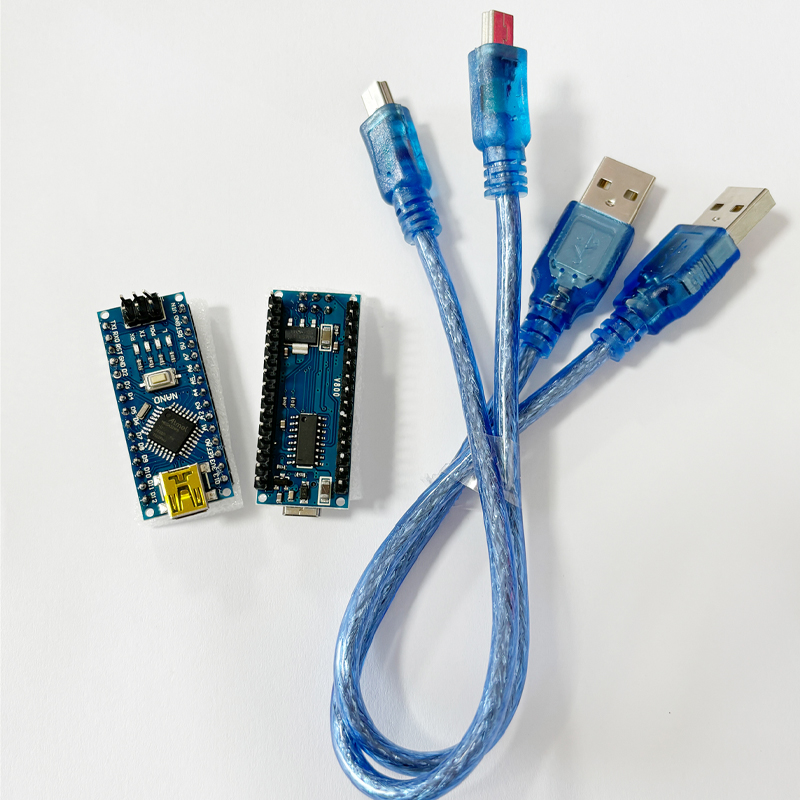
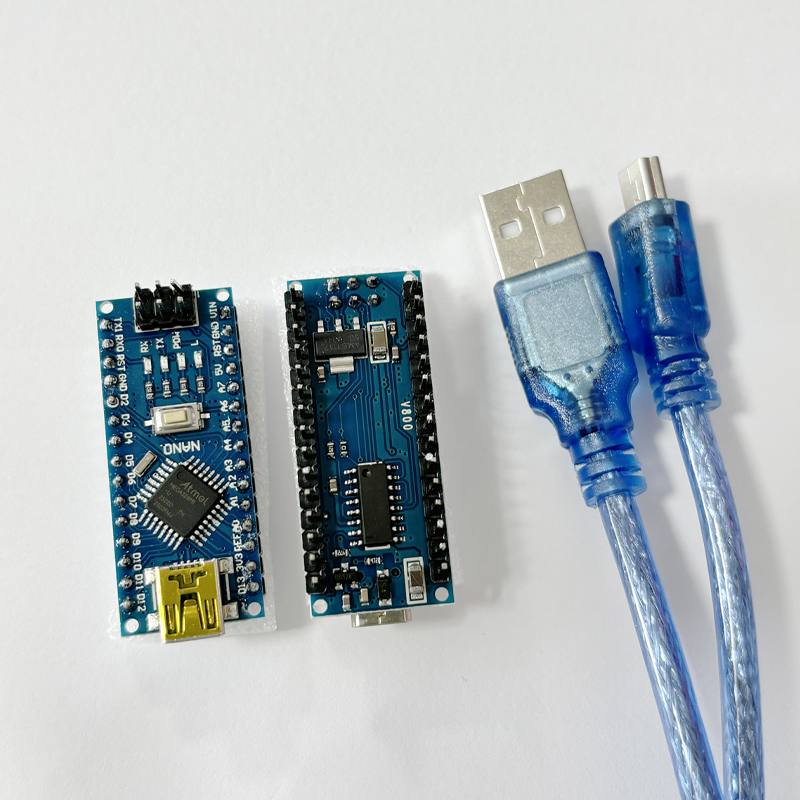
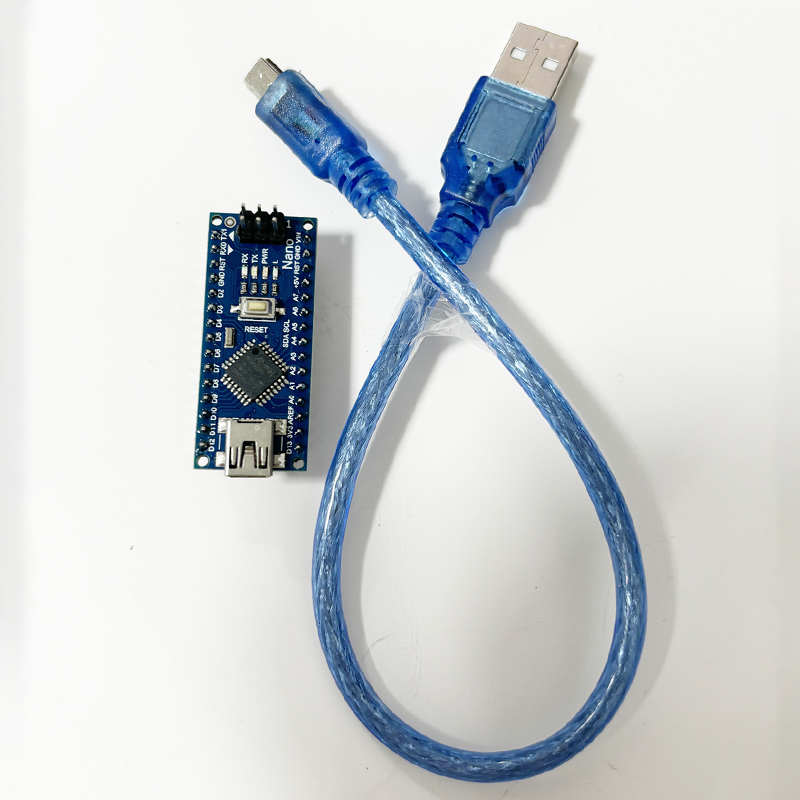
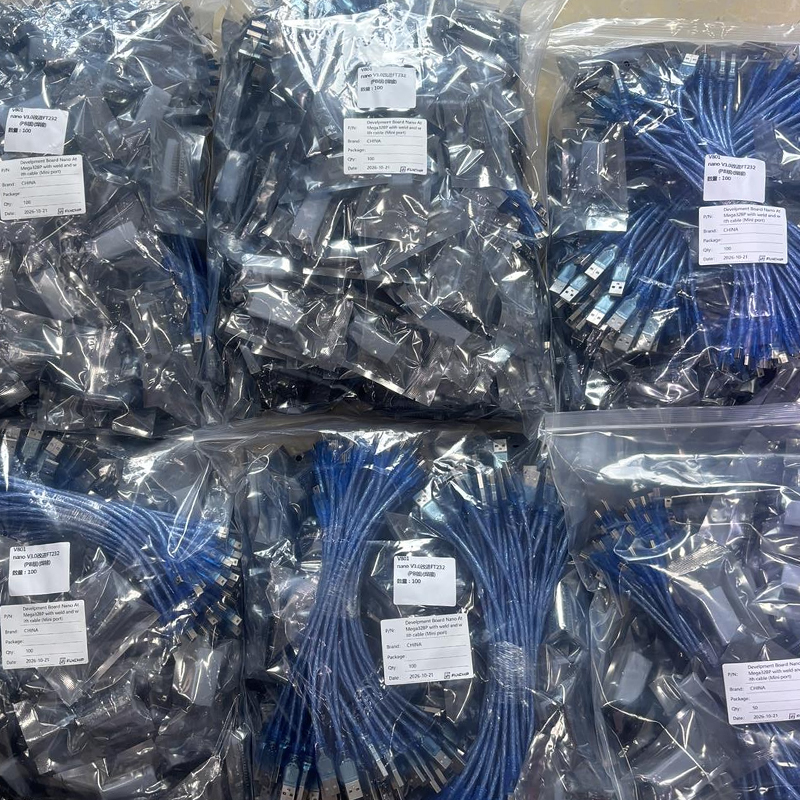
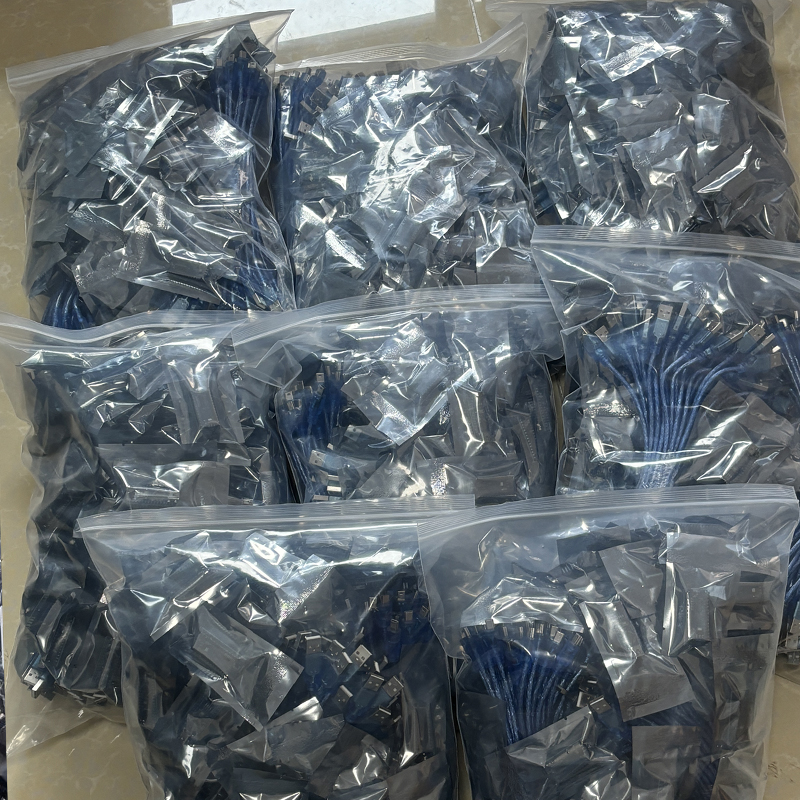
The supplied product is identified as a China-brand compatible development board. The actual product photograph shows a blue Nano-format PCB, a Mini-B USB connector, soldered pin-header connections and a blue USB-A to Mini-B cable. The included cable provides a convenient connection for power and, when wired for data, programming and serial communication.
The board is intended for development and prototyping rather than as a standalone industrial controller. Its final electrical characteristics depend on the exact board revision, regulator, USB-to-serial interface and bootloader fitted by the supplier.
- 16 MHz
- Classic Nano reference clock frequency; verify the supplied board revision.
- 32 KB
- ATmega328P program Flash capacity, including bootloader allocation.
- 18 × 45 mm
- Typical classic Nano reference PCB dimensions, not a measured drawing of this lot.
Key Specifications and Reference Parameters
The following table combines the supplied product description with the published reference characteristics of the classic ATmega328-based Nano platform. Clone-board implementations can differ. Confirm the exact revision and component markings before using these values as production design limits.
| Parameter | Reference Specification | Engineering Notes |
|---|---|---|
| Product Type | Nano-Compatible Microcontroller Development Board | Compact AVR development and prototyping platform. |
| Brand | China | As supplied in the product listing; exact OEM is not identified. |
| Series | Nano V3 Compatible | Classic Nano-style board format. |
| Core Processor | ATmega328P | 8-bit AVR microcontroller; verify the IC top marking. |
| Architecture | AVR 8-bit RISC | Suitable for embedded control and low-complexity firmware. |
| Clock Speed | 16 MHz typical reference | Confirm the oscillator fitted to the actual board. |
| Operating Logic Voltage | 5 V typical reference | Check the board revision and connected peripheral voltage levels. |
| Flash Memory | 32 KB | Approximately 2 KB is commonly allocated to the bootloader. |
| SRAM | 2 KB | Consider buffer and stack usage in memory-intensive sketches. |
| EEPROM | 1 KB | Non-volatile storage for small configuration data. |
| Digital I/O | 14 pins, D0–D13 | Classic Nano reference pin arrangement. |
| PWM Outputs | 6 channels | Commonly available on D3, D5, D6, D9, D10 and D11. |
| Analog Inputs | 8 channels, A0–A7 | 10-bit ADC reference; A6 and A7 are analog-input-only on the classic layout. |
| Serial Interfaces | UART, I2C, SPI | UART on D0/D1; I2C on A4/A5; SPI on D10–D13. |
| USB Connector | Mini-B USB | Mini USB connector visible in the supplied photograph. |
| Included Cable | USB-A to Mini-B cable | Blue cable shown in the supplied product photograph; confirm data capability. |
| USB-to-Serial IC | Not confirmed | Identify the fitted bridge IC from its marking or device enumeration. |
| Mounting Type | Through-hole pin headers, soldered | Based on the supplied product description and visible board assembly. |
| Reference PCB Size | Approximately 18 × 45 mm | Classic Nano reference dimension; measure the supplied board for enclosure design. |
| VIN Input | 7–12 V typical classic Nano reference | Verify regulator and input limits for this specific compatible board before applying external power. |
| Operating Temperature | Board-specific; not confirmed | Use the exact MCU, regulator and board documentation for thermal limits. |
Engineering Check and MCU Selection
The ATmega328P is an 8-bit AVR microcontroller with integrated Flash, SRAM, EEPROM, timers, ADC and serial communication peripherals. It is commonly used in compact control boards where deterministic GPIO handling, basic sensor acquisition and lightweight embedded firmware are sufficient.
Before approving the board for a design, confirm the MCU marking, board clock, logic voltage, bootloader and pin mapping. The Nano-compatible form factor alone does not establish that two boards have identical firmware, electrical characteristics or USB interface components.
Confirm ATmega328P identity, bootloader compatibility, clock source and Arduino IDE board selection.
Check 5 V logic compatibility with sensors, displays, communication modules and external controllers.
Review Flash, SRAM and EEPROM consumption before adding libraries, buffers or data logging functions.
Reserve UART, I2C, SPI, PWM and interrupt-capable pins according to the complete system schematic.
Interface Allocation Reference
| Interface | Nano Pin Reference | Design Consideration |
|---|---|---|
| UART | D0 / RX, D1 / TX | Shared with the USB serial programming path on typical Nano implementations. |
| I2C / TWI | A4 / SDA, A5 / SCL | Check pull-up voltage and bus capacitance. |
| SPI | D10 / SS, D11 / MOSI, D12 / MISO, D13 / SCK | Coordinate chip-select assignments for multiple SPI devices. |
| PWM | D3, D5, D6, D9, D10, D11 | Check timer sharing and frequency requirements. |
| Analog Input | A0–A7 | Keep input voltage within the selected analog reference range. |
This board uses the ATmega328P platform. A Leonardo-compatible board uses the ATmega32U4 platform, which has native USB functionality. USB HID behavior, firmware architecture, pin assignments and board definitions are not equivalent. A direct replacement requires application-level redesign and validation.
Power Supply, Mini USB and Programming Interface
The Mini-B USB connector is the visible computer interface on the supplied board. With a suitable data cable and a working USB-to-serial interface, it can provide board power and support sketch uploads and serial monitoring.
The included cable has a USB-A plug at the host end and a Mini-B plug at the board end. The photograph confirms the connector style and cable inclusion, but does not by itself prove that all cable conductors are connected for data transfer. Confirm USB enumeration before treating the cable as a programming cable.
Use a stable USB 5 V source. Check board current demand and peripheral loading.
The classic Nano reference commonly uses 7–12 V at VIN. Verify the clone regulator and input circuit first.
Identify the USB-to-serial IC before installing a driver. Do not assume CH340, FT232 or CP2102 from the front-side photograph.
Choose the correct ATmega328P processor option in the Arduino IDE. Some third-party Nano boards require an older bootloader setting.
Basic Programming Workflow
- 1
-
Connect the cable
Connect the Mini-B end to the board and the USB-A end to the computer.
- 2
-
Check device enumeration
Confirm that the operating system detects a serial port and identify the USB bridge if needed.
- 3
-
Select the board
Choose Arduino Nano or the applicable Nano-compatible board definition in the IDE.
- 4
-
Verify processor and upload
Test the ATmega328P processor option and, if upload fails, check whether the board uses an old bootloader.
Sourcing Experience and Product Identification
Nano-compatible development boards are available in multiple manufacturing revisions. Boards with similar PCB dimensions may use different USB-to-serial bridge ICs, regulators, crystal components, bootloader configurations and header assemblies. For engineering purchasing, the complete physical configuration is more useful than the generic name "Nano V3" alone.
The supplied product description specifies a soldered-header version with a Mini USB cable. The actual photograph should be retained as a visual reference for the offered board and accessory configuration.
| Identification Item | What to Verify | Purchasing Purpose |
|---|---|---|
| Board Marking | Nano silkscreen, PCB revision and visible component labels | Distinguishes board revisions and supplier configurations. |
| MCU Marking | ATmega328P top marking and package version | Confirms the specified MCU identity. |
| USB Interface | USB-to-serial IC marking on the actual board | Determines driver and host communication requirements. |
| Header Assembly | Pre-soldered pin headers, alignment and solder quality | Confirms the supplied assembly configuration. |
| Cable | USB-A to Mini-B connector and data continuity | Checks whether the cable supports programming as well as power. |
| Bootloader | ATmega328P bootloader type and upload test | Reduces commissioning and programming issues. |
Quality Review and Incoming Inspection
Incoming inspection should focus on the board's physical condition, connector integrity, soldered headers, power-up behavior and basic programming function. A visual inspection alone cannot establish MCU authenticity, long-term reliability or full electrical compliance.
Inspect the PCB for scratches, contamination, damaged pads, missing parts and inconsistent component placement.
Check pin alignment, solder wetting, mechanical stability and possible bridges between adjacent pads.
Inspect Mini-B shell retention, connector alignment and cable insertion stability.
Check for abnormal heating, unexpected current draw, unstable power indication or reset behavior.
Perform a controlled sketch upload using the correct board, processor and serial-port settings.
Verify selected digital outputs, analog inputs, UART communication and other interfaces used by the target application.
BOM Support and Application Matching
This board can serve as a compact controller in prototype assemblies and educational or engineering development systems. It is most suitable when the application can operate within the ATmega328P memory, processing, I/O and voltage constraints.
Sensor Interfaces
Digital sensors, analog signal modules, temperature sensing and basic measurement prototypes.
Embedded Control
Small logic controllers, status indicators, simple timing and low-complexity automation tasks.
Communication Experiments
UART, I2C and SPI peripheral development, subject to interface voltage and bus requirements.
Educational Prototyping
AVR programming, GPIO exercises, analog acquisition and basic embedded-system learning.
Related BOM and Integration Checks
- Confirm sensor and peripheral operating voltage before connecting modules to the 5 V Nano interface.
- Use suitable transistor, MOSFET or driver circuitry for motors, relays and other loads beyond GPIO capability.
- Reserve communication pins and confirm pull-up requirements when adding I2C or SPI peripherals.
- Record the exact board revision, USB interface, cable and bootloader configuration in the project BOM.
Procurement Risks and Alternative Qualification
A Nano-compatible board should not be approved as a direct replacement solely because its PCB shape and pin labels look similar. Variants may differ in the MCU fitted, clock frequency, operating voltage, USB bridge, bootloader, regulator and pre-soldered header configuration.
| Alternative or Variant | Potential Difference | Required Qualification |
|---|---|---|
| ATmega168 Nano | Smaller Flash and SRAM capacity than ATmega328P. | Recheck firmware size, memory usage and peripheral requirements. |
| 3.3 V / 8 MHz Nano | Different logic level and clock configuration. | Recheck timing, serial baud rate and connected device voltage compatibility. |
| Different USB Bridge | May require a different driver or host setup. | Identify the IC and test USB enumeration and sketch upload. |
| Old Bootloader Variant | May use a different upload protocol or baud-rate configuration. | Verify the processor option in Arduino IDE. |
| Unsoldered Header Board | Different mechanical and assembly condition. | Confirm whether headers are supplied separately or already soldered. |
| Micro USB / USB-C Version | Different connector and cable requirement. | Check connector footprint and cable compatibility before replacement. |
| ATmega32U4 Leonardo Board | Different MCU architecture and native USB capability. | Recheck firmware, USB HID requirements, pin mapping and board support. |
Microchip's current ATmega328P product information marks the device as "Not Recommended for new designs." This is a manufacturer lifecycle notice for the MCU family, not a verified lifecycle status for this complete China-brand development board. For long-term programs, review component authenticity, lifecycle exposure and an approved migration strategy before committing to a new platform.
Any substitute should be evaluated against the actual application requirements, not only the Nano board outline. For an existing design, perform a controlled firmware upload, interface test, power check and mechanical fit review before changing the BOM.
Supply Chain and Exact-Order Review
The product is identified in the supplied listing as China brand. Since no specific OEM or factory part number has been provided, purchasing records should retain the seller's exact product description, photographs, board revision and inspection criteria.
Before placing a repeat order, confirm that the supplier can maintain the same MCU, USB interface, PCB layout, header assembly and cable configuration. A generic Nano-compatible description may cover multiple hardware revisions.
| Procurement Check | Information to Request | Reason |
|---|---|---|
| Exact Product Identity | Board model, revision, seller SKU and actual product photographs | Reduces ambiguity between visually similar variants. |
| MCU Confirmation | ATmega328P marking and package information | Supports component-level identification. |
| USB Bridge | USB-to-serial IC manufacturer and part number | Supports driver planning and programming compatibility. |
| Cable Configuration | USB-A to Mini-B connector and data-transfer confirmation | Prevents power-only cable substitution. |
| Assembly Condition | Pre-soldered headers and soldering inspection criteria | Confirms the ordered mechanical configuration. |
| Lot Traceability | Supplier lot reference, shipment record and available inspection evidence | Supports incoming quality review and repeat-order comparison. |
| Commercial Terms | Quoted quantity, lead time, packing format and quotation validity | These are transaction-specific and must be confirmed at order time. |
PCB, Header and System Integration
The Nano form factor is intended for compact prototyping and breadboard-oriented integration. The soldered pin headers shown in the supplied product configuration simplify connection to compatible breadboards, sockets and development fixtures.
For a custom carrier PCB or enclosure, use the actual board outline, pin pitch, header position and Mini-B connector drawing from the received hardware. The commonly published 18 × 45 mm Nano dimensions are a reference only and should not replace a mechanical measurement or controlled drawing for this specific board revision.
Check soldered pin straightness, row spacing, insertion depth and mechanical clearance.
Provide sufficient Mini-B plug clearance and avoid mechanical stress on the connector shell.
Keep supply and ground paths suitable for the board and peripheral current demand.
Keep high-current switching paths away from sensitive analog input wiring where practical.
Check regulator temperature under the actual input voltage and load conditions.
Keep the reset button, USB connector and required programming pins accessible after installation.
Purchase Decision and Engineering Release Flow
The Nano ATmega328P board is a practical candidate for compact development and prototype applications that fit the classic Nano platform. Purchasing approval should be based on the exact physical configuration and application-level test results.
For an RFQ, specify the Nano-compatible ATmega328P board, soldered pin headers, Mini-B USB connector and USB-A to Mini-B cable. Where the USB bridge, bootloader or regulator is important to the project, list those requirements separately instead of relying on the generic Nano product name.
- 1
-
Requirement matching
Confirm processor, voltage, I/O, memory, communication and mechanical requirements.
- 2
-
Supplier confirmation
Obtain board revision, MCU marking, USB bridge and cable details.
- 3
-
Incoming verification
Inspect board assembly and perform a controlled power-up and programming test.
- 4
-
BOM release
Record the approved board configuration and supplier evidence in the purchasing file.
Nano ATmega328P Development Board – Product FAQ
The following answers cover product identification, connector compatibility, programming and engineering selection. Confirm board-specific details against the supplied hardware revision.
What is the Nano ATmega328P Development Board?
Is this an original Arduino Nano?
Which USB connector does this board use?
Is the USB cable included with the board?
What is the typical operating voltage and clock speed?
Which USB-to-serial driver does this board require?
How do I select the correct processor in Arduino IDE?
Is this board a direct replacement for Leonardo ATmega32U4?
Are the pin headers already soldered?
Can the Nano board directly drive motors or relays?
Technical Sources and Evidence Boundaries
Reference review date: 24 November 2026. The product identification and included cable configuration are based on the supplied product description and photograph. Reference Nano specifications and ATmega328P device information are based on the technical sources listed below.
The published classic Nano specifications are used as a platform reference only. They do not independently verify the exact USB bridge, oscillator, voltage regulator, bootloader, MCU authenticity, manufacturing origin, certifications or electrical test results of this China-brand compatible board.
The engineering recommendations in this review are selection and incoming-inspection guidance. They are not a factory test report, an authorization statement, a guarantee of current stock or a certification of a finished application. Always verify the actual board revision and applicable system requirements before production release.
- Arduino Official Documentation – Nano – Classic Nano overview, Mini-B USB connector, pin headers and reference board dimensions.
- Arduino Official Store – Arduino Nano – Reference operating voltage, memory, clock speed, I/O and classic Nano specifications.
- Arduino Help Center – Select the Right Processor for Arduino Nano – ATmega328P, old bootloader and third-party Nano processor-selection guidance.
- Microchip Technology – ATmega328P – MCU memory, architecture, operating characteristics and current lifecycle information.
- Microchip ATmega48A/PA, ATmega88A/PA, ATmega168A/PA and ATmega328/P Datasheet – Device architecture, memory organization and electrical characteristics.
From Component Sourcing to Production Delivery
Flychip has been providing electronic components to global customers for 20 years. We combine component supply, BOM services, PCB, SMT and PCBA support to help customers accelerate product development and delivery.
-
R&D Support
Fast sourcing support for prototype development, sample validation and early-stage engineering needs.
-
BOM Services
Multi-line BOM matching with component supply, alternative suggestions and procurement follow-up.
-
Mass Production
Stable supply coordination for production preparation, batch delivery and long-term purchasing needs.
-
Experienced Team
Over 15 years of channel management, quality control, sales management and organization management experience.
Nano ATmega328P Development Board with Mini USB Cable Technical Information
- Specifications
- FAQ
- Hot Sale
- Related Products
Specifications
- Product Attributes
- Attribute Value
- Manufacturer:
- CHINA
- Series:
- Nano V3 Compatible
- Packaging:
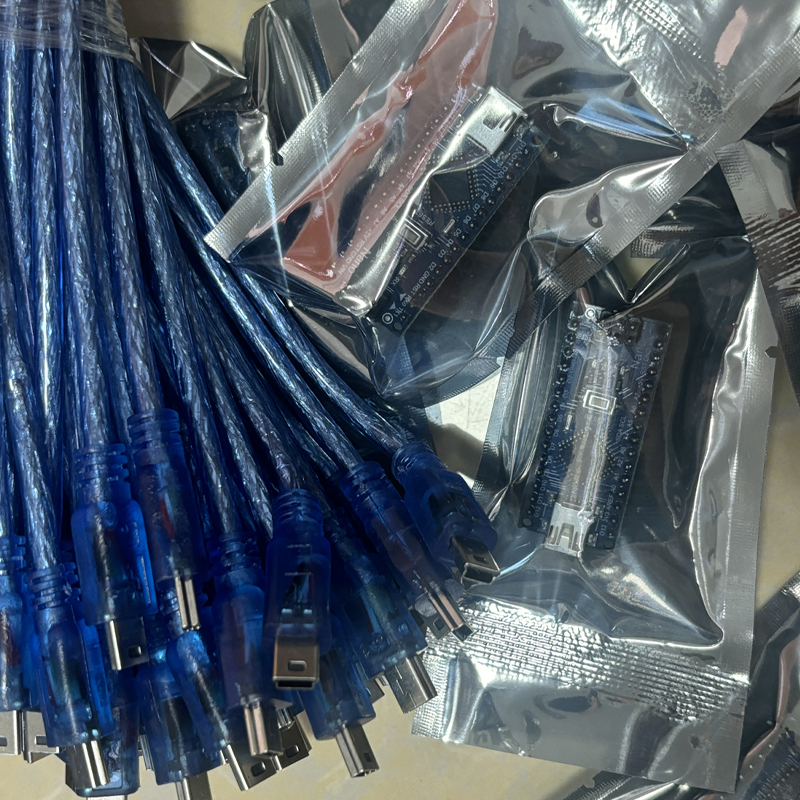
- Bulk
- Product Status:
- Active
- Type:
- Microcontroller Development Board
- Core Processor:
- ATmega328P
- Platform:
- Arduino Nano Compatible
- Utilized IC / Part:
- ATmega328P
- Mounting Type:
- Through Hole, Soldered Headers
- Contents:
- 1× Nano Development Board, 1× USB-A to Mini-B Cable
FAQ
1. How to order Nano ATmega328P Development Board with Mini USB Cable on Flychip?
You can submit an RFQ directly on this page. Our sales team will review your quantity, delivery requirements and target price, then reply with a quotation as soon as possible.
2. How does Flychip verify the quality of Nano ATmega328P Development Board with Mini USB Cable?
We work with qualified channels including international chip manufacturers and well-known distributors. Our team pays close attention to supplier review, traceability, product condition and quality control.
3. Are the price and inventory of Nano ATmega328P Development Board with Mini USB Cable updated in real time?
Inventory and prices of electronic components may fluctuate frequently. The displayed data is for reference, and the final quotation will be confirmed by our sales team.
4. What payment methods are accepted?
Wire Transfer, PayPal, Alipay, WeChat, Credit Card, Western Union, MoneyGram and Escrow may be supported depending on the order and region.
5. How is shipping arranged?
We can arrange international shipping through DHL, UPS, FedEx, TNT and other logistics channels. Tracking information will be provided after shipment.
6. What is the return or replacement process for Nano ATmega328P Development Board with Mini USB Cable?
Please contact our sales team within the specified period if there are quantity differences, wrong items, or clear external defects. The product should remain unused and in its original packaging.
7. Can I request technical support for Nano ATmega328P Development Board with Mini USB Cable?
Yes. You can contact us for datasheet, package details, pin information and sourcing assistance related to Nano ATmega328P Development Board with Mini USB Cable.
Hot Sale
Related Products
-
-
SC0915
Raspberry Pi
-
-
102010428
Seeed Technology Co., Ltd
-
-
SC0917
Raspberry Pi
-
-
SC1631
Raspberry Pi
-
-
102010328
Seeed Technology Co., Ltd
-
-
102010388
Seeed Technology Co., Ltd
-
-
4600
Adafruit Industries LLC
-
-
102010268
Seeed Technology Co., Ltd
-
-
C124
M5Stack Technology Co., Ltd.
-
-
3500
Adafruit Industries LLC
-
-
5302
Adafruit Industries LLC
-
-
DFR0282
DFRobot
Nano ATmega328P Development Board with Mini USB Cable Sourcing & Technical Support
Nano ATmega328P Development Board with Mini USB Cable is supplied by CHINA. This page provides key purchasing information including manufacturer, package, datasheet, stock reference, price reference and RFQ support.
As your reliable partner for semiconductor solutions, Flychip supports customers from research and development to mass production with electronic component supply, BOM sourcing, PCB, SMT and PCBA solutions.
Our sourcing partners include international chip manufacturers and well-known distributors. With rich experience in channel management, quality control and sales management, Flychip helps customers accelerate product development and delivery.
- Part Number
- Nano ATmega328P Development Board with Mini USB Cable
- Manufacturer
- CHINA
- Package
- Category
- Embedded MCU, DSP Evaluation Boards
Quick RFQ Send your inquiry and our sales team will respond quickly.
Tips
Please check your information and try again.