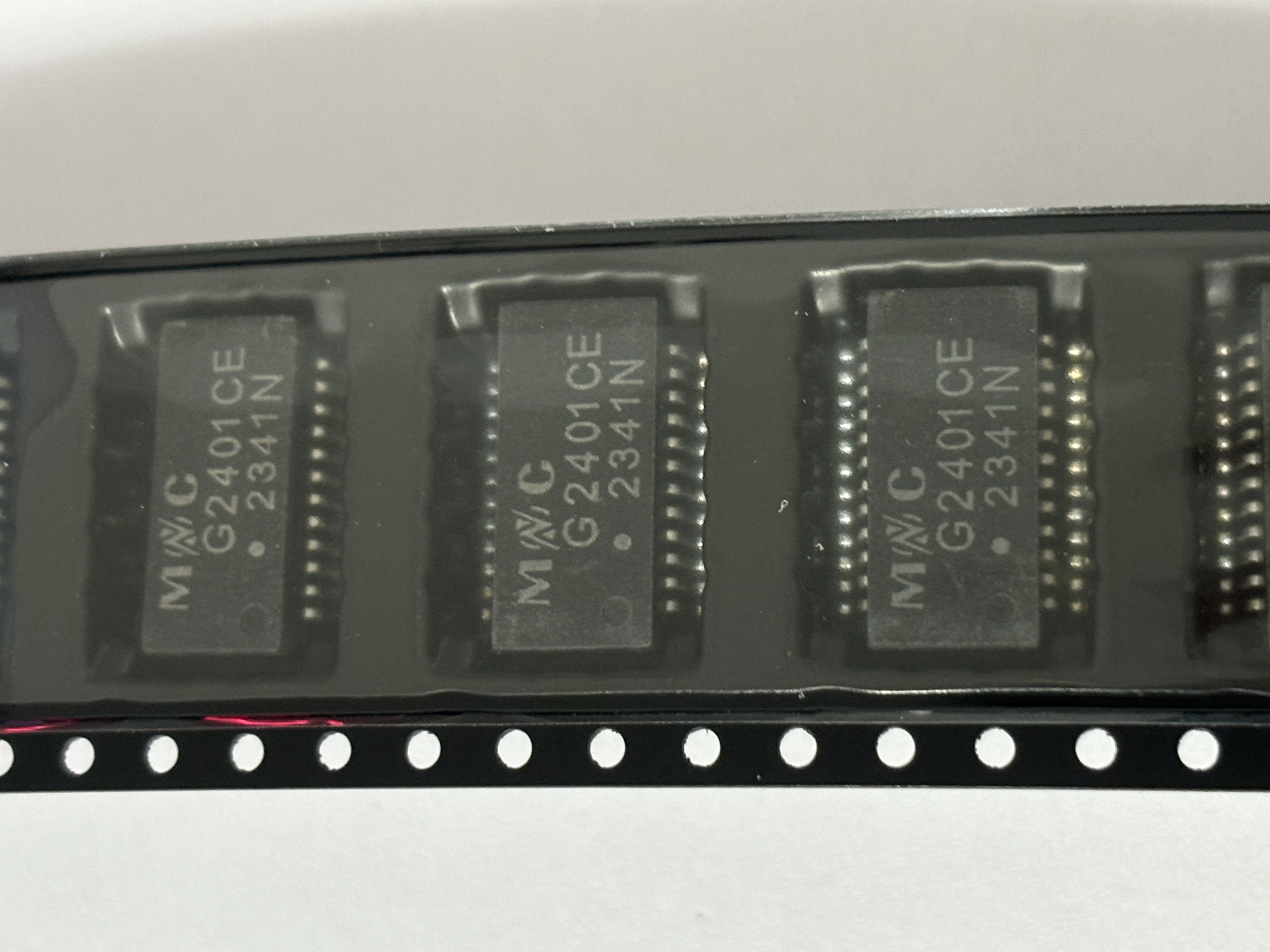


G2401CE Gigabit Ethernet LAN Transformer: Specifications, Design & Applications
A practical engineering guide to the Mentech G2401CE single-port Gigabit Ethernet LAN transformer, covering 10/100/1000 BASE-T operation, 1CT:1CT turns ratio, 350 µH inductance, 1.5 kV isolation, signal integrity, common-mode noise control, PCB layout, Ethernet PHY integration and replacement selection.
What Is the G2401CE?
G2401CE is a single-port surface-mount LAN transformer from Mentech designed for 10/100/1000 BASE-T Ethernet applications. It provides the magnetic isolation required between an Ethernet PHY and the external cable while helping control common-mode noise and signal integrity. The device uses a 24-pin SMT package and is specified as a non-PoE LAN magnetic component. Typical listed electrical characteristics include a 1CT:1CT turns ratio, approximately 350 µH inductance and 1.5 kV isolation capability.
G2401CE Key Specifications
The G2401CE LAN transformer is designed for Ethernet interfaces where the PHY must communicate with twisted-pair cable while remaining electrically isolated from the external network connection. It combines multiple magnetic channels inside one compact surface-mount component.
For engineers, this means G2401CE should not be viewed as an ordinary power transformer. It is a high-frequency signal transformer optimized for Ethernet data paths, impedance behavior, common-mode rejection and electrical isolation.
| Parameter | G2401CE | Engineering Meaning |
|---|---|---|
| Manufacturer | Mentech | Manufacturer of magnetic and communication components |
| Product Type | LAN / Ethernet Transformer | Provides Ethernet signal coupling and isolation |
| Ethernet Rate | 10/100/1000 BASE-T | Suitable for Fast Ethernet and Gigabit Ethernet systems |
| Port Count | Single Port | Supports one Ethernet connection |
| Turns Ratio | 1CT:1CT | Matches common Gigabit Ethernet PHY transformer requirements |
| Inductance | 350 µH | Supports low-frequency signal transfer and common-mode performance |
| Isolation Voltage | 1.5 kV Class | Provides galvanic isolation between PHY and cable side |
| POE Function | No | Designed as a non-PoE LAN transformer |
| Mounting | Surface Mount | Suitable for automated SMT production |
| Pin Count | 24 | Provides connections for the four Gigabit Ethernet pairs |
| Package | SMD-24P | Compact PCB-mounted LAN magnetics package |
| Operating Temperature | -40°C to +85°C | Suitable for many industrial and communication environments |
A LAN transformer should be selected by more than Ethernet speed. Turns ratio, insertion loss, return loss, common-mode rejection, isolation, package pinout and PHY compatibility all affect real network performance.
How the G2401CE Ethernet Transformer Works
Ethernet over copper cable uses differential signals. Instead of sending data as a voltage referenced directly to ground, each twisted pair carries a balanced signal whose two conductors move in opposite directions.
This differential technique provides strong resistance to external electrical noise. Noise that couples equally into both wires tends to be rejected by the receiver.
The G2401CE sits between the Ethernet PHY and the cable connector. Its transformer windings magnetically couple the useful AC data signal while preventing a direct DC electrical connection between the two sides.
Transfers high-speed differential Ethernet information from the PHY side to the cable side and back.
Separates the internal electronics electrically from the external network cable.
Helps reduce common-mode noise and unwanted emissions traveling through the Ethernet connection.
These functions are important because an Ethernet cable can extend many meters away from the PCB. The equipment at the other end may have a different ground potential, and the cable itself can pick up electromagnetic interference.
G2401CE for 10/100/1000 BASE-T Ethernet
Gigabit Ethernet places more demands on LAN magnetics than older 10BASE-T systems. A 1000BASE-T connection uses all four twisted pairs of a standard Ethernet cable at the same time.
This means the magnetic component must maintain useful electrical performance across multiple signal paths while controlling crosstalk between those paths.
10BASE-T
10BASE-T represents the original widely used 10 Mbps twisted-pair Ethernet system. Its bandwidth requirements are modest compared with modern networking.
100BASE-TX
100BASE-TX increases the data rate to 100 Mbps and places greater importance on insertion loss, impedance matching and PCB routing.
1000BASE-T
1000BASE-T reaches Gigabit data rates by using sophisticated signaling across four cable pairs. Transformer consistency, return loss, crosstalk performance and layout become increasingly important.
G2401CE is designed as a Gigabit-capable LAN magnetic component, making it useful in equipment that needs to support modern 10/100/1000 Mbps auto-negotiating Ethernet interfaces.
Understanding the 1CT:1CT Turns Ratio
The listed 1CT:1CT turns ratio is an important part of G2401CE compatibility with Ethernet PHY devices.
A 1:1 ratio means the number of turns on the primary and secondary windings is approximately equal. Therefore, the transformer is used mainly for signal coupling and isolation rather than intentionally stepping the Ethernet signal voltage substantially up or down.
The letters CT indicate a center-tapped winding. Center taps are commonly used in Ethernet magnetics for bias, termination and common-mode control arrangements.
The exact center-tap connection should always follow the Ethernet PHY manufacturer's reference schematic. Some PHY designs connect center taps through filtering networks, supply rails or capacitors depending on architecture.
Do not assume that every 1:1 LAN transformer is interchangeable. Two parts can share the same turns ratio but have different pinouts, return loss, common-mode rejection or winding arrangements.
Why the 350 µH Inductance Matters
G2401CE is commonly listed with approximately 350 µH minimum inductance under the specified test conditions.
This parameter is often called open-circuit inductance, or OCL, in Ethernet transformer documentation.
OCL matters because the transformer must pass the lower-frequency components of the Ethernet waveform without creating excessive distortion.
If magnetizing inductance is too low, low-frequency components of the data waveform may be affected. That can increase baseline wander and reduce signal margin.
The correct value must also be maintained while the transformer is subjected to the operating conditions defined by the datasheet. This is why Ethernet transformer specifications often define OCL at a particular frequency, voltage and bias condition.
Engineers selecting a replacement should therefore compare the actual OCL test conditions rather than comparing only the headline "350 µH" number.
G2401CE 1.5 kV Ethernet Isolation
Electrical isolation is one of the main reasons Ethernet magnetics exist. The internal PHY electronics and external copper cable should not share a direct conductive signal path.
G2401CE is commonly specified in the 1.5 kV isolation class. This high-voltage isolation test verifies the insulation barrier between the relevant transformer windings.
Helps prevent normal ground-potential differences from flowing directly through the Ethernet signal interface.
Provides an electrical barrier between external cable wiring and sensitive internal PHY electronics.
The magnetic architecture also contributes to common-mode noise management at the cable interface.
Isolation voltage should not be interpreted as permission to expose the LAN transformer to arbitrary high-voltage transients. External surge protection, ESD components and connector design may still be required depending on the product environment.
Insertion Loss, Return Loss and Crosstalk
Three specifications are especially important when evaluating a Gigabit Ethernet transformer: insertion loss, return loss and crosstalk.
Insertion Loss
Insertion loss describes how much useful signal amplitude is lost while passing through the magnetic component.
Every real transformer introduces some loss. The design objective is to keep that loss low enough across the Ethernet operating bandwidth that the receiver still has adequate signal margin.
Return Loss
Return loss describes how well the interface is impedance matched. A poorly matched transformer or PCB structure reflects more of the signal back toward the transmitter.
Those reflections can distort high-speed waveforms and reduce the maximum reliable cable length.
Crosstalk
Gigabit Ethernet uses several pairs simultaneously, so energy from one channel must not couple excessively into another channel.
Good transformer construction and PCB layout both help minimize this unwanted interaction.
The important insight is that the magnetic device and PCB cannot be evaluated separately. Even a transformer with strong laboratory specifications can perform poorly if traces are long, asymmetric or routed too close together.
Common-Mode Rejection and EMI Control
Ethernet data is transmitted differentially, but unwanted common-mode energy can still appear on the cable.
This noise can come from clock edges, switching regulators, PHY output imbalance, PCB coupling and external interference.
LAN magnetics help prevent common-mode energy from passing freely between the PCB and cable.
This is important for electromagnetic compatibility because an Ethernet cable is long enough to behave as an effective antenna at many frequencies.
Good common-mode performance can therefore contribute to lower radiated emissions and improved immunity.
However, the transformer cannot solve every EMC problem by itself. Connector shielding, chassis design, common-mode termination, grounding strategy and PCB stack-up still matter.
Is G2401CE a PoE Transformer?
The Mentech G2401CE is listed as a non-PoE Ethernet transformer.
That distinction is important. Power over Ethernet systems intentionally carry DC power together with Ethernet data over the cable. Magnetics used in those systems may need to support defined DC current through center taps and must be selected for the relevant PoE architecture.
For G2401CE, the official product information identifies the PoE function as No.
Therefore, engineers designing a PoE powered device, PoE injector, PSE or PD interface should not assume G2401CE has the required PoE current capability merely because it supports Gigabit Ethernet.
"Gigabit capable" and "PoE capable" describe two different requirements. Data rate alone does not determine whether an Ethernet transformer is suitable for carrying PoE current.
Connecting G2401CE to an Ethernet PHY
In a typical design, the Ethernet PHY sits between a processor or MAC controller and the LAN transformer.
The PHY creates the analog differential signals required for twisted-pair Ethernet. Those signals pass through G2401CE before reaching the RJ45 connector and cable.
When designing this section, follow the PHY manufacturer's reference layout closely.
- Confirm the PHY requires a 1:1 transformer ratio.
- Check center-tap connections carefully.
- Follow recommended PHY termination values.
- Keep differential traces symmetrical.
- Maintain the required differential impedance.
- Avoid unnecessary vias in high-speed signal paths.
- Place the transformer near the Ethernet connector.
- Keep noisy clocks away from the cable-side interface.
Different PHY families can use slightly different analog front-end arrangements. Copying a transformer connection from an unrelated design is therefore less reliable than using the reference circuit for the exact PHY.
PCB Layout Guidelines for G2401CE
PCB layout is critical in Gigabit Ethernet because the transformer is part of a controlled high-speed signal path.
The PHY-to-transformer and transformer-to-connector traces should be treated as differential pairs rather than ordinary PCB wires.
- Maintain controlled differential impedance.
- Route both conductors of each pair together.
- Match the lengths within each differential pair.
- Keep pair-to-pair spacing sufficient to reduce crosstalk.
- Keep differential routing as short as practical.
- Avoid sharp routing discontinuities where possible.
- Keep switching power nodes away from Ethernet pairs.
- Place the LAN transformer close to the RJ45 interface.
- Follow the PHY vendor's ground-plane recommendations.
- Use appropriate ESD protection near the external connector.
Do Not Route Through Noisy Power Areas
A switching regulator node may have fast voltage transitions containing significant high-frequency energy. Routing an Ethernet differential pair close to that node can inject unwanted noise into the PHY signal.
Keep high-current inductors, MOSFET switching nodes and fast clock signals away from the Ethernet analog front end.
Transformer Placement
The exact preferred placement depends on the complete interface design, but the magnetic component is normally positioned between the PHY and external connector with short, clean differential routing.
For Gigabit Ethernet, the PCB traces are part of the analog communication system. The schematic may be correct while poor routing still causes link instability, reduced cable reach or EMC failures.
G2401CE Operating Temperature Range
The Mentech product specification lists an operating temperature range from approximately -40°C to +85°C.
This makes G2401CE relevant to more than simple indoor desktop electronics. It can be considered for communication and embedded systems operating across wider environmental conditions.
Temperature affects magnetic materials, winding resistance and electrical characteristics, so the complete interface should be evaluated across the application's real operating range.
For industrial equipment, engineers should also consider enclosure temperature rather than assuming ambient room temperature represents the transformer environment.
Common G2401CE Applications
Any product with a copper Gigabit Ethernet interface needs suitable magnetics between the PHY and cable. G2401CE is therefore relevant to many categories of electronic equipment.
- Gigabit Ethernet switches
- Industrial Ethernet controllers
- Network gateways
- Routers
- Embedded Linux boards
- Network video recorders
- IP cameras without PoE through this transformer
- Industrial automation equipment
- Security and monitoring systems
- Communication gateways
- Consumer networking products
- Test and measurement equipment
Industrial Automation
Industrial equipment increasingly uses Ethernet for controller communication, remote monitoring and factory data collection. A transformer such as G2401CE provides the required physical isolation at the copper network interface.
Embedded Networking
Single-board computers and embedded processors often connect an integrated MAC or external PHY to an RJ45 connector. A compact single-port LAN transformer is a practical part of that signal chain.
Security Equipment
Network cameras, recorders and access-control systems may need stable Ethernet communication over long cable runs. Proper magnetics and PCB layout help maintain signal integrity in electrically noisy environments.
Common Ethernet Transformer Troubleshooting Problems
No Ethernet Link
Check the transformer pinout, PHY power rails, oscillator, reset condition, differential pair routing and center-tap connections. A single swapped or open signal can prevent link establishment.
100 Mbps Works but 1000 Mbps Does Not
This is a classic high-speed signal-integrity symptom. Gigabit Ethernet uses all four pairs, while lower-speed modes use fewer resources. Check all transformer channels, pair routing, solder joints, connector wiring and PHY configuration.
Link Drops with Long Cable
Review return loss, insertion loss, differential impedance and cable quality. A marginal interface may appear stable with a short bench cable but fail with a longer installation.
EMI Test Failure
Investigate common-mode termination, transformer placement, PCB ground structure, connector shield connection and noise coupling from digital or switching-power circuits.
Intermittent Link After Assembly
Inspect the 24-pin surface-mount solder joints carefully. A partially soldered transformer terminal may create an intermittent signal that is difficult to reproduce.
G2401CE Replacement and Equivalent Selection
An alternative LAN transformer should not be chosen solely because its catalog description says "Gigabit Ethernet."
| Replacement Check | G2401CE Reference | Why It Matters |
|---|---|---|
| Ethernet Standard | 10/100/1000 BASE-T | The replacement must support the required network speed |
| Port Count | Single Port | Determines channel configuration |
| Turns Ratio | 1CT:1CT | Must match the PHY interface requirement |
| Inductance | 350 µH Class | Affects low-frequency signal performance |
| Isolation | 1.5 kV Class | Important for safety and Ethernet isolation requirements |
| PoE Capability | Non-PoE | Do not substitute blindly in a PoE design |
| Pin Count | 24 | Pinout and PCB footprint must match |
| Mounting Type | SMT | Must fit the existing production process |
| Temperature | -40°C to +85°C | Replacement should meet environmental requirements |
| RF / Signal Parameters | Compare datasheets | Insertion loss, return loss and crosstalk affect link quality |
The best drop-in replacement is a part with compatible electrical performance, identical or verified pin mapping, the same mechanical footprint and qualification for the same operating environment.
How to Source G2401CE Correctly
For purchasing and product-database purposes, keep the manufacturer part number clean:
Manufacturer: Mentech
MPN: G2401CE
Product Type: Single-Port Gigabit LAN Transformer
- Confirm the complete G2401CE part number.
- Verify Mentech as the manufacturer.
- Confirm the 24-pin SMT package.
- Check the non-PoE requirement.
- Verify 10/100/1000 BASE-T compatibility.
- Confirm the PHY-side transformer ratio.
- Review lot and date-code requirements.
- Check RoHS and compliance requirements.
- Verify reel quantity for automated assembly.
- Review the latest datasheet before production approval.
Do not put the full SEO product title inside the MPN field. Use G2401CE as the clean manufacturer identifier, while descriptive terms such as "Gigabit Ethernet LAN Transformer" belong in the product title and description.
G2401CE FAQ
What is G2401CE?
G2401CE is a Mentech single-port surface-mount LAN transformer designed for 10/100/1000 BASE-T Ethernet interfaces. It provides signal coupling, electrical isolation and common-mode noise control between an Ethernet PHY and copper network cable.
Who manufactures G2401CE?
G2401CE is manufactured by Mentech, also known as Dongguan Mentech Optical & Magnetic in electronic-component distribution databases.
Does G2401CE support Gigabit Ethernet?
Yes. G2401CE is designed for 10/100/1000 BASE-T networking and can therefore be used in Gigabit Ethernet interfaces when the complete PHY and PCB design are compatible.
What is the G2401CE turns ratio?
The commonly listed transformer turns ratio is 1CT:1CT for the Ethernet signal channels.
What is the inductance of G2401CE?
G2401CE is commonly specified with approximately 350 µH open-circuit inductance under the defined datasheet measurement conditions.
What is the isolation voltage of G2401CE?
The component is commonly listed in the 1.5 kV isolation class. Engineers should use the exact datasheet test conditions when validating safety and compliance requirements.
Does G2401CE support PoE?
No. Mentech lists G2401CE as a non-PoE LAN transformer. A separate PoE-capable magnetic component should be selected when the application requires Power over Ethernet current.
How many Ethernet ports does G2401CE support?
G2401CE is a single-port LAN transformer, so one component is intended for one Ethernet interface.
How many pins does G2401CE have?
The Mentech G2401CE uses a 24-pin surface-mount package.
What is the operating temperature of G2401CE?
The official Mentech product information specifies an operating temperature range of approximately -40°C to +85°C.
Why does an Ethernet port need a transformer?
Ethernet magnetics provide galvanic isolation between internal electronics and the external network cable, transfer the differential data signal and help control common-mode noise and EMI.
Can G2401CE be connected directly to any Ethernet PHY?
Not automatically. The PHY must be compatible with the transformer ratio, center-tap arrangement and electrical specifications. Always follow the reference schematic for the exact Ethernet PHY.
Why can 100 Mbps work while 1000 Mbps fails?
Gigabit Ethernet uses all four twisted pairs and places tighter demands on signal integrity. A wiring error, poor solder joint, missing channel, incorrect PCB impedance or crosstalk problem may therefore affect 1000BASE-T even when a lower-speed connection still works.
Is G2401CE surface mount?
Yes. G2401CE is designed as an SMT LAN transformer suitable for surface-mount PCB assembly.
Can another Gigabit LAN transformer replace G2401CE?
Possibly, but a replacement should be checked for pinout, footprint, 1CT:1CT ratio, inductance, isolation voltage, insertion loss, return loss, crosstalk, temperature range and PoE requirements before use.
Final Engineering Perspective
The G2401CE is a compact but important part of a copper Ethernet interface. Its purpose is not simply to "pass network data." It forms part of the analog physical layer that connects sensitive Ethernet PHY electronics to a long external twisted-pair cable.
For 10/100/1000 BASE-T systems, this role becomes especially important. Gigabit Ethernet uses all four cable pairs simultaneously and depends on controlled impedance, low insertion loss, suitable return loss, good crosstalk performance and balanced differential signaling.
The listed 1CT:1CT winding configuration makes G2401CE compatible with the transformer architecture commonly used by Gigabit PHYs, while the approximately 350 µH inductance supports the low-frequency behavior required by the Ethernet signal.
Its isolation barrier separates the internal circuit from the cable side, reducing direct ground-current paths and contributing to a safer, more robust network interface. At the same time, the magnetic structure helps control common-mode energy that could otherwise travel onto the Ethernet cable and create EMC problems.
The component is also relatively simple to manufacture into a product. Its 24-pin surface-mount format works with automated PCB assembly and provides the multiple winding connections needed by a four-pair Gigabit interface.
However, good LAN magnetics cannot compensate for a poor board design. PHY differential pairs should maintain controlled impedance, both traces of each pair should be routed together, pair-to-pair coupling should be minimized, and noisy power-switching nodes should be kept away from the Ethernet analog front end.
Engineers should also remember that G2401CE is officially listed as a non-PoE transformer. A design that must carry Power over Ethernet should use magnetics specifically qualified for the required PoE current and architecture rather than assuming any Gigabit transformer can perform that role.
For a single-port 10/100/1000 BASE-T design that requires compact SMT LAN magnetics, a 1CT:1CT transformer arrangement and industrial-range operation, Mentech G2401CE is a practical component to evaluate. Final selection should always be confirmed against the latest G2401CE datasheet and the reference design for the exact Ethernet PHY used in the product.