JK-PB2A16S-20P
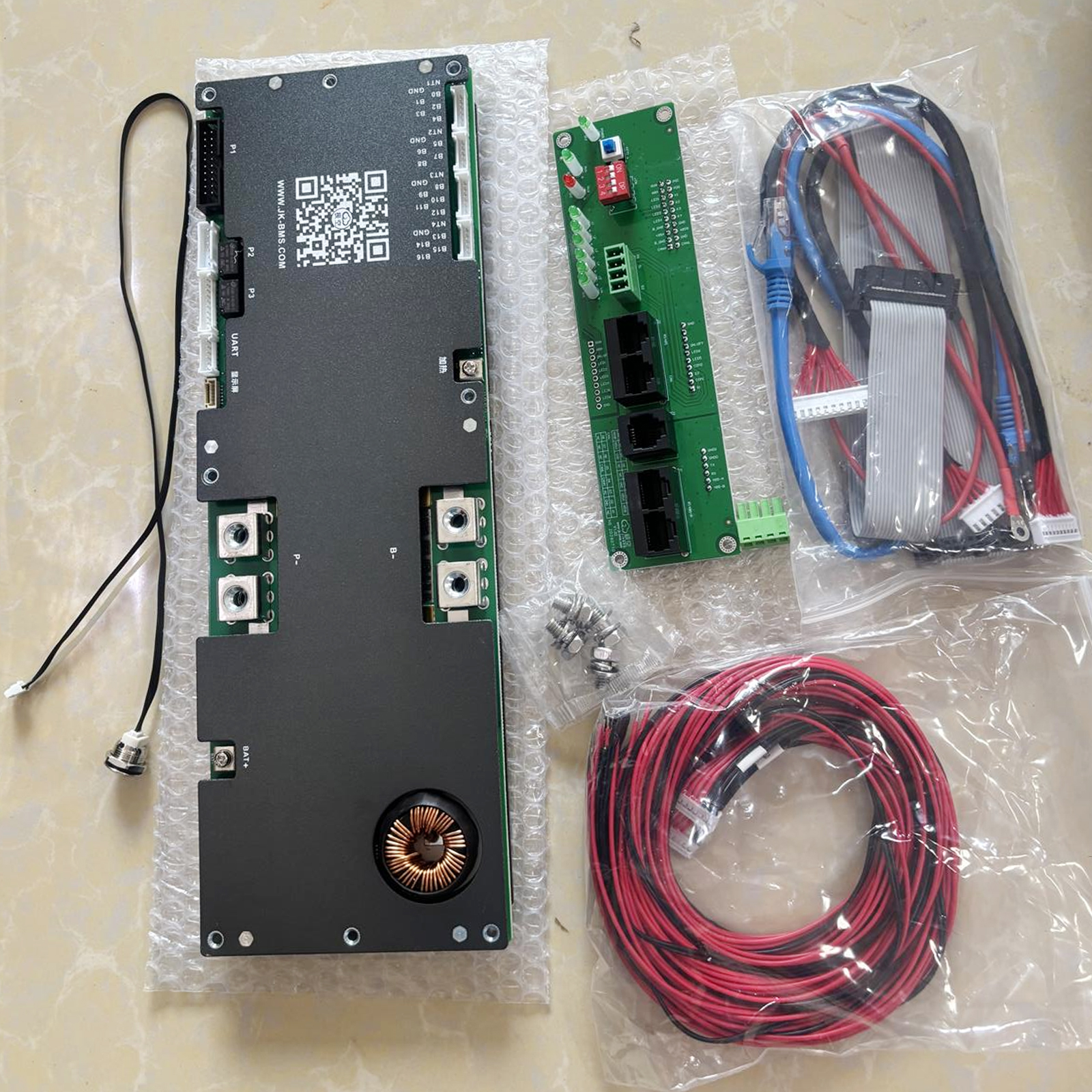
JK-PB2A16S-20P is a JIKONG smart energy-storage BMS with 2A active balancing and 200A-class current capability, supporting up to 16-series lithium battery systems with CAN, RS485, Bluetooth, display, heating and parallel-pack functions.
Your reliable partner for semiconductor solutions. Flychip supports customers from R&D to mass production with electronic component supply, BOM sourcing, PCB, SMT and PCBA services.
- 20+
- Years Component Supply
- BOM
- Multi-Part Sourcing
- PCBA
- PCB / SMT Support
- Part No.:
- JK-PB2A16S-20P
- Manufacturer:
- CHINA
- Category:
- Battery Product Accessories
- Package:
- Datasheet:
-
-
- Description:
- JK-PB2A16S-20P is a JIKONG smart energy-storage BMS with 2A active balancing and 200A-class current capability, supporting up to 16-series lithium battery systems with CAN, RS485, Bluetooth, display, heating and parallel-pack functions.
- Quantity:


-
Quality Control
Supplier review, channel management and product verification before delivery.
-
Global Channels
International chip manufacturer and well-known distributor sourcing network.
-
BOM to Production
Component supply support from R&D prototype to mass production.
-
PCB / SMT / PCBA
Integrated manufacturing support to accelerate product development and delivery.
Product Details
Engineering and sourcing review of the JIKONG JK-PB2A16S-20P smart energy-storage battery management system, covering its 200A current class, 2A active balancing, up-to-16S battery architecture, CAN / RS485 communications, parallel-pack functions, protection configuration, V24 hardware revision, wiring compatibility and procurement risk.
- 200A
- JK-PB2A16S-20P current-class configuration
- 2A
- Maximum active balancing current class
- 16S
- Maximum documented series-cell architecture
- CAN + RS485
- Energy-storage and parallel communication interfaces
JK-PB2A16S-20P Product Details
JK-PB2A16S-20P is a JIKONG / JK intelligent battery management system designed primarily for lithium battery energy-storage applications. It combines pack protection, cell-voltage monitoring, current measurement, temperature supervision and 2A active energy-transfer balancing in one BMS platform.
The 20P version belongs to the 200A current class. Unlike a simple protection board, the PB-series architecture also integrates communication and system-management functions useful in inverter, solar-storage, battery-cabinet and parallel battery-pack applications.
| Parameter | JK-PB2A16S-20P | Engineering Meaning |
|---|---|---|
| Brand / Platform | JIKONG / JK BMS | Smart lithium-battery management platform for energy-storage applications. |
| Model | JK-PB2A16S-20P | Exact model should be preserved together with the hardware revision. |
| BMS Category | Smart Energy-Storage BMS | Designed for pack monitoring, protection, balancing and communication. |
| Maximum Cell Count | Up to 16 series cells | Minimum usable series count depends on chemistry and hardware/manual revision. |
| Active Balancing | 2A class | Transfers energy between cells instead of relying only on passive resistor bleeding. |
| Current Class | 200A | Published selection documentation maps the 20P variant to the 200A tier. |
| Battery Chemistry | LiFePO4, ternary / Li-ion and lithium titanate configurations | Cell-voltage limits and minimum series count must match the selected chemistry. |
| Bluetooth | Supported | Allows compatible mobile-app monitoring and configuration. |
| CAN | Supported | Commonly used for inverter or energy-storage system communication. |
| RS485 | Dual-channel architecture documented | Used for system monitoring, host software and parallel-pack communication depending on port. |
| RS232 / UART | Documented on applicable versions | Used for host or service communication on supported hardware. |
| Display Interface | Supported | Compatible display configuration depends on supplied kit and revision. |
| Dry Contacts | Two-channel function documented | Can be used for alarm or external-system signaling. |
| Heating Control | Supported function | Useful for controlled battery heating in low-temperature charging applications. |
| Parallel-Pack Support | Parallel communication / current limiting | Important where several battery packs operate on a common DC bus. |
| Temperature Monitoring | Internal + multiple external temperature sensing points | Used for cell and BMS thermal protection and warning logic. |
JK-PB2A16S-20P has existed across multiple hardware and firmware revisions. Electrical settings, connector details, physical power terminals and some documented ranges can differ between manuals. Production qualification should therefore record both the model and the actual hardware / firmware revision.
JK-PB2A16S-20P System Architecture
The BMS sits between the battery cells and the external DC system. It continuously samples cell voltages, pack current and temperature information, then applies configured protection and balancing logic.
Monitors individual cell voltages for balancing and over/undervoltage protection.
Measures charge and discharge current for overcurrent and short-circuit protection.
Battery and BMS temperature data are used for charge/discharge protection.
CAN, RS485 and Bluetooth integrate the BMS with inverter, software and pack systems.
Battery Chemistry and Series-Cell Selection
JK-PB2A16S-20P is an up-to-16S BMS, but "16S" does not mean that every battery chemistry should use identical cell-voltage or protection settings. LiFePO4, ternary lithium / conventional Li-ion and lithium-titanate cells operate in different voltage windows.
| Selection Item | Engineering Guidance | Evidence Boundary |
|---|---|---|
| Maximum Series Count | 16S | Consistently identified as the maximum series-cell architecture for this model family. |
| LiFePO4 | Supported chemistry; verify minimum series count for the shipped revision. | Published documentation copies are not fully consistent on the minimum series count. |
| Ternary / Li-ion | Supported chemistry; verify series range against current hardware documentation. | Do not transpose LiFePO4 voltage settings into NMC systems. |
| Lithium Titanate | Supported in applicable series configurations. | LTO operates at materially lower cell voltage than LiFePO4 or NMC. |
| Cell Protection Values | Configure according to actual cell manufacturer's limits. | BMS default values are not a substitute for cell-datasheet limits. |
A BMS parameter that is reasonable for LiFePO4 may be unsuitable for NMC or LTO. Overcharge, undervoltage, balancing-start voltage and temperature limits should be configured from the battery-cell specification and pack design.
Publicly available JK documentation from different revisions contains conflicting minimum-cell entries for LiFePO4 and ternary lithium packs. For a production EEAT page, it is more defensible to identify 16S as the maximum architecture and require revision-specific confirmation of the minimum series count than to present conflicting legacy data as one universal specification.
200A Current-Class Engineering Review
Selection documentation maps JK-PB2A16S-20P to the 200A tier. However, a 200A BMS should not be treated as permission to design the complete battery system around 200A without thermal and conductor calculations.
| Current Design Area | Engineering Check | Why It Matters |
|---|---|---|
| BMS Current Tier | 200A-class / 20P configuration | Establishes the model family selection point. |
| Battery Cells | Verify cell continuous and peak discharge capability. | BMS rating cannot increase the safe current capability of cells. |
| Busbars | Size for current, temperature rise and fault energy. | High-current resistance produces significant I²R heating. |
| Battery Cable | Select conductor gauge, insulation and termination for the actual installation. | Cable ampacity and voltage drop can become the limiting factor. |
| Lugs / Terminals | Verify contact area, torque and hardware revision. | Poor contact resistance can create localized thermal failure. |
| Cooling | Confirm enclosure airflow, ambient temperature and mounting. | Real continuous current capability is thermally dependent. |
| Fuse / Breaker | Use independent appropriately engineered circuit protection. | BMS electronic protection should not automatically replace a correctly designed fuse system. |
Continuous system current depends on the cells, busbars, cables, connectors, ambient temperature, enclosure cooling and configured protection thresholds. The complete power path needs to be engineered as a system.
2A Active Balancing and Cell Management
JK-PB2A16S-20P uses active balancing with up to 2A balancing current class. Instead of dissipating all excess cell energy as heat through passive resistors, active balancing transfers energy between cells.
| Balancing Item | JK-PB2A16S-20P | Engineering Interpretation |
|---|---|---|
| Balance Method | Active energy transfer | Designed to redistribute energy between higher- and lower-voltage cells. |
| Maximum Balance Current | 2A class | Useful for large-capacity energy storage packs where small passive balancing currents may take too long. |
| Trigger Difference | Configurable | Threshold should be chosen to suit cell chemistry, pack size and balancing objective. |
| Balance Start Voltage | Configurable | Should not be copied blindly from another battery chemistry. |
| Pack Capacity | User-defined / application dependent | A 2A balancing system has different practical balancing time on 100Ah versus 300Ah cells. |
In large stationary battery packs, cell mismatch can represent several amp-hours of imbalance. A higher active-balancing current can reduce the time needed to redistribute that energy compared with small passive balancing currents.
CAN, RS485, Bluetooth and System Communication
One of the main reasons to choose the PB-series rather than a basic protection board is system communication. JK-PB2A16S-20P documentation lists CAN, RS485, Bluetooth and display communication functions, with RS485 also used in parallel-pack architectures.
| Interface | Typical Role | Engineering Check |
|---|---|---|
| Bluetooth | Local smartphone monitoring and configuration. | Confirm compatible JK application, firmware and access settings. |
| CAN | BMS-to-inverter or system-controller communication. | Confirm protocol support, baud rate, inverter profile and cable pinout. |
| RS485-1 | Host / inverter communication depending on configuration. | Protocol compatibility must be checked, not just connector shape. |
| RS485-2 | Parallel pack or host communication. | Verify the intended port assignment for the supplied revision. |
| RS232 / UART | PC / servicing / upgrade functions on applicable hardware. | Use the correct adapter and pinout. |
| Display | Local battery-state visualization. | Display type and accessory package should be specified during purchase. |
CAN describes the physical communication technology, not the complete application protocol. Before purchasing for an inverter system, confirm that the required inverter protocol, firmware profile, baud rate and cable pinout are supported.
Protection Functions and Configuration Strategy
JK-PB2A16S-20P supports configurable battery protection functions including cell overvoltage, undervoltage, charge/discharge overcurrent, short circuit and temperature protection. These settings should be engineered for the battery pack rather than copied from a screenshot or another user's configuration.
Cell-level high-voltage threshold and recovery should match the cell chemistry.
Protects cells from excessive discharge and should consider load behavior.
Protects the power path from abnormal current conditions subject to configured logic.
Charge, discharge and MOS-temperature thresholds can protect cells and BMS hardware.
| Setting Type | Selection Basis | Do Not Base It Only On |
|---|---|---|
| Charge Voltage | Cell manufacturer's datasheet | BMS factory default |
| Discharge Cutoff | Cell specification + load requirements | Another battery pack's settings |
| Charge Current | Cell charge rating + charger + cable capability | 200A model name |
| Discharge Current | Cell, cable, busbar, fuse and thermal limits | BMS current tier alone |
| Low Temperature | Battery chemistry and cell manufacturer guidance | Generic lithium settings |
V19 vs V24 Hardware Revision Control
Hardware revision is a critical procurement field for JK-PB2A16S-20P. A 2026 product-change notice documents a permanent upgrade from the older V19 hardware to V24.
The most important mechanical change is the high-current terminal spacing. The terminal center distance increased from 20.70 mm on V19 to 37.68 mm on V24. The change is intended to improve high-current assembly spacing and thermal behavior.
| Revision Item | V19 | V24 |
|---|---|---|
| Product Generation | Previous production revision | Current upgraded production generation |
| Power Terminal Pitch | 20.70 mm center distance | 37.68 mm center distance |
| PCB Outer Size | 300 × 100 mm class | 300 × 100 mm retained |
| Existing Copper Busbar | Designed around old terminal spacing | Must be reconfirmed or remade for new terminal spacing. |
| Sampling Harness | Revision-specific verification required | PCN states sampling pinout remains unchanged. |
| Communication Ports | Supported | PCN reports core communication interfaces remain unchanged. |
Even though the model name remains JK-PB2A16S-20P, the upgraded terminal spacing means a battery cabinet designed around older V19 copper bars should not automatically be assumed mechanically compatible with a newly supplied V24 board.
Add hardware revision, terminal drawing and copper-busbar compatibility to the purchasing checklist whenever JK-PB2A16S-20P is used for replacement, maintenance or repeat production.
Wiring, Busbar and Installation Engineering
A high-current BMS is part of the battery safety architecture. Correct installation requires more than connecting B-, P- and the cell sampling harness. Polarity, sequence, torque, insulation, fuse design, communication wiring and harness assignment all need controlled installation procedures.
| Installation Item | Recommended Check | Risk Controlled |
|---|---|---|
| BAT+ | Verify total battery-positive connection against current diagram. | Prevents incorrect board power and pack wiring. |
| B- | Connect to pack negative according to the exact hardware diagram. | Establishes the correct battery negative reference. |
| P- | Confirm common-port charge / discharge configuration. | Prevents incorrect external current-path wiring. |
| Cell Sense Harness | Verify every B0–B16 wire and connection sequence before insertion. | Wrong cell-sense order can cause incorrect readings or hardware damage. |
| NTC Sensors | Position sensors where they represent actual battery temperature. | Poor sensor placement can hide local hot or cold cells. |
| High-Current Terminals | Match terminal spacing, busbar, washer and torque requirements. | Controls thermal resistance and mechanical safety. |
| CAN / RS485 | Confirm pinout before attaching an inverter or external controller. | RJ45 connector shape alone does not guarantee Ethernet-style pinout. |
JK BMS communication ports may use RJ45 connectors, but their pin assignments are application-specific CAN or RS485 signals. Do not connect a network cable to unrelated Ethernet equipment merely because the connector physically fits.
Quality Review Before Quotation
Procurement of JK-PB2A16S-20P should include revision and accessory verification in addition to the normal supplier and appearance checks. A visually similar board can be electrically functional yet incompatible with the customer's existing busbar, harness or inverter configuration.
Confirm JK-PB2A16S-20P rather than 10P, 15P or another PB-series version.
Record V19, V24 or other shipped hardware/firmware identifier.
Verify power-terminal spacing against the customer's copper busbar design.
Confirm sampling wires, communication cable, adapters and display accessories.
| Incoming Check | What to Verify |
|---|---|
| Product Label | Model, revision and available production identification. |
| PCB / Heat Sink | Mechanical damage, contamination, terminal deformation and assembly condition. |
| Power Terminals | Correct V24/V19 layout and undamaged threaded hardware. |
| Sampling Harness | Connector type, pin count, wire condition and quantity. |
| Communication | Confirm ordered interface board, RJ45 cable and display configuration. |
| Functional Test | Where applicable, verify startup, cell readings, temperature inputs, communication and output control. |
BOM, Harness and Accessory Control
For a BMS, the purchasing item is often not only the control board. Sampling cables, interface adapters, display wiring and communication harnesses can determine whether the BMS can actually be installed in the target cabinet.
- 1
-
Model Check
Confirm exact 20P / 200A-class model.
- 2
-
Revision Check
Confirm V24 versus legacy V19 hardware.
- 3
-
Harness Review
Check cell, NTC, display and communication cables.
- 4
-
System Validation
Confirm inverter protocol and cabinet mechanics.
| Accessory Area | Procurement Question | Reason |
|---|---|---|
| Sampling Wires | Are all required cell-sense harnesses included? | BMS cannot monitor cells correctly without compatible sense wiring. |
| NTC Sensors | Are external temperature sensors supplied as required? | Temperature protection depends on correct sensor installation. |
| Interface Board | Is the correct communication adapter included? | Different system configurations may require different adapters. |
| Display | Is an LCD included or sold separately? | Product listings may represent board-only and display-kit variants. |
| RJ45 Cable | Is the cable pinout compatible with the inverter? | Physical RJ45 compatibility does not establish electrical compatibility. |
| Busbar Hardware | Is it designed for V24 terminal spacing? | Legacy V19 copper bars may not fit. |
JK-PB2A16S-20P Procurement Risk Points
| Risk Point | Recommended Verification | Why It Matters |
|---|---|---|
| Model Confusion | Confirm full JK-PB2A16S-20P model. | PB-series models differ in balance and current configurations. |
| Hardware Revision | Confirm V24 or required legacy revision. | Power-terminal geometry changed between V19 and V24. |
| "200A" Interpretation | Verify system thermal and conductor design. | Model current class is not a substitute for battery-system engineering. |
| Inverter Compatibility | Confirm CAN / RS485 protocol profile. | Connector compatibility alone does not guarantee communication. |
| Missing Accessories | Define board-only versus full kit. | Sampling harnesses and adapters may be essential for installation. |
| Firmware Mismatch | Confirm firmware belongs to the exact model and hardware revision. | Incorrect firmware can create configuration or operational problems. |
| Old Online Specifications | Compare seller data with the current revision documentation. | Historical manuals remain online after hardware revisions. |
"The PB2A16S-20P belongs to the 200A / 2A-balance model tier" is a model-level technical claim. "This specific unit is V24 with a particular firmware and accessory kit" is shipment-specific information and must be established from the actual supplier, label and purchase documentation.
Recommended Purchase Decision Flow
JK-PB2A16S-20P should be selected as part of a complete battery-system architecture rather than as an isolated 200A component.
| Decision | Recommendation |
|---|---|
| Select JK-PB2A16S-20P when | The battery is within the verified series-cell range, requires the 200A current tier, benefits from 2A active balancing and needs smart communication functions. |
| Recheck before ordering when | The BMS must replace an older V19 unit, use existing copper bars or communicate with a specific inverter. |
| Confirm engineering settings when | Changing battery chemistry, cell supplier, pack capacity or current requirements. |
| Do not release to production until | Hardware revision, wiring diagram, protection parameters, protocol, busbar geometry and accessory list are controlled. |
JK-PB2A16S-20P Frequently Asked Questions
What is JK-PB2A16S-20P?
Is JK-PB2A16S-20P a 200A BMS?
What is the balancing current of JK-PB2A16S-20P?
Does JK-PB2A16S-20P support LiFePO4?
Does JK-PB2A16S-20P support CAN?
Does JK-PB2A16S-20P have RS485?
Does JK-PB2A16S-20P have Bluetooth?
What is the difference between V19 and V24?
Can I replace a V19 board directly with V24?
Can JK-PB2A16S-20P communicate with any inverter?
Does the BMS replace the battery fuse?
What should be confirmed before buying JK-PB2A16S-20P?
Engineering Evidence and Review Notice
This page is intended to support product identification, preliminary battery-system engineering, sourcing evaluation, installation planning and procurement review for JK-PB2A16S-20P.
JK BMS specifications are revision sensitive. Manufacturer or revision-controlled documentation should remain the primary evidence for electrical settings, wiring, connector pinout, firmware, mechanical dimensions and protection parameters. Shipment-specific claims should be verified from the actual product label and supplier documentation.
| Evidence Area | Preferred Evidence | Purpose |
|---|---|---|
| Model Configuration | Current JK/JIKONG PB-series product documentation | Confirm 2A balancing, 200A class and supported functions. |
| Hardware Revision | Current PCN and actual product label | Distinguish V19 from upgraded V24 mechanical configuration. |
| Wiring | Revision-matched wiring diagram | Verify battery, sampling, NTC and communication connections. |
| Battery Parameters | Cell manufacturer's datasheet | Establish correct charge, discharge and temperature limits. |
| Inverter Communication | JK protocol documentation + inverter compatibility information | Confirm CAN / RS485 system integration. |
| Shipment Configuration | Supplier quotation, label and incoming inspection | Verify firmware, accessories, harnesses and actual supplied revision. |
From Component Sourcing to Production Delivery
Flychip has been providing electronic components to global customers for 20 years. We combine component supply, BOM services, PCB, SMT and PCBA support to help customers accelerate product development and delivery.
-
R&D Support
Fast sourcing support for prototype development, sample validation and early-stage engineering needs.
-
BOM Services
Multi-line BOM matching with component supply, alternative suggestions and procurement follow-up.
-
Mass Production
Stable supply coordination for production preparation, batch delivery and long-term purchasing needs.
-
Experienced Team
Over 15 years of channel management, quality control, sales management and organization management experience.
JK-PB2A16S-20P Technical Information
- Specifications
- FAQ
- Hot Sale
- Related Products
Specifications
- Product Attributes
- Attribute Value
- Manufacturer:
- CHINA
- Series:
- JK-PB Series
- Packaging:
- Individual / Box
- Product Status:
- Active
- Accessory Type:
- Smart Battery Management System (BMS)
- For Use With/Related Products:
- 8S-16S Li-ion / LiFePO4 / LTO Battery Packs
FAQ
1. How to order JK-PB2A16S-20P on Flychip?
You can submit an RFQ directly on this page. Our sales team will review your quantity, delivery requirements and target price, then reply with a quotation as soon as possible.
2. How does Flychip verify the quality of JK-PB2A16S-20P?
We work with qualified channels including international chip manufacturers and well-known distributors. Our team pays close attention to supplier review, traceability, product condition and quality control.
3. Are the price and inventory of JK-PB2A16S-20P updated in real time?
Inventory and prices of electronic components may fluctuate frequently. The displayed data is for reference, and the final quotation will be confirmed by our sales team.
4. What payment methods are accepted?
Wire Transfer, PayPal, Alipay, WeChat, Credit Card, Western Union, MoneyGram and Escrow may be supported depending on the order and region.
5. How is shipping arranged?
We can arrange international shipping through DHL, UPS, FedEx, TNT and other logistics channels. Tracking information will be provided after shipment.
6. What is the return or replacement process for JK-PB2A16S-20P?
Please contact our sales team within the specified period if there are quantity differences, wrong items, or clear external defects. The product should remain unused and in its original packaging.
7. Can I request technical support for JK-PB2A16S-20P?
Yes. You can contact us for datasheet, package details, pin information and sourcing assistance related to JK-PB2A16S-20P.
Hot Sale
Related Products
-

-
117
Keystone Electronics
-

-
119
Keystone Electronics
-
-
121
Keystone Electronics
-

-
BI-2032
MPD (Memory Protection Devices)
-

-
BI-UM-3-4
MPD (Memory Protection Devices)
-

-
BHSD-2032-COVER
MPD (Memory Protection Devices)
-

-
46211-01
Littelfuse/Commercial Vehicle Products
-

-
46211-R
Littelfuse/Commercial Vehicle Products
-

-
111
Keystone Electronics
-

-
96
Keystone Electronics
-

-
BI-UM-1-2
MPD (Memory Protection Devices)
-
-
59
Keystone Electronics
JK-PB2A16S-20P Sourcing & Technical Support
JK-PB2A16S-20P is supplied by CHINA. This page provides key purchasing information including manufacturer, package, datasheet, stock reference, price reference and RFQ support.
As your reliable partner for semiconductor solutions, Flychip supports customers from research and development to mass production with electronic component supply, BOM sourcing, PCB, SMT and PCBA solutions.
Our sourcing partners include international chip manufacturers and well-known distributors. With rich experience in channel management, quality control and sales management, Flychip helps customers accelerate product development and delivery.
- Part Number
- JK-PB2A16S-20P
- Manufacturer
- CHINA
- Package
- Category
- Battery Product Accessories
Quick RFQ Send your inquiry and our sales team will respond quickly.
Tips
Please check your information and try again.