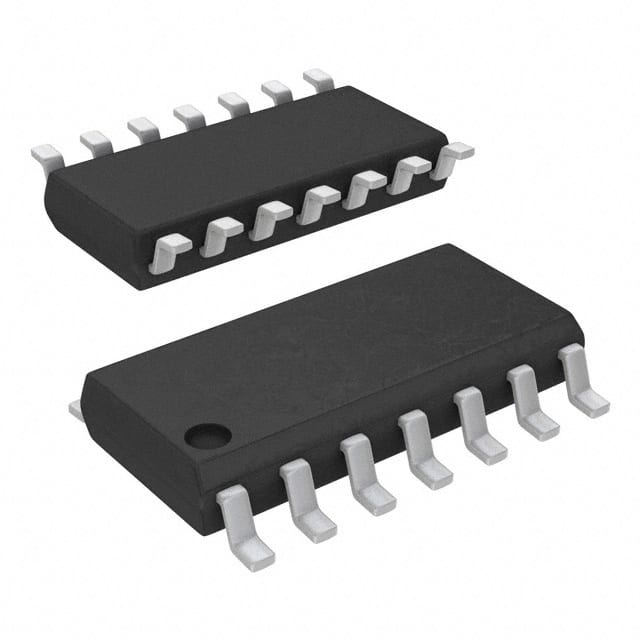


MCP4922-E/SLVAO 12-Bit Dual Voltage-Output SPI DAC
The MCP4922-E/SLVAO is a dual-channel, 12-bit voltage-output digital-to-analog converter from Microchip Technology. It is designed for embedded systems that need to turn digital commands into controlled analog voltages without adding a large discrete analog circuit.
The device combines two DAC channels, an SPI serial interface, buffered voltage outputs, an external voltage reference input, selectable gain, and a 2.7V to 5.5V supply range. The VAO suffix is especially important for automotive sourcing because Microchip identifies VAO devices as automotive standard products.
Automotive ordering note: Microchip states that product numbers ending in VAO are automotive standard products that can be ordered by automotive customers. Microchip also notes that VAO part numbers do not include an associated PPAP. This distinction matters when an automotive project has specific documentation and quality-system requirements.
1. What Is MCP4922-E/SLVAO?
MCP4922-E/SLVAO is a 12-bit dual digital-to-analog converter designed to generate analog voltage outputs from digital input codes. Instead of measuring an analog voltage like an ADC, a DAC performs the opposite conversion: it receives a digital value and creates a corresponding analog output.
That makes the MCP4922-E/SLVAO useful in systems where a microcontroller needs to control an analog quantity. Examples include programmable reference levels, actuator commands, bias voltages, threshold settings, instrument control and closed-loop control systems.
The "dual" part is important. Two independent DAC channels are integrated into the same device, so one SPI-connected chip can generate two analog control signals. This can save PCB area and reduce the amount of digital interface hardware required compared with using two unrelated single-channel DAC devices.
The MCP4922 belongs to a related family that includes the MCP4902 and MCP4912. The MCP4902 provides 8-bit dual DAC conversion, MCP4912 provides 10-bit dual conversion, and MCP4922 provides the 12-bit version. Microchip describes the three devices as dual voltage-output DACs with SPI interfaces.
2. MCP4922-E/SLVAO Key Specifications
| Parameter | MCP4922-E/SLVAO | Engineering Meaning |
|---|---|---|
| Converter Type | Dual voltage-output DAC | Two analog outputs from one digital-control device. |
| Resolution | 12-bit | 4,096 nominal digital code levels per channel. |
| D/A Channels | 2 | Two independently programmable DAC outputs. |
| Digital Interface | SPI | Fast serial interface suitable for MCU control. |
| Output Type | Buffered voltage output | Integrated output amplifier reduces the need for a separate buffer in many designs. |
| Reference | External reference | Allows the analog output scale to be established by an external reference source. |
| Gain | 1x / 2x | Provides selectable output scaling relative to VREF. |
| Supply Voltage | 2.7V to 5.5V | Works across common embedded supply rails. |
| Typical Settling Time | 4.5 µs | Useful for control signals that need more than static output capability. |
| Package | 14-SOIC | Surface-mount package for practical PCB integration. |
| Operating Temperature | -40°C to +125°C | Matches the extended-temperature grade. |
| Automotive Ordering | VAO | Microchip identifies VAO as an automotive standard ordering designation. |
3. Why 12-Bit Resolution Is Often Enough
A common misconception in converter selection is that more bits are always better. In practice, resolution should match the control problem. The MCP4922-E/SLVAO provides 12-bit resolution, which means each DAC channel has 4,096 nominal input codes.
Twelve bits is a useful middle point for many control systems. It is much finer than an 8-bit DAC, while remaining straightforward to integrate into systems that do not need the complexity of extremely high-resolution conversion.
Consider an ideal 0V to 2.048V output span. With 12-bit resolution, one nominal code step is VREF divided by 4,096 when the 1x gain setting is used. The actual application-level voltage step depends on the chosen reference and gain configuration.
This equation highlights an important design advantage of the MCP4922: the output range is not locked to a single internal reference. The external reference gives the system designer control over the voltage scale.
4. External Reference: A Useful System-Level Feature
The MCP4922-E/SLVAO uses an external voltage reference. This characteristic is easy to overlook, but it provides significant flexibility when a DAC is part of a larger analog system.
A reference voltage establishes the scale of the DAC output. By choosing an appropriate external reference, engineers can make the DAC fit the voltage range required by the surrounding circuit instead of accepting a fixed output span.
This becomes particularly useful when the DAC output is used as a control voltage, calibration level, programmable threshold, sensor excitation setting or analog feedback reference.
The trade-off is equally important: the external reference becomes part of the signal path. Reference noise and reference drift can affect the resulting analog output. For precision designs, the reference should be treated as an active circuit element rather than a passive specification hidden in the schematic.
5. Dual DAC Architecture: Two Outputs, One Interface
One of the strongest reasons to consider MCP4922-E/SLVAO is its dual-channel architecture. Two DAC outputs are integrated into one package and controlled digitally through SPI.
Independent Analog Control
Channel A can generate its own analog output code and can therefore be assigned to one control function without requiring a second DAC package.
Second Analog Control
Channel B provides another independently programmable analog output, making the device useful for dual-reference, dual-bias and two-parameter control systems.
The dual architecture is particularly useful when two analog quantities belong to the same functional block. For example, a control board might need one programmable voltage for a threshold and another for a bias level. Keeping both outputs in one IC simplifies the BOM and can create a cleaner PCB layout.
6. SPI Interface and Embedded Control
The MCP4922-E/SLVAO uses an SPI serial interface, making it a natural match for microcontrollers, digital signal processors and other embedded controllers that already provide SPI hardware.
Compared with a parallel DAC interface, SPI can reduce the number of digital traces required between the processor and converter. That matters in compact automotive and industrial boards where connector count, routing density and electromagnetic compatibility all have practical consequences.
SPI also provides a straightforward software model: the microcontroller prepares the DAC command word, selects the required channel and gain settings, sends the serial data, and then allows the converter to update the associated output.
The exact SPI timing, input thresholds, clock limits and control-bit behavior should be designed directly from the current Microchip datasheet rather than copied from a generic SPI example. The protocol may be simple, but correct timing is still necessary for reliable production hardware.
7. Understanding the Output Buffer
The MCP4922 architecture includes an output amplifier for each DAC channel. The buffered output is important because a DAC resistor network alone is not always enough to drive a real-world load directly.
In a system without an integrated buffer, the DAC output can become affected by the resistance and current demands of the following circuit. A buffered architecture makes the DAC more practical as a direct analog control source.
This does not mean that the output can drive every possible load without consideration. Engineers should still review output swing, load resistance, capacitive loading, transient behavior and downstream amplifier requirements for the actual design.
A useful mental model is to think of the DAC as producing the requested analog command first, then ask whether the downstream circuit needs more current, filtering, protection or amplification. That separates the conversion problem from the power-driving problem.
8. What Makes the VAO Suffix Important?
The final characters of an automotive semiconductor ordering code are not decorative. In this case, VAO has a specific meaning in Microchip's automotive ordering system.
Microchip states that part numbers ending in VAO are automotive standard products and can be ordered by automotive customers. Microchip also notes that VAO part numbers do not include a PPAP. That is different from a customer-specific automotive part number created with PPAP support.
For purchasing teams, this means the exact string MCP4922-E/SLVAO should remain unchanged in the BOM and sourcing records. It should not automatically be replaced by MCP4922-E/SL simply because the two parts share the same core converter family.
Procurement insight: For automotive projects, electrical similarity does not always mean purchasing equivalence. Ordering codes can carry manufacturing, qualification and documentation differences. Use the exact manufacturer part number approved for the design.
9. MCP4922-E/SLVAO Package and Temperature Grade
MCP4922-E/SLVAO is associated with a 14-pin SOIC package. The extended-temperature grade is specified for operation from -40°C to +125°C in public component listings and Microchip family documentation.
The SOIC package offers a practical compromise between board density and manufacturing convenience. It is considerably more compact than many through-hole packages while still providing a form factor that is easy to inspect and handle during PCB assembly.
In automotive electronics, package selection also needs to be considered alongside thermal cycling, board flex, component placement and solder-joint reliability. The package should therefore be evaluated as part of the complete mechanical design rather than as a footprint-only decision.
10. MCP4922-E/SLVAO Typical Signal Chain
MCU
Software determines the desired analog control value.
SPI
The command word is transferred to the DAC.
DAC Core
The digital code is translated into an analog value.
Output Buffer
The selected voltage is delivered through the integrated output amplifier.
System Load
The analog command controls a reference, threshold, bias or actuator stage.
11. Applications for MCP4922-E/SLVAO
A dual 12-bit DAC is useful wherever digital intelligence needs to create predictable analog control voltages. The MCP4922-E/SLVAO is therefore not limited to one type of application.
| Application | Why a Dual 12-Bit DAC Helps | Important Design Point |
|---|---|---|
| Programmable Reference | Provides a digitally adjustable reference level for an analog subsystem. | Reference accuracy and output stability. |
| Threshold Control | Allows software to change an analog threshold without changing hardware. | Resolution and noise. |
| Motor Control | Two DAC outputs can support multiple analog command or control functions. | Response time and downstream driver design. |
| Industrial Control | Useful for programmable analog set points and calibration levels. | EMI, grounding and analog filtering. |
| Automotive Electronics | VAO ordering supports automotive-standard procurement requirements. | Qualification, documentation and thermal environment. |
| Instrumentation | 12-bit resolution provides fine software-controlled analog adjustment. | Reference stability and system calibration. |
12. A Better Way to Think About DAC Resolution
DAC resolution should be evaluated from the perspective of the controlled physical system. The key question is not simply how many bits the DAC has, but how much voltage change at the output corresponds to one digital code and whether that difference matters to the application.
A 12-bit DAC has 4,096 nominal codes. If the selected full-scale range is relatively small, each code can represent a fine voltage step. If the output range is larger, each code represents a larger voltage increment.
This is another reason the external reference and gain architecture matter. They allow the designer to choose a voltage scale that better matches the system rather than accepting one universal output range.
Use Resolution Where It Matters
Match the DAC's code step to the smallest analog adjustment that the controlled system actually needs.
Do Not Ignore Noise
A theoretical DAC code that is smaller than the surrounding analog noise does not automatically create a meaningful real-world improvement.
Reference Sets the Scale
The external reference strongly influences the output span and therefore the practical voltage step represented by each code.
Think in System Units
Translate one DAC count into the application's real unit, such as millivolts, motor speed, pressure threshold or actuator command.
13. PCB Layout Considerations
A DAC is an analog component even though its input is digital. Poor PCB layout can therefore introduce output noise that is visible at the analog pins even when the SPI communication is perfectly reliable.
Keep the reference path clean. The reference directly influences the output scale, so unnecessary noise on the reference node can appear as unwanted movement in the analog output.
The SPI interface should also be routed with awareness of edge rates. Fast digital transitions can couple into high-impedance analog nodes through board capacitance or poor return-current paths.
Local decoupling near the supply pins should be part of the basic layout strategy. At the same time, avoid allowing large digital switching currents to share sensitive analog return paths.
The best DAC layout is often not the one with the shortest digital path. It is the one that keeps the reference, DAC output and sensitive analog circuitry electrically quiet while giving the digital interface a clear return path.
14. Settling Time and Real-Time Control
Microchip's MCP4922 documentation specifies a typical settling time of 4.5 µs for the device family. That makes the converter useful for more than static calibration settings.
A programmable output may be changed repeatedly as part of a control loop, user interface adjustment or automated calibration process. Settling time becomes important when the system needs the analog output to reach its new value within a known time window.
However, a DAC's settling time should never be treated as the same thing as total system response time. The complete signal path can include SPI transfer time, firmware scheduling, output loading, downstream filtering and amplifier settling. The system-level response can therefore be much longer than the DAC's own nominal settling specification.
15. Common MCP4922-E/SLVAO Design Mistakes
Mistake 1: Choosing a Reference Without Checking Its Noise
Since the DAC uses an external reference, reference quality directly affects the analog output. A noisy reference can limit the practical benefit of the converter's resolution.
Mistake 2: Treating Both Channels as Completely Identical Under Every Load
Both DAC channels share the same device environment, but the real output behavior can still depend on the load and surrounding circuit. Each channel should be checked against its actual application.
Mistake 3: Ignoring Output Loading
The integrated output buffer is useful, but it does not make every load electrically harmless. Review the output specifications and downstream circuit requirements.
Mistake 4: Ignoring Digital-to-Analog Noise Coupling
SPI edges can create switching noise. Careful grounding, trace routing and decoupling help keep that digital activity away from the reference and analog output paths.
Mistake 5: Losing the VAO Suffix During Procurement
This is especially important in automotive projects. The difference between MCP4922-E/SL and MCP4922-E/SLVAO can matter from a procurement and qualification perspective even when the core converter specification appears similar.
16. MCP4922-E/SLVAO Part Number Breakdown
17. MCP4922-E/SLVAO vs. MCP4922-E/SL
The most useful comparison is not to assume that these two order codes are unrelated devices. Instead, recognize that the core MCP4922 converter family remains the same while the ordering code communicates important production and qualification information.
Public distributor listings for MCP4922-E/SL show the core electrical characteristics: 12-bit resolution, two converters, SPI interface, buffered voltage outputs, 2.7V to 5.5V supply, 14-SOIC package and -40°C to +125°C operation. The exact MCP4922-E/SLVAO listing adds the automotive/VAO ordering designation.
| Item | MCP4922-E/SL | MCP4922-E/SLVAO |
|---|---|---|
| Core Device | MCP4922 | MCP4922 |
| Resolution | 12-bit | 12-bit |
| Channels | 2 | 2 |
| Interface | SPI | SPI |
| Package | 14-SOIC | 14-SOIC |
| Temperature Grade | -40°C to +125°C | -40°C to +125°C |
| Automotive Ordering | Standard part number | VAO automotive standard ordering code |
| Procurement Meaning | General product ordering code | Automotive-oriented ordering designation |
In an automotive BOM, therefore, the safest approach is to use the exact approved ordering code rather than treating the two numbers as casually interchangeable.
18. Why MCP4922-E/SLVAO Can Be a Strong Automotive DAC Choice
The combination of dual outputs, 12-bit resolution, SPI control, buffered voltage outputs, selectable gain and external reference makes MCP4922 a flexible analog-control component.
The VAO designation adds another important layer: it identifies the ordering code within Microchip's automotive standard product framework. That makes MCP4922-E/SLVAO particularly relevant for automotive sourcing teams that need to track approved manufacturer part numbers rather than simply identify a generic function.
For an automotive design engineer, this distinction can simplify the communication between hardware, purchasing and quality teams. The hardware group can specify the exact device, purchasing can source the correct code, and the project documentation can retain the same full identifier throughout the product lifecycle.
19. Design Checklist for MCP4922-E/SLVAO
| Design Area | Question to Ask | Recommended Focus |
|---|---|---|
| Resolution | Is 12-bit control fine enough? | Translate one DAC code into the real system unit. |
| Reference | Is the external reference clean and stable? | Check noise, drift and decoupling. |
| Gain | Which 1x or 2x scale matches the required range? | Leave suitable headroom for the output. |
| SPI | Does the MCU meet the required timing? | Verify clock, setup, hold and command timing. |
| Load | What will each analog output drive? | Check output swing and loading conditions. |
| Layout | Are analog and digital return paths controlled? | Separate noisy switching currents from sensitive analog nodes. |
| Temperature | Will the product operate over the required environment? | Review the -40°C to +125°C range and system thermal conditions. |
| Procurement | Does the BOM require the automotive VAO code? | Keep MCP4922-E/SLVAO as the exact approved identifier. |
20. MCP4922-E/SLVAO FAQ
The questions below use a responsive two-column layout. Each item opens and closes without JavaScript, keeping the FAQ lightweight and easy to maintain.
What is MCP4922-E/SLVAO?
How many channels does MCP4922-E/SLVAO have?
Is MCP4922-E/SLVAO a 12-bit DAC?
What interface does MCP4922-E/SLVAO use?
What is the MCP4922 reference type?
Does MCP4922 have selectable gain?
What supply voltage does MCP4922 support?
What is the typical settling time?
Does MCP4922 have buffered voltage outputs?
What package is MCP4922-E/SLVAO?
What temperature range does it support?
What does VAO mean on the part number?
Is MCP4922-E/SLVAO an automotive DAC?
Can both DAC outputs be used independently?
What applications use MCP4922?
Is MCP4922 suitable for high-speed waveform generation?
Why should the full part number be preserved?
What is the difference between DAC and ADC?
21. Final Engineering Perspective
The MCP4922-E/SLVAO is more than a basic 12-bit DAC. Its practical value comes from combining two voltage-output channels, SPI control, buffered analog outputs, an external reference and selectable gain in a compact 14-pin SOIC device.
The dual-channel architecture is especially useful in embedded systems where multiple analog control voltages are needed but board space and digital connections need to remain under control. One device can manage two programmable outputs while communicating with the host controller through a standard serial interface.
The external reference provides another layer of flexibility. Rather than accepting one fixed output scale, the designer can build the DAC into a broader reference strategy. This is useful for calibration, programmable thresholds, analog set points and other systems in which output scale matters.
The 12-bit resolution also deserves to be viewed from the system level. Twelve bits provide 4,096 nominal codes, but the most useful question is always how those codes translate into the real analog quantity being controlled. Reference quality, board noise, output loading and downstream circuitry can all influence the final result.
Finally, the VAO suffix makes MCP4922-E/SLVAO especially relevant for automotive sourcing. Microchip explicitly uses VAO as an automotive standard ordering designation. That does not eliminate the need to review the qualification and documentation requirements of a specific vehicle program, but it does make the complete part number an important procurement identifier rather than an optional suffix.
For engineers searching for MCP4922-E/SLVAO, the best way to evaluate the device is therefore to look at the whole architecture: 12-bit resolution, two independent voltage outputs, SPI connectivity, external reference flexibility, selectable gain, output buffering, 2.7V to 5.5V supply operation, extended temperature capability and the automotive VAO ordering framework.
Microchip MCP4922 product page: Microchip MCP4922
Microchip MCP4902/MCP4912/MCP4922 datasheet: MCP4902/4912/4922 Data Sheet
Microchip automotive ordering information: Microchip Automotive Ordering Codes
Public distributor data for MCP4922-E/SLVAO lists the device as a 12-bit dual DAC, 14-SOIC, buffered voltage output, SPI interface, 2.7V–5.5V supply, -40°C to +125°C operation and 4.5 µs typical settling time.