

FT62F083-RB FMD 8-Bit Touch MCU: Specifications, Design & Applications
A practical guide to the FMD FT62F083-RB 8-bit RISC microcontroller, covering its 8K program memory, 1K RAM, 256-byte EEPROM, 10-channel touch interface, 12-bit ADC, PWM resources, UART, I2C, wide supply range, SOP-16 package and embedded design considerations.
What Is the FT62F083-RB?
FT62F083-RB is an 8-bit RISC microcontroller from FMD (Fremont Micro Devices) designed for cost-sensitive embedded control and capacitive-touch applications. The SOP-16 device combines 8K program memory, 1K data RAM, 256-byte EEPROM, up to 16 MHz operation, 14 general-purpose I/O resources, 10 touch channels, a 12-bit ADC, PWM functions, UART and I2C communication. Its 1.9 V to 5.5 V operating range makes it suitable for a broad range of consumer, appliance, lighting and control products.
FT62F083-RB Key Specifications
The FMD FT62F083-RB belongs to a class of microcontrollers designed to place useful analog, digital and touch functions inside a compact and economical device.
Rather than requiring a separate touch controller, EEPROM, PWM controller and communication interface, the MCU combines these resources in one package. This can simplify the bill of materials and make it easier to design compact control boards.
| Parameter | FT62F083-RB | Engineering Meaning |
|---|---|---|
| Manufacturer | FMD / Fremont Micro Devices | Embedded MCU manufacturer |
| MCU Architecture | 8-Bit RISC | Optimized for compact embedded control firmware |
| Program Memory | 8K | Stores application firmware |
| Data RAM | 1K Bytes | Used for variables, buffers and runtime data |
| Data EEPROM | 256 Bytes | Stores settings that should survive power loss |
| Maximum Frequency | Up to 16 MHz | Provides practical processing speed for control applications |
| GPIO | 14 | Supports switches, LEDs, sensors and external control signals |
| Touch Channels | 10 | Useful for capacitive-touch user interfaces |
| ADC | 12-Bit, 4 External + 1 Internal Channel | Measures analog voltages with higher resolution than a basic 10-bit ADC |
| 16-Bit Timers | 2 | Useful for timing, capture, comparison and PWM functions |
| 8-Bit Timer | 1 | Supports general timing functions |
| PWM Resources | 4 + 2 | Supports LED, motor and power-control applications |
| UART | 1 | Provides asynchronous serial communication |
| I2C | 1 | Connects compatible sensors and peripheral devices |
| Operating Voltage | 1.9 V to 5.5 V | Supports several common embedded supply rails |
| Operating Temperature | -40°C to +85°C | Suitable for many industrial and consumer environments |
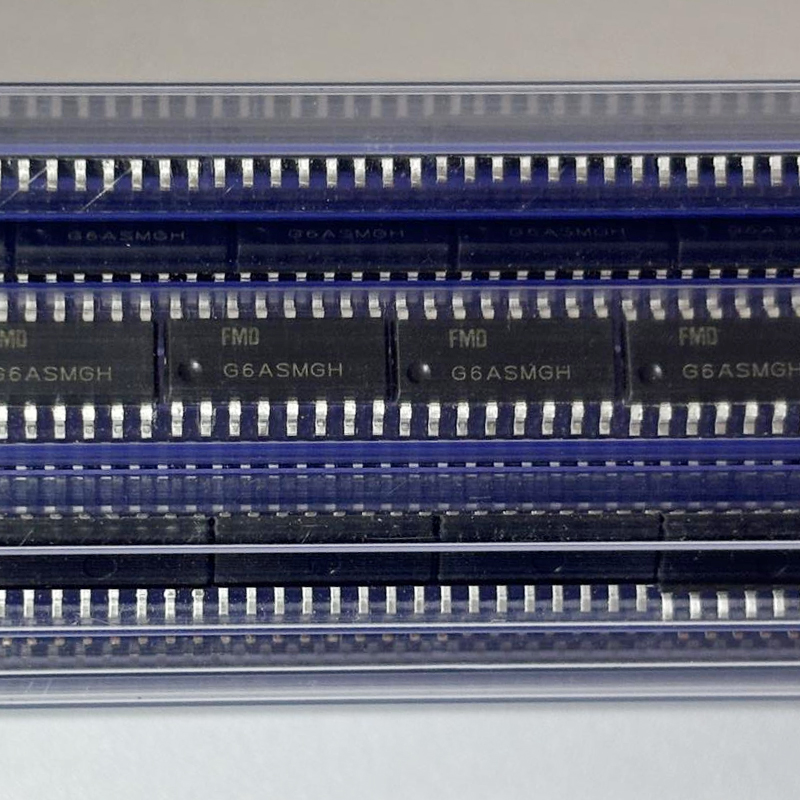
| Package | SOP-16 | Compact surface-mount package |
The FT62F083-RB should be evaluated as a complete embedded control platform rather than simply as an 8-bit CPU. Its combination of touch, analog measurement, nonvolatile memory, PWM and communication functions is what makes the part useful in real products.
Understanding the FT62F083-RB 8-Bit RISC Architecture
The FT62F083-RB uses an enhanced 8-bit RISC architecture. RISC stands for Reduced Instruction Set Computer. The basic idea is to use a relatively compact instruction set that allows common operations to execute efficiently.
For small embedded products, an 8-bit MCU can still be an excellent choice. A touch-control panel, appliance controller or LED interface usually does not need the processing power of a high-end 32-bit microcontroller.
What matters more is whether the MCU has enough I/O, timers, analog inputs, memory and communication resources for the product.
An 8-bit architecture is well suited to state machines, button scanning, simple calculations and real-time control.
Touch sensing, ADC, PWM, timers and communication reduce the number of external support ICs.
One MCU can handle user input, sensing, control outputs and communication in many compact products.
The FT62F08X family documentation also describes selectable instruction timing and internal clock resources. This gives designers flexibility to balance execution speed against power requirements.
8K Program Memory, 1K RAM and 256B EEPROM
Memory size determines how much firmware and runtime information the microcontroller can manage.
8K Program Memory
The FT62F083-RB provides 8K of program memory for application code. For a focused embedded controller, this can be enough for touch-key processing, state-machine logic, display control, ADC measurements, PWM generation, serial communication and protection functions.
The best approach is to keep the firmware architecture simple. Instead of trying to place a large software framework inside the MCU, use compact event-driven code designed around the actual product.
1K Data RAM
The 1K RAM is used for temporary variables, communication buffers, touch-processing values, ADC readings, counters and application state.
In an 8-bit embedded project, memory management matters. Large temporary arrays can consume RAM quickly, so buffer sizes should be chosen based on the real communication requirements.
256 Bytes of EEPROM
The integrated EEPROM is particularly useful because it can store information that must remain available after power is removed.
- User configuration values
- Touch calibration parameters
- Device operating modes
- Brightness settings
- Threshold values
- Production calibration data
- Usage counters
- Product configuration codes
For small appliances and control panels, 256 bytes of EEPROM can be more practically valuable than a large increase in program memory, because it allows the product to remember real user and calibration settings without adding an external EEPROM.
FT62F083-RB 10-Channel Touch Sensing
Touch sensing is one of the defining features of the FT62F083-RB touch MCU.
The device provides up to 10 touch channels in this package configuration, making it suitable for user interfaces that replace mechanical buttons with capacitive touch electrodes.
A capacitive touch button works by measuring a small change in electrical capacitance when a finger approaches or touches an electrode. The MCU firmware evaluates these measurements and determines whether the user intended to activate the key.
This can create a flat front panel with no moving button mechanism. Such designs are common in household appliances, lighting controls, small instruments and consumer products.
Why Integrated Touch Matters
Without an MCU that includes touch capability, the designer may need a separate touch-controller IC. That adds cost, PCB area, communication wiring and another component to source.
Integrating the touch engine into the main controller allows firmware to combine touch measurements directly with application state. For example, a long press can change operating mode, while a short press adjusts a setting.
PCB Design Still Matters
A touch-enabled MCU does not guarantee a reliable touch panel by itself. Electrode geometry, overlay material, PCB thickness, ground placement, nearby switching signals and moisture can all influence sensitivity.
Touch traces should be routed carefully and kept away from high-current switching nodes where possible. Firmware thresholds should also include margin for temperature and environmental variation.
Using the FT62F083-RB 12-Bit ADC
The FT62F083-RB includes a 12-bit analog-to-digital converter. A 12-bit ADC can represent an analog input using up to 4096 digital levels.
Compared with a simpler 8-bit converter, the additional resolution provides much finer measurement steps.
This is useful when the MCU needs to monitor slowly changing analog signals such as:
- Temperature sensors
- Battery or supply voltage
- Analog control knobs
- Light sensors
- Pressure or force sensors
- Current-sense voltages
- NTC thermistors
- General analog feedback
The FT62F083-RB configuration is commonly listed with four external ADC channels plus an additional internal measurement channel.
Resolution Does Not Equal Accuracy
A common engineering mistake is to assume that a 12-bit ADC automatically creates a 12-bit accurate measurement system.
Actual measurement quality depends on power-supply noise, reference stability, PCB grounding, source impedance, ADC calibration and the quality of the sensor signal.
The best way to improve ADC performance is often not adding more digital filtering. A clean reference, short analog routing and correct grounding can remove noise before it reaches the converter.
Timers and PWM Resources in FT62F083-RB
Timers are among the most useful peripherals in any embedded microcontroller. They allow the processor to measure or generate timing without continuously counting software loops.
The FT62F083-RB configuration provides 16-bit and 8-bit timing resources, along with several PWM outputs.
LED Brightness Control
PWM can control LED brightness by rapidly switching the LED between on and off states. Changing the duty cycle changes the average power and therefore perceived brightness.
Motor and Fan Control
PWM can also control small motors, fans or external transistor stages. The MCU generates the control waveform while an external driver handles the load current.
Buzzer and Sound Output
Timer-generated waveforms can drive a buzzer or simple sounder. Different frequencies can create button feedback, alarm tones or status signals.
Timing and Measurement
Timers can measure event periods, count pulses, create delays and schedule recurring control tasks.
Using hardware timers instead of software delay loops usually makes firmware more responsive because the CPU can continue performing other tasks while timing proceeds in hardware.
UART and I2C Communication Interfaces
Embedded controllers rarely operate completely alone. The FT62F083-RB includes communication resources that allow it to exchange information with other electronics.
Useful for debugging, factory testing, serial communication and connection to external modules.
Useful for connecting sensors, EEPROM devices, displays and other addressable peripherals using a small number of wires.
General-purpose pins can implement additional simple control protocols when dedicated hardware is not required.
Using UART for Debugging
UART can dramatically simplify firmware development. Instead of debugging every problem with LEDs or an oscilloscope, firmware can transmit internal values and status messages to a computer through a suitable serial interface.
This makes it easier to inspect ADC readings, touch values, operating states and error conditions during product development.
Using I2C for Peripheral Expansion
I2C allows multiple compatible peripherals to share the same clock and data lines. This is useful when a compact MCU needs additional sensors or external storage without using many GPIO pins.
1.9 V to 5.5 V Operating Range
A wide supply range gives engineers flexibility when integrating the FT62F083-RB into different system architectures.
The device is specified for operation across approximately 1.9 V to 5.5 V, while maximum clock capability depends on the selected supply voltage and operating conditions.
This makes the MCU relevant to battery-powered electronics, 3.3 V digital systems and traditional 5 V appliance-control designs.
However, a wide operating range does not mean every clock frequency is available at every voltage. The application should follow the voltage-versus-frequency limits defined by the device documentation.
Designers should also check the logic levels of external devices. For example, a sensor powered from 3.3 V may have different high-level input requirements from a 5 V peripheral.
LVR and LVD Power-Supply Protection
Embedded devices can behave unpredictably if the supply voltage falls too low for reliable CPU operation.
The FT62F083-RB includes low-voltage reset and low-voltage detection functions that can help the firmware respond more safely to unstable power conditions.
Low-Voltage Reset
LVR can hold or return the MCU to a known reset condition when the supply becomes too low for reliable execution.
Low-Voltage Detection
LVD gives the application a way to detect a falling supply before the system completely stops operating.
Firmware can potentially use this warning to stop a motor, save important settings or move outputs into a safe state.
In an appliance controller, low-voltage behavior is part of functional reliability. A processor that continues executing corrupted logic during a brownout can be more dangerous than a processor that resets cleanly.
Common FT62F083-RB Applications
The combination of touch inputs, analog measurement, PWM, EEPROM and digital communication makes the FT62F083-RB suitable for many human-interface and control applications.
- Touch-control panels
- Kitchen appliances
- Lighting controllers
- Home appliance interfaces
- Electric fans
- Small control panels
- Electronic toys
- Access-control products
- Small instruments
- Sensor-control boards
- LED control systems
- Consumer electronics
- Temperature controllers
- Keypad replacement designs
Small Household Appliances
A typical appliance may need several touch buttons, status LEDs, temperature measurement, a buzzer, saved user settings and control outputs. FT62F083-RB can handle many of these functions inside a single MCU.
Lighting Control
Touch keys can select brightness or operating modes while PWM outputs control external LED drivers or switching devices.
Access and Control Panels
Touch input and serial communication can be combined to create compact front-panel controllers that communicate with a larger system.
Why the SOP-16 Package Matters
The FT62F083-RB SOP-16 package provides a useful balance between PCB size and manufacturing convenience.
Compared with very small QFN packages, an SOP package has visible leads that are easier to inspect during manufacturing and prototype work. It is also easier to hand solder during development or repair.
The trade-off is pin count. A 16-pin package cannot expose every possible peripheral resource available across the broader MCU family. This is why engineers should always use specifications for the exact FT62F083-RB package instead of assuming that every feature listed for a larger FT62F08X device is available on the SOP-16 version.
This distinction is especially important for touch channels, ADC inputs, PWM outputs and general-purpose I/O.
PCB Design Guidelines for FT62F083-RB
The schematic for an 8-bit MCU can look simple, but good PCB layout still has a major effect on touch sensing and ADC stability.
- Place the supply decoupling capacitor close to the MCU.
- Keep the main ground path low impedance.
- Keep touch traces away from noisy switching signals.
- Avoid routing PWM power currents close to touch electrodes.
- Keep sensitive ADC traces short.
- Separate high-current loads from analog measurement paths.
- Follow the recommended programming connection.
- Check unused pin configuration in firmware.
- Use suitable protection on externally accessible inputs.
- Test touch performance with the final front-panel material installed.
Touch Layout Is Part of the Sensor
The PCB electrode is not merely a wire attached to the touch controller. Its shape, area, spacing and surrounding copper form part of the actual capacitive sensor.
A prototype that works with a bare PCB may behave differently after a plastic or glass cover is added. Final validation should therefore use the real mechanical stack-up.
Firmware Strategy for FT62F083-RB
The most effective firmware for a compact 8-bit MCU is usually simple, predictable and event driven.
Instead of building the entire application around long blocking delays, the program can divide work into small periodic tasks.
Scan critical inputs and update time-sensitive outputs at short intervals.
Process touch keys, ADC values and control-state changes.
Save settings, update indicators and perform diagnostic checks less frequently.
This structure reduces unnecessary CPU load and keeps the application responsive even when several peripherals are active.
EEPROM writes should also be managed carefully because configuration data usually does not need to be rewritten every time through the main loop. Save only when values actually change or when a defined event requires persistent storage.
When Should You Choose FT62F083-RB?
FT62F083-RB is a strong candidate when a design needs a small, cost-conscious MCU with integrated touch sensing and moderate analog and timing resources.
It is especially attractive when all of the following are true:
- 8-bit processing performance is sufficient.
- The application fits within 8K program memory.
- 1K RAM is enough for runtime data.
- Integrated EEPROM is useful.
- Several capacitive touch keys are required.
- 12-bit analog measurement is valuable.
- UART or I2C communication is required.
- A compact SOP-16 package is preferred.
A larger MCU may be more appropriate when the product requires a large graphic display, complex networking stack, significant floating-point processing or large memory buffers.
The best MCU is therefore not always the most powerful part. It is the device whose resources match the real application with enough margin for firmware growth and production variation.
FT62F083-RB Replacement and Equivalent Selection
Searching for an FT62F083-RB equivalent requires more than finding another 8-bit MCU in a 16-pin package.
| Replacement Check | FT62F083-RB Reference | Why It Matters |
|---|---|---|
| Architecture | FMD 8-Bit RISC | Firmware is normally architecture-specific |
| Program Memory | 8K | Replacement must fit the application firmware |
| RAM | 1K | Runtime buffers and variables require enough memory |
| EEPROM | 256 Bytes | Important if settings are stored internally |
| Touch Channels | 10 | Touch-panel firmware and PCB depend on available channels |
| ADC | 12-Bit | Resolution and input mapping affect sensor circuits |
| Communication | UART + I2C | External peripherals must remain compatible |
| Supply Voltage | 1.9 V to 5.5 V | Replacement must operate on the existing rail |
| Package | SOP-16 | Mechanical footprint and pin assignment must match |
Even another FMD MCU may not be a drop-in substitute unless its pin assignment, programming method, peripheral mapping and firmware compatibility have been confirmed.
For an existing production board, the safest replacement process is to compare both datasheets pin by pin and then validate the new device in the real application.
How to Source FT62F083-RB Correctly
The complete part number should be preserved when creating a BOM, product listing or purchase request.
Use:
Manufacturer: FMD / Fremont Micro Devices
MPN: FT62F083-RB
Package: SOP-16
Do not turn the MPN into a marketing sentence such as "FT62F083-RB FMD 8-Bit Touch MCU SOP16." Product titles may contain those keywords, but the MPN field should remain the clean manufacturer identifier.
- Confirm the full FT62F083-RB part number.
- Verify FMD as the manufacturer.
- Confirm SOP-16 package requirements.
- Check package markings.
- Verify production lot requirements.
- Request traceability when required.
- Confirm programming tools and firmware support.
- Check the latest datasheet before PCB production.
FT62F083-RB FAQ
What is FT62F083-RB?
FT62F083-RB is an FMD 8-bit RISC microcontroller designed for embedded control and capacitive-touch applications. It combines program memory, RAM, EEPROM, touch sensing, ADC, PWM, timers and serial communication functions in an SOP-16 package.
Who manufactures FT62F083-RB?
FT62F083-RB is manufactured by FMD, also known as Fremont Micro Devices.
Is FT62F083-RB an MCU?
Yes. FT62F083-RB is an 8-bit RISC microcontroller rather than a simple touch-controller IC.
What package does FT62F083-RB use?
FT62F083-RB uses a 16-pin SOP surface-mount package, commonly listed as SOP-16.
How much program memory does FT62F083-RB have?
FT62F083-RB is commonly specified with 8K of program memory for application firmware.
How much RAM does FT62F083-RB have?
The device provides approximately 1K byte of data RAM for variables, buffers and application state.
Does FT62F083-RB have EEPROM?
Yes. It provides 256 bytes of data EEPROM that can be used to store settings, calibration information and other values that should remain after power is removed.
Does FT62F083-RB support capacitive touch?
Yes. The SOP-16 FT62F083-RB configuration is commonly listed with 10 touch channels, making it useful for touch-control panels and button-replacement applications.
Does FT62F083-RB have a 12-bit ADC?
Yes. The device includes a 12-bit ADC. The FT62F083-RB configuration is commonly listed with four external analog channels plus an additional internal measurement channel.
What is the maximum frequency of FT62F083-RB?
FT62F083-RB supports operation up to 16 MHz under the appropriate supply-voltage and clock conditions.
What is the FT62F083-RB operating voltage?
The device supports a wide operating-voltage range of approximately 1.9 V to 5.5 V. The maximum usable CPU frequency depends on supply voltage and the conditions defined in the device documentation.
What is the FT62F083-RB operating temperature?
The commonly specified operating-temperature range is approximately -40°C to +85°C.
Does FT62F083-RB support UART?
Yes. FT62F083-RB provides a UART interface that can be used for serial communication, debugging and connection to compatible external modules.
Does FT62F083-RB support I2C?
Yes. The device provides an I2C interface for compatible sensors, memories and other peripheral devices.
What is FT62F083-RB used for?
Typical applications include touch-control panels, small household appliances, lighting control, electronic toys, instruments, access control, sensor systems and other compact embedded products.
Can another 8-bit MCU directly replace FT62F083-RB?
Not automatically. A replacement must be checked for pinout, memory, touch channels, ADC, timers, communication interfaces, supply range, package, firmware architecture and programming compatibility.
Final Engineering Perspective
The FT62F083-RB is most useful when viewed as a compact mixed-signal control platform rather than simply as another inexpensive 8-bit microcontroller.
Its 8K program memory, 1K RAM and 256-byte EEPROM provide a practical memory structure for focused embedded applications. The integrated touch channels allow the same MCU to manage a capacitive user interface without requiring a separate touch-controller chip.
The 12-bit ADC adds analog measurement capability for sensors, thermistors, supply monitoring and other feedback signals. Timers and PWM resources can handle LED brightness, buzzers, motor control and periodic timing tasks, while UART and I2C provide useful connections to external systems.
The wide 1.9 V to 5.5 V operating range also gives designers flexibility when working with battery-powered, 3.3 V and 5 V electronics.
For a product such as a touch-controlled appliance panel, one FT62F083-RB can potentially read the user's touch inputs, monitor temperature through the ADC, control LEDs using PWM, save preferences in EEPROM and communicate with another controller through UART or I2C. That is a strong amount of functionality for a compact SOP-16 device.
Good system design still matters. Touch electrodes require careful PCB layout, ADC inputs need clean analog routing, power supplies need proper decoupling and firmware should manage memory efficiently.
For compact products that need integrated touch sensing, analog measurement and straightforward embedded control without the complexity of a larger MCU platform, FMD FT62F083-RB provides a balanced and practical set of resources.
.JPG)