HRC Fuse Guide: What It Is, How It Works, Types & Selection
Find the HRC Fuse Answer You Need
This guide is organized around the questions engineers, technicians and buyers most often need to answer before choosing or replacing an HRC fuse.
What does HRC stand for?
HRC means High Rupturing Capacity: the ability of a fuse to interrupt a high prospective fault current safely. Read the definition →
How does an HRC fuse work?
The calibrated element melts during overcurrent, an arc forms, and the enclosed filler helps absorb heat and extinguish the arc so the fault can be isolated safely. See the working process →
What is the difference between fuse current and breaking capacity?
Rated current describes normal current-carrying duty. Breaking capacity describes the maximum prospective fault current the fuse can safely interrupt. Compare the ratings →
Which HRC fuse type should I choose?
The answer depends on whether you are protecting cables, motors, transformers, semiconductors, distribution equipment or another load. Compare HRC fuse types →
HRC fuse or circuit breaker?
Neither is universally better. HRC fuses can provide very fast current limitation, while circuit breakers are usually resettable and may offer adjustable protection. See the comparison →
Can the same HRC fuse be used on AC and DC?
Only when the manufacturer specifies suitable ratings for the intended AC or DC circuit. Do not assume an AC rating provides the same DC interruption capability. See the FAQ →
What is I²t in an HRC fuse?
I²t is used to evaluate fault-energy let-through. It is especially important when protecting semiconductors, drives, cables and other components with limited fault-energy withstand. Understand I²t →
How do I select the right HRC fuse?
Check normal load current, voltage, prospective short-circuit current, breaking capacity, load type, time-current curve, I²t, physical fit and standards. Follow the selection steps →
Direct answer: An HRC fuse is a high-fault-current protective fuse. Its key job is to carry normal current reliably and then interrupt a dangerous short circuit safely when the prospective fault current may be many times higher than the normal load.
What Is an HRC Fuse and What Does High Rupturing Capacity Mean?
High Rupturing Capacity is an important concept in modern electrical protection. It describes the ability of a fuse to interrupt a very high prospective fault current safely under specified conditions. A high rupturing capacity fuse, usually called an HRC fuse, is therefore designed for circuits where a short circuit may produce far more current than the system normally carries.
This distinction matters because normal operating current and short-circuit current are two very different things. A circuit may carry only 20 A, 100 A, or 400 A during normal operation, while a severe fault at the same point could produce thousands or tens of thousands of amperes depending on the transformer, supply impedance, conductors, and installation layout.
The job of an HRC fuse is not simply to melt when too much current flows. It must interrupt that fault in a predictable and controlled way while limiting the thermal and mechanical energy reaching cables, busbars, motors, transformers, switchgear, and electronic equipment.
What Does High Rupturing Capacity Mean?
High Rupturing Capacity refers to the fuse's ability to safely interrupt a high fault current without an unsafe rupture of the protective device. The term is closely related to breaking capacity or interrupting capacity.
This rating should never be confused with the current rating printed on the fuse.
| Fuse Parameter | Meaning | Why It Matters |
|---|---|---|
| Rated Current | The current the fuse is designed to carry under specified conditions | Must suit the normal load and conductor capacity |
| Rated Voltage | The maximum specified operating voltage | The fuse must be suitable for the actual circuit voltage |
| Breaking Capacity | The prospective fault current the fuse can safely interrupt | Must be high enough for the available short-circuit current |
| Time-Current Characteristic | How quickly the fuse responds at different current levels | Helps coordinate protection with load behavior |
| I²t | A measure associated with energy let-through during operation | Important for cables, semiconductors, and sensitive equipment |
For example, two HRC fuses may both carry a 100 A marking but still have different voltage ratings, breaking capacities, fuse classes, time-current curves, physical dimensions, and I²t values. They should not automatically be treated as interchangeable.
Why HRC Fuses Matter in Modern Electrical Systems
Modern industrial systems often use larger transformers, powerful motors, variable-frequency drives, automation equipment, UPS systems, solar inverters, battery storage, and high-density electrical distribution. These systems can make fault-current management increasingly important.
The value of a high rupturing capacity fuse is therefore not simply that it disconnects a failed circuit. Its deeper purpose is to manage fault energy before that energy produces wider damage.
This leads to a useful engineering principle: the best fuse is not necessarily the one with the largest current rating or even the highest breaking capacity. It is the fuse whose complete electrical behavior matches the circuit it is protecting.
Direct answer: An HRC fuse works by melting a calibrated fuse element during excessive current and controlling the resulting electrical arc inside a strong enclosed body, commonly with quartz or silica-based filling material.
How Does an HRC Fuse Work and What Is Inside It?
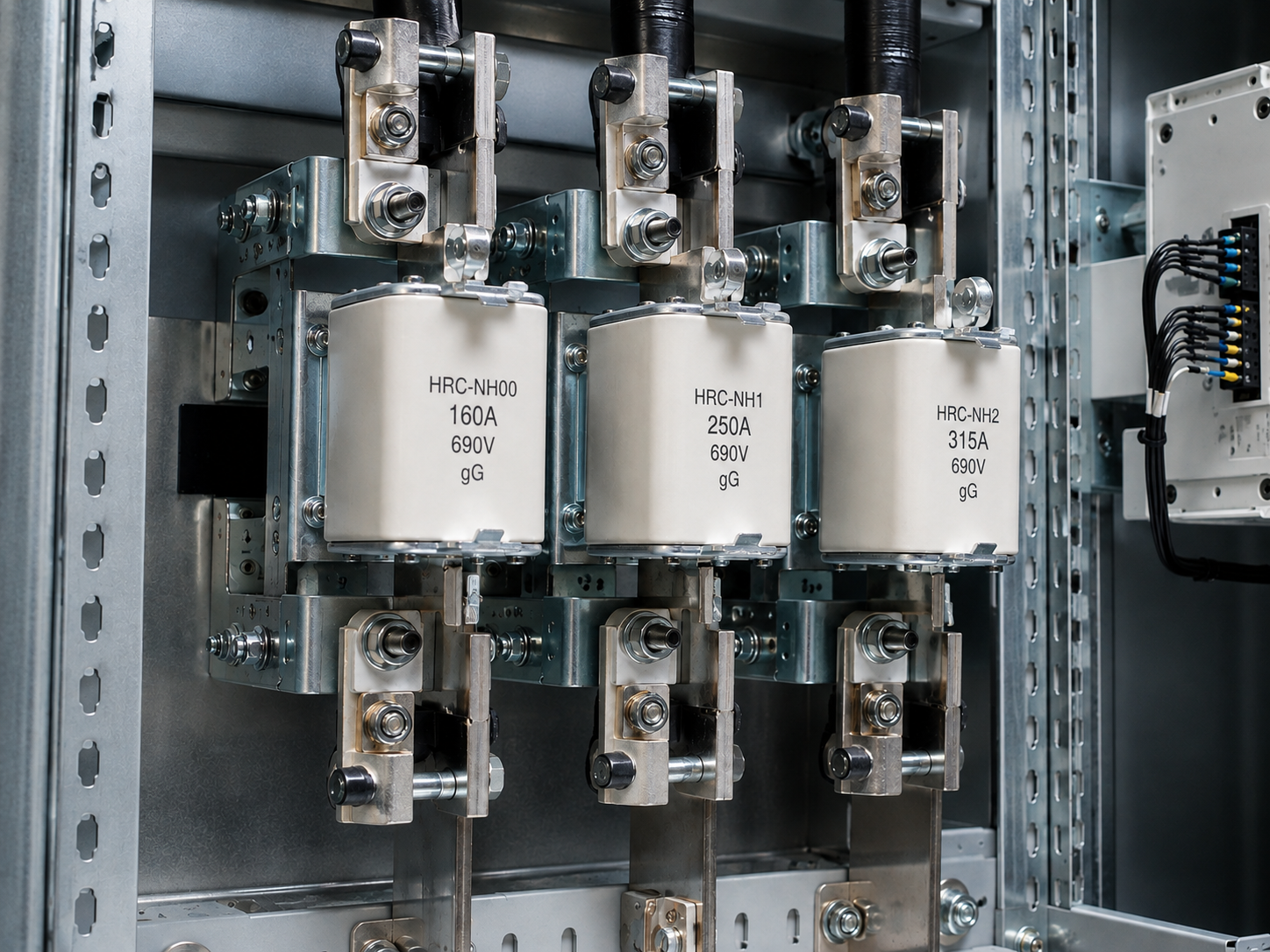
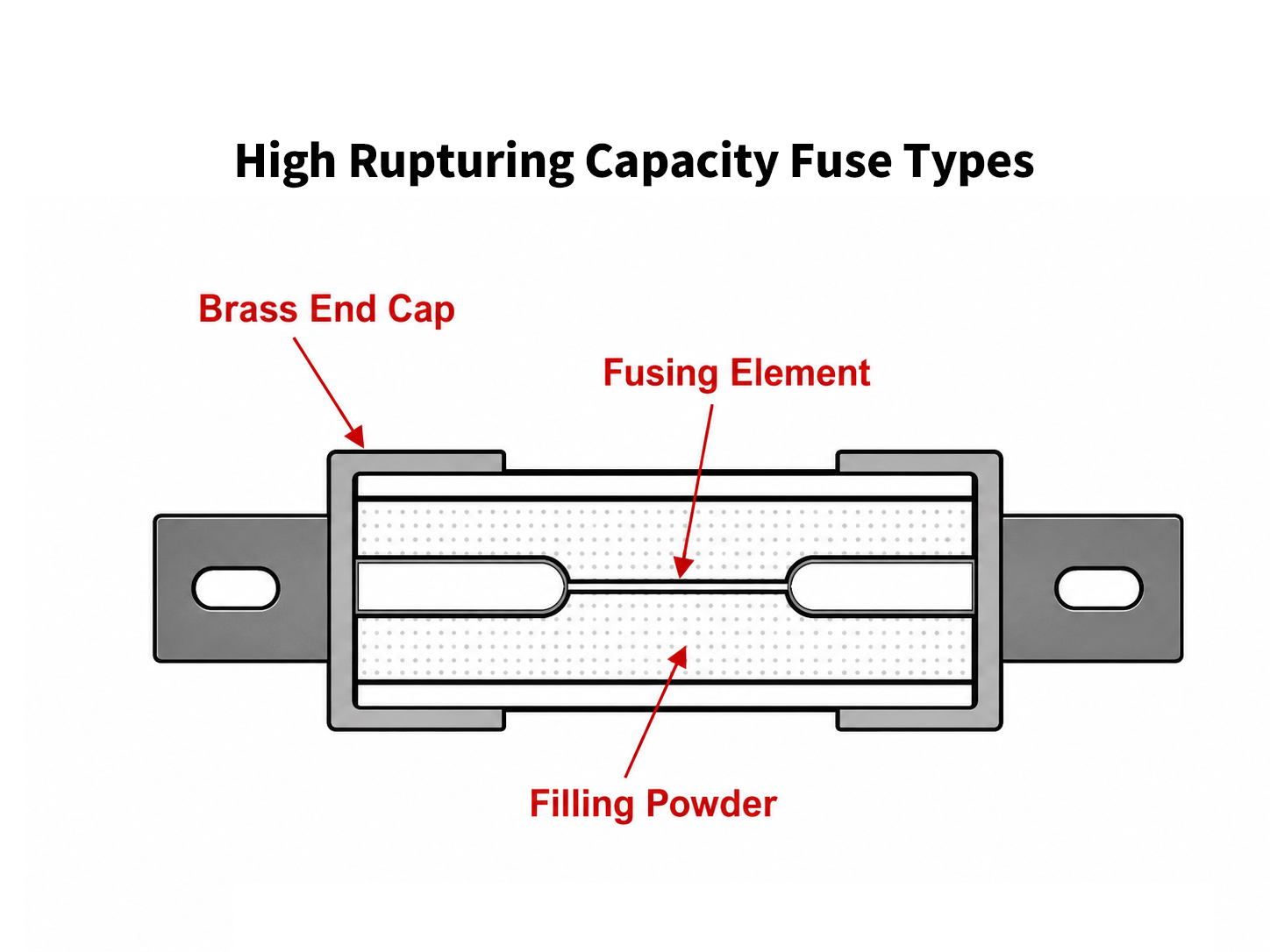
The dependable performance of an HRC fuse comes from its internal design. Unlike a simple exposed fuse wire, an industrial HRC fuse normally combines a calibrated fusible element, a strong insulating body, metal contacts, and an arc-control system.
Each part has a specific role. The fuse element decides when interruption begins, while the surrounding structure helps the device survive and control the high-energy conditions created during a short circuit.
Ceramic or High-Strength Fuse Body
Many HRC fuse designs use a ceramic body because ceramic provides good electrical insulation and can tolerate high temperatures and mechanical stress.
During a major short circuit, fault interruption can happen very quickly, but the internal temperature and pressure can rise sharply. The fuse body therefore needs to remain mechanically stable throughout the clearing process.
Calibrated Fuse Element
The fuse element is the electrically active part of the device. Depending on the design, it may use materials such as silver or copper and may include several carefully shaped narrow sections.
These restrictions are important because they help control where melting starts. The element is therefore more sophisticated than a simple piece of wire.
Its geometry helps determine:
- normal current-carrying performance;
- response to overload current;
- response to high short-circuit current;
- pre-arcing energy;
- total clearing time;
- current-limiting behavior.
Quartz or Silica Arc-Quenching Material
Many industrial high rupturing capacity fuse designs contain quartz or silica-based material around the fuse element.
When the element melts during a serious fault, the current does not necessarily disappear immediately. Electrical arcs can form between the separated sections of the element. These arcs contain substantial thermal energy.
The filler helps absorb heat, control the arc, increase resistance in the arc path, and support rapid interruption.
This internal arc-management process is one of the main reasons an HRC fuse can interrupt fault currents that are many times larger than its normal operating current.
End Contacts and Terminals
HRC fuse connections vary according to the fuse system. Products may use blade contacts, cylindrical end caps, bolted terminals, or other standardized contact arrangements.
The quality of these connections matters because poor contact can increase resistance and local heating. A correct fuse therefore needs a compatible fuse holder or switching device, not merely a mechanically similar opening.
Indicator and Striker Mechanisms
Some HRC fuses include an indicator that provides a visual sign after operation. Certain industrial versions can also use striker mechanisms that interact with switches or monitoring systems.
This can simplify maintenance because technicians can locate an operated fuse more quickly in a large electrical panel.
How Does an HRC Fuse Work?
The operating principle can be understood in six stages.
- Normal operation: current passes through the calibrated fuse element with minimal disturbance to the circuit.
- Overcurrent occurs: an overload or short circuit increases current through the element.
- Rapid heating develops: electrical heating rises strongly as current increases.
- The fuse element melts: designed weak points open the conducting path.
- Electrical arcs form and are controlled: the surrounding filler absorbs energy and assists arc extinction.
- The fault is isolated: current flow stops and the operated fuse must normally be replaced.
The important point is that the fuse does not merely "burn out." A well-designed High Rupturing Capacity fuse manages a high-energy electrical event in a controlled way.
Direct answer: The main benefits of HRC fuses are high breaking capacity, fast fault clearing, current limitation and predictable time-current behavior. Their main limitation is that an operated fuse link normally has to be replaced.
What Are the Main HRC Fuse Features, Advantages and Limitations?
Several characteristics explain why HRC fuses remain widely used even though modern circuit breakers are available.
High Breaking Capacity
The defining feature is the ability to interrupt substantial prospective fault current. This makes HRC protection useful in industrial distribution systems where short-circuit current can be far higher than in small electronic circuits.
Fast Fault Response
During a severe short circuit, an HRC fuse can operate very quickly. Fast clearing helps reduce the time that cables, busbars, switching contacts, and downstream equipment are exposed to damaging current.
Current-Limiting Performance
Many HRC fuses have strong current-limiting characteristics. This means a serious fault may be interrupted before the prospective current reaches its natural peak.
That distinction is important. The electrical system may theoretically be capable of supplying an extremely high short-circuit current, but a fast current-limiting fuse can reduce the actual peak current and energy passing through downstream equipment.
Understanding I²t
I²t is an important parameter when comparing fuse performance. In simple terms, it relates current squared to time and helps engineers evaluate the amount of energy associated with a fault-clearing event.
Manufacturers may publish both pre-arcing I²t and total clearing I²t.
- Pre-arcing I²t: energy up to the stage when the fuse element melts and arcing begins.
- Total clearing I²t: energy associated with the complete interruption process.
These values become especially important when protecting semiconductor devices, converters, rectifiers, drives, cables, and other equipment with limited short-circuit withstand capability.
Predictable Time-Current Characteristics
A professional HRC fuse is designed around a defined time-current curve. This curve shows approximately how long the fuse takes to operate at different multiples of rated current.
This is important because not every high current is a fault. Motors can draw large starting current, transformers can have magnetizing inrush, and capacitor systems can experience charging transients.
Good protection must allow acceptable temporary current while still interrupting dangerous conditions.
Advantages of HRC Fuses
- High fault interruption capability: suitable for installations with substantial prospective short-circuit current.
- Rapid operation: severe faults can be cleared quickly.
- Current limitation: many types reduce peak fault current and energy let-through.
- Simple construction: there is no complex mechanical trip mechanism inside the fuse link.
- Predictable characteristics: manufacturer curves help engineers coordinate the fuse with equipment.
- Compact protection: substantial fault-interruption capability can be achieved in a relatively compact package.
- Wide application range: versions are available for distribution, motors, transformers, power electronics, and other industrial systems.
Limitations of HRC Fuses
- An operated fuse normally needs to be replaced.
- Maintenance teams need suitable spare fuse links.
- A physically compatible replacement may not be electrically equivalent.
- Incorrect replacement ratings can reduce protection.
- Some motor and semiconductor applications require specialized fuse characteristics.
- AC and DC ratings must not be assumed to be interchangeable.
- A fuse may need to work with other protection devices rather than acting as the only protective component.
HRC Fuse vs Circuit Breaker
| Feature | HRC Fuse | Circuit Breaker |
|---|---|---|
| Operation | Fuse element melts | Mechanical or electronic trip mechanism opens contacts |
| After Fault | Fuse normally requires replacement | Usually resettable after fault investigation |
| Current Limitation | Can be extremely effective | Depends on breaker design |
| Settings | Fixed characteristic for the selected fuse | Some breakers offer adjustable protection |
| Mechanical Complexity | Low | Higher |
| Maintenance | Replacement stock required | Inspection and mechanical maintenance may be required |
Neither option is automatically better. In professional electrical systems, HRC fuses and circuit breakers are often used together at different protection levels.
Why Selective Coordination Matters
A well-designed electrical protection system should ideally isolate only the section where a fault occurs.
For example, if one machine develops a short circuit in a large factory, the preferred result is usually for the local protective device to operate while upstream feeders continue supplying other equipment.
This principle is called selective coordination or discrimination.
Fuse coordination should therefore consider time-current curves and manufacturer coordination data. Simply installing progressively larger HRC fuses upstream does not automatically guarantee selectivity.
Direct answer: Common HRC fuse families include cartridge, NH, blade, BS-type, cylindrical, gG, aM and high-speed semiconductor fuses. The correct type depends on the protected load and required operating characteristic.
What Types of HRC Fuses Are Available?
There is no single physical design for every high rupturing capacity fuse. Different electrical systems, regional practices, current levels, and protection objectives have produced several HRC fuse families.
Cartridge HRC Fuse
Cartridge fuse designs use a fully enclosed body with electrical contacts at each end. Their enclosed construction can provide stable mechanical protection and controlled interruption of fault current.
Cartridge-style products are available in many sizes and ratings for industrial equipment, control circuits, power supplies, and distribution applications.
NH HRC Fuse
NH fuses are common in industrial and commercial low-voltage distribution systems. They typically use blade contacts and are available across a wide current range.
Typical uses include:
- distribution boards;
- industrial machinery;
- feeder protection;
- cable protection;
- motor circuits;
- switch-fuse assemblies.
Blade-Type HRC Fuse
Blade-type HRC fuses use flat conductive terminals that provide a strong and compact electrical connection. The exact dimensions and performance depend on the relevant product family and standard.
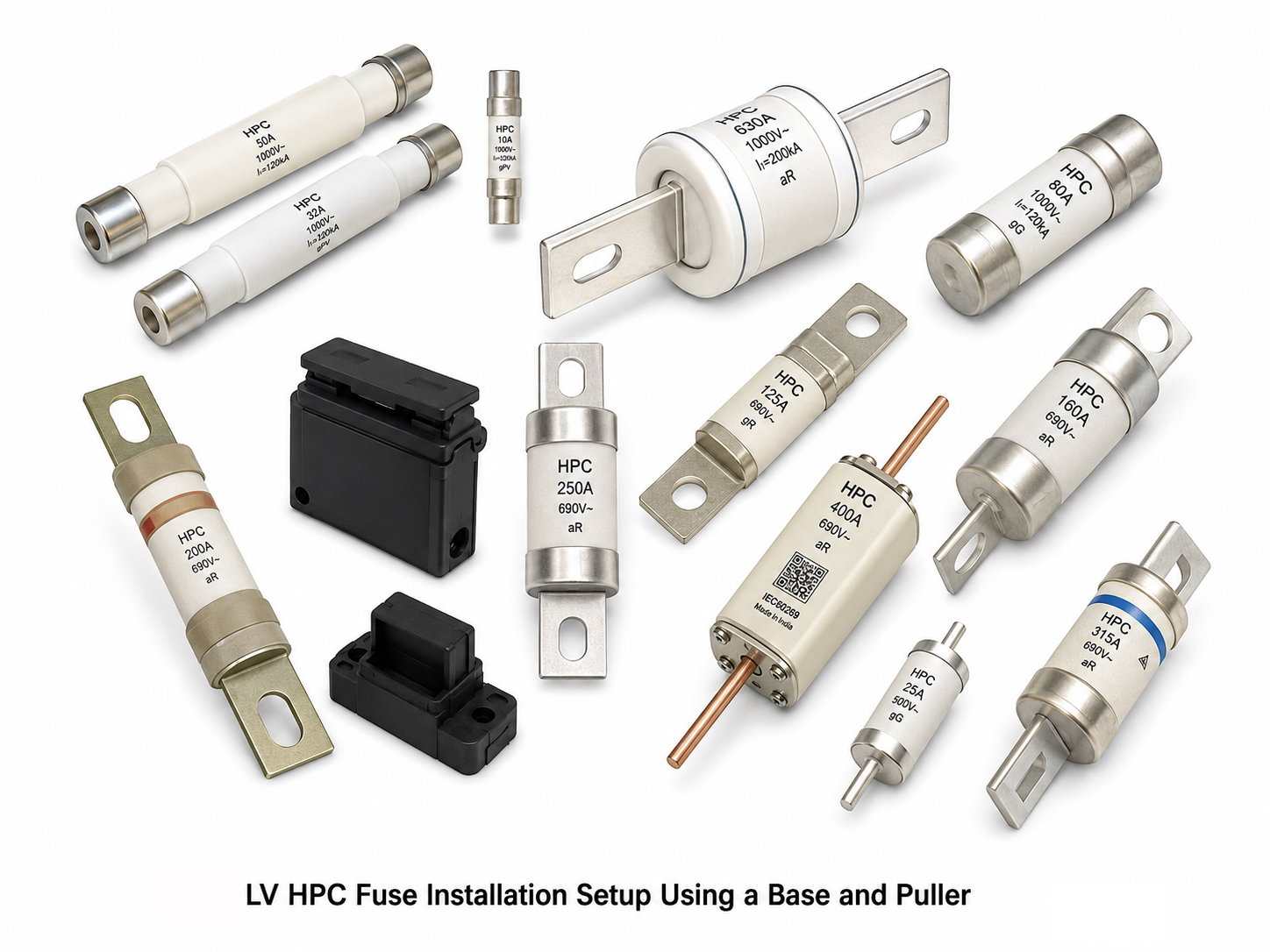
BS-Type HRC Fuse
British-style HRC fuse systems are widely found in industrial switchgear, motor control centers, distribution equipment, and existing electrical installations.
Depending on the specific series, they may use bolted or blade-style connections.
Cylindrical HRC Fuse
Cylindrical fuses use metal end contacts and a tubular body. They can provide a compact solution for control, machinery, distribution, photovoltaic, and other applications when the correct fuse series is selected.
High-Speed Semiconductor Fuse
Semiconductor equipment often requires a different level of protection from ordinary cables or motors.
Devices such as:
- thyristors;
- diodes;
- rectifier bridges;
- industrial drives;
- power converters;
- inverters;
- UPS equipment;
- power semiconductor modules
can be damaged by fault energy very quickly.
High-speed fuses are therefore designed to provide low energy let-through and rapid fault interruption. For these applications, I²t characteristics may be just as important as ampere rating.
gG HRC Fuse
A gG fuse is generally associated with full-range general-purpose protection. It is commonly used to protect cables, conductors, feeders, and distribution systems against overload and short-circuit conditions within its specified operating range.
aM HRC Fuse
An aM fuse is commonly associated with motor circuit protection. It is mainly intended to provide short-circuit protection over part of the current range and normally works together with a separate overload protection device.
This arrangement is useful because motors may draw several times their normal running current while starting.
Are Fusibles HRC and Fusible HRC Different Products?
International buyers sometimes search using terms such as fusibles HRC or fusible HRC. These phrases are commonly used in multilingual product searches for HRC-type fuse products.
However, a translated product name is not enough to confirm compatibility.
When sourcing fusibles HRC, always verify:
- manufacturer;
- part number;
- rated current;
- rated voltage;
- breaking capacity;
- fuse category;
- dimensions;
- time-current characteristics;
- applicable standards.
Is an SRC Fuse the Same as an HRC Fuse?
The phrase SRC fuse may appear in online searches or supplier descriptions, but it should not automatically be treated as a universal synonym for an HRC fuse.
If a supplier uses the term SRC fuse, confirm the manufacturer's datasheet. Fuse substitution should be based on verified electrical characteristics rather than similar-looking abbreviations.
Direct answer: HRC fuses are used in distribution panels, motors, transformers, power electronics, renewable-energy systems, battery systems and industrial machinery. Selection should start with the actual load, voltage and prospective short-circuit current.
Where Are HRC Fuses Used and How Do You Select the Right One?
The main application for a High Rupturing Capacity fuse is a circuit where potentially high fault current must be interrupted safely and quickly.
Industrial Distribution Panels
Factories can have large transformers and low-impedance distribution networks. A short circuit close to the supply may therefore produce substantial fault current.
HRC fuses are widely used in feeders, switchgear, distribution boards, and industrial control panels because of their strong fault-clearing capability.
Motor Protection
Electric motors create an interesting protection challenge because normal starting current can be much higher than running current.
An appropriately selected HRC fuse can provide strong short-circuit protection while coordinating with contactors and overload relays.
The objective is not simply to choose a fuse that operates quickly. It must also remain stable during acceptable motor-starting conditions.
Transformer Protection
Transformers can experience magnetizing inrush when energized and can also supply very high downstream fault currents.
Fuse selection therefore needs to consider transformer rating, inrush behavior, short-circuit level, cable protection, and downstream coordination.
Power Factor Correction Systems
Capacitor banks can experience inrush current, harmonics, and abnormal fault conditions. The correct fuse should be selected according to the capacitor equipment manufacturer's requirements and the electrical characteristics of the system.
Power Electronics
Variable-frequency drives, rectifiers, converters, UPS systems, inverters, and power supplies can contain semiconductor devices with limited short-circuit energy withstand.
For these applications, a specialized high-speed HRC fuse may be required. Selection should consider semiconductor I²t limits rather than relying only on normal operating current.
Solar and Renewable Energy
Photovoltaic arrays, battery systems, energy storage equipment, and renewable energy converters require carefully selected overcurrent protection.
DC systems deserve particular attention because DC current does not have the natural zero crossing present in AC systems. The fuse must therefore be specifically rated and approved for the intended DC voltage and application.
Battery Energy Storage Systems
Large battery banks can deliver substantial fault currents because of their low internal impedance. Fast, correctly coordinated protection can therefore be important in battery energy storage systems.
Engineers should evaluate voltage, prospective fault current, DC interruption capability, I²t, and equipment recommendations.
Industrial Machinery
Modern machines may combine motors, heaters, servo drives, PLC systems, power supplies, and semiconductor control devices in one cabinet.
Different parts of the machine may require different protection strategies. HRC fuses can provide feeder, branch, motor, or semiconductor protection when the correct fuse class is used.
Backup Protection
In some systems, an HRC fuse works together with another protective device. Rather than replacing the circuit breaker, the fuse may provide fast high-fault-current backup protection.
This is another reason fuse selection should be treated as a system-level engineering decision.
How to Select the Right HRC Fuse
A useful selection process should examine the complete electrical environment rather than only the fuse ampere rating.
1. Determine Normal Load Current
Identify the expected continuous current and operating duty of the equipment.
Consider ambient temperature, enclosure conditions, cable rating, load cycle, manufacturer derating guidance, and temporary inrush current.
2. Confirm System Voltage
The fuse voltage rating must be suitable for the actual circuit voltage and type.
Never assume an AC-rated fuse has equivalent DC interruption capability.
3. Calculate or Obtain Prospective Short-Circuit Current
This is one of the most important steps when selecting a high rupturing capacity fuse.
The required breaking capacity depends on the available fault current at the exact installation point. This value may change significantly depending on transformer size, supply impedance, cable length, and conductor size.
4. Identify the Load Type
A motor, transformer, cable, heating element, capacitor, semiconductor converter, and battery system do not behave the same way.
Choose a fuse family whose operating characteristic is designed for the actual load.
5. Review the Time-Current Curve
The manufacturer's time-current curve helps determine whether the fuse will survive normal starting or inrush conditions while still operating fast enough during dangerous faults.
6. Compare I²t
For sensitive downstream components, compare fuse let-through characteristics with the equipment's withstand capability.
7. Check Physical Compatibility
Verify body dimensions, terminal type, fuse holder, mounting method, and required accessories.
8. Verify Standards and Certification
Confirm that the product meets the standards, certifications, equipment requirements, and local regulations relevant to the installation.
Common HRC Fuse Selection Mistakes
- Choosing only by amperes: two 100 A fuses can have very different protection characteristics.
- Ignoring fault current: breaking capacity must suit the available prospective short-circuit current.
- Ignoring motor or transformer inrush: normal temporary current can cause nuisance operation if the fuse characteristic is incorrect.
- Using the wrong utilization category: general-purpose, motor, and semiconductor applications can require different fuse designs.
- Assuming AC and DC ratings are equal: interruption conditions are different.
- Installing a larger fuse after repeated operation: this may remove necessary protection from cables or equipment.
- Replacing by physical size only: identical dimensions do not guarantee identical electrical performance.
A Practical HRC Fuse Selection Checklist
| Check | Question to Ask |
|---|---|
| Rated Current | Can the fuse carry the normal load without nuisance operation? |
| Voltage Rating | Is the fuse approved for the actual AC or DC system voltage? |
| Breaking Capacity | Can it interrupt the maximum prospective fault current? |
| Fuse Category | Is it suitable for cable, motor, semiconductor, or another application? |
| Time-Current Curve | Will it tolerate expected inrush while clearing dangerous faults? |
| I²t | Is the downstream equipment protected from excessive fault energy? |
| Physical Format | Does it correctly fit the approved holder? |
| Standards | Does it meet the required technical and regulatory standards? |
Direct answer: HRC fuse performance depends on precise element geometry, strong terminals and body construction, controlled arc-quenching material and verified electrical testing. Buyers should confirm the exact datasheet rather than choosing by appearance alone.
How Is an HRC Fuse Made and What Should Buyers Check?
Understanding how an HRC fuse is manufactured helps explain why fuse quality matters. A fuse may look simple from the outside, but consistent fault protection depends on precise materials, controlled dimensions, and repeatable production.
Step 1: Designing the Electrical Characteristic
Before production begins, the manufacturer defines the fuse's target current rating, voltage, utilization category, time-current behavior, breaking capacity, and energy characteristics.
The fuse element geometry is then designed around these objectives.
Step 2: Producing the Fuse Element
Conductive metal is formed into a carefully controlled element. Narrow sections or other calibrated shapes can be introduced so that melting occurs in a predictable way under specified fault conditions.
Small dimensional changes can influence resistance, heating, and operating time. Precision is therefore essential.
Step 3: Connecting the Element to the Terminals
The element is connected to the fuse terminals or end contacts. The electrical connection needs low resistance, good mechanical strength, and stable performance over the expected life of the fuse.
Step 4: Installing the Element Inside the Fuse Body
The assembled element is positioned within the ceramic or insulating housing. Proper alignment helps maintain consistent spacing and electrical behavior.
Step 5: Adding Arc-Quenching Material
In many current-limiting HRC fuse designs, carefully selected quartz or silica material is added around the fuse element.
The quality, particle properties, and packing of this material influence how effectively the fuse manages arc energy during interruption.
Step 6: Sealing the Fuse
The body is closed and sealed so that the internal components remain stable and protected from external contamination.
Step 7: Adding Indicators or Strikers
If required by the product design, an operation indicator or striker mechanism is added.
Step 8: Electrical and Mechanical Testing
Professional fuse production requires testing because the printed ampere value alone cannot demonstrate protection performance.
Depending on the product and applicable standard, manufacturers may evaluate characteristics such as:
- dimensional accuracy;
- electrical resistance;
- temperature rise;
- time-current operation;
- power dissipation;
- breaking performance;
- mechanical strength;
- insulation performance.
Why Manufacturing Quality Matters
During normal operation, a fuse may appear to do almost nothing. That can make it easy to underestimate its importance.
However, its real performance is required during an abnormal event that may last only milliseconds.
At that moment, the fuse element, ceramic body, filler, contacts, and manufacturing tolerances must all work together correctly.
This is why professional engineers and purchasing teams should avoid selecting HRC fuses based only on low price or a similar-looking package.
What to Check on an HRC Fuse Datasheet
Before purchasing an HRC fuse, review the technical datasheet and confirm:
- manufacturer part number;
- rated current;
- rated AC or DC voltage;
- breaking capacity;
- utilization category;
- time-current curves;
- pre-arcing I²t;
- total clearing I²t;
- peak let-through data;
- power loss;
- dimensions;
- terminal type;
- compatible holder;
- temperature information;
- derating guidance;
- applicable standards and certifications.
How to Buy HRC Fuses More Effectively
For OEM manufacturers, distributors, maintenance departments, and industrial purchasing teams, the safest sourcing method is to begin with the exact manufacturer part number whenever possible.
If the original part is unavailable, an alternative should be selected only after comparing its complete electrical and mechanical specification.
A professional sourcing request should include:
- current rating;
- voltage;
- AC or DC application;
- required breaking capacity;
- fuse format;
- utilization category;
- dimensions;
- application;
- standard or certification;
- required quantity.
Search terms such as high rupturing capacity fuse, HRC fuse, HRC fuses, fusibles HRC, and fusible HRC can help buyers discover products, but the final decision should always be based on verified technical documentation.
HRC Fuse FAQ: Direct Answers to Common Questions
What does HRC stand for?
HRC stands for High Rupturing Capacity. It describes a fuse designed to safely interrupt high prospective fault current under specified conditions.
What is a high rupturing capacity fuse?
A high rupturing capacity fuse is an enclosed electrical protection device designed to interrupt excessive current, including severe short-circuit current, while controlling the energy generated during interruption.
What is the difference between rated current and breaking capacity?
Rated current refers to the fuse's normal current-carrying rating under specified conditions. Breaking capacity refers to the magnitude of prospective fault current the fuse can safely interrupt.
Why is quartz sand used inside many HRC fuses?
Quartz or silica-based filling material helps absorb thermal energy and supports control and extinction of the electrical arcs created when the fuse element melts.
Can an HRC fuse be reused?
No. A conventional HRC fuse is a one-time protective device. Once the fuse element has operated, the fuse link normally needs to be replaced.
Is an HRC fuse better than an MCB?
Not automatically. An HRC fuse can offer very fast current limitation and strong high-fault-current performance, while an MCB provides convenient resettable operation. The correct solution depends on the circuit.
Can HRC fuses protect motors?
Yes. HRC fuses are widely used in motor circuits, but the selected fuse must tolerate normal motor starting current and coordinate with overload relays and contactors.
What happens if the HRC fuse rating is too low?
The fuse may operate unnecessarily during acceptable load or starting conditions, resulting in nuisance interruptions.
What happens if the fuse rating is too high?
An oversized fuse may allow damaging current to flow for too long and can reduce protection for cables, conductors, motors, or other equipment.
Can I replace a blown HRC fuse with a higher ampere rating?
Not simply to stop the fuse from operating again. Repeated fuse operation usually indicates a fault, overload, incorrect rating, or another system problem that should be investigated first.
Can the same HRC fuse be used for AC and DC?
Only when the manufacturer specifically provides suitable ratings for the required application. AC and DC arcs behave differently, so the relevant voltage and interruption rating must be verified.
What is I²t in an HRC fuse?
I²t is a parameter associated with the energy passing through the fuse during operation. It is particularly useful when coordinating protection for cables and semiconductor devices.
What are fusibles HRC?
Fusibles HRC is a phrase often used in multilingual markets when searching for High Rupturing Capacity fuse products. The technical datasheet should still be used to confirm actual compatibility.
What does fusible HRC mean?
Fusible HRC is another international search expression associated with HRC fuse products. The actual electrical specification is more important than the wording used by the seller.
Is an SRC fuse equal to an HRC fuse?
Not necessarily. SRC fuse should not automatically be considered a direct replacement term for HRC. Check the manufacturer's exact definition and datasheet before making a substitution.
How long can an HRC fuse last?
A correctly selected quality fuse can remain in service for a long period when operated within its specified electrical and environmental conditions. Service life can still be influenced by loading, temperature, connections, vibration, and repeated current cycling.
How can I tell if an HRC fuse has operated?
Some HRC fuses include visual indicators. A qualified technician can also confirm electrical continuity using suitable test equipment after the system has been made safe.
HRC Fuse Selection: Final Answer
A High Rupturing Capacity fuse is more than a sacrificial component that melts when current becomes too high. It is a carefully engineered protection device designed to control one of the most destructive events that can occur in an electrical system: a high-energy short circuit.
Its performance depends on the interaction of the fuse element, ceramic body, terminals, arc-quenching material, time-current characteristic, breaking capacity, and energy let-through.
That is why selecting an HRC fuse by ampere rating alone is not enough.
A reliable selection should consider:
- normal operating current;
- system voltage;
- AC or DC operation;
- prospective short-circuit current;
- required breaking capacity;
- load characteristics;
- utilization category;
- time-current curves;
- I²t;
- selective coordination;
- physical compatibility;
- applicable standards.
For engineers, technicians, buyers, and maintenance teams, this creates a better way to think about fuse selection. Instead of asking only, "What amp HRC fuse do I need?", ask:
"Which fuse can carry my normal load, tolerate expected operating conditions, protect downstream equipment, coordinate with other protective devices, and safely interrupt the maximum fault current available at this exact point in the system?"
That question captures the real meaning of High Rupturing Capacity.
Whether you are selecting a high rupturing capacity fuse for a motor, transformer, industrial distribution panel, inverter, battery system, or power converter, the best choice is not simply the biggest or fastest fuse. It is the fuse whose complete performance matches the electrical system.
For international sourcing searches involving HRC fuses, fusibles HRC, fusible HRC, or SRC fuse, always use the manufacturer's technical documentation as the final reference before approving a replacement or new design.
Technical note: Always confirm the exact manufacturer datasheet, applicable standard, rated voltage, breaking capacity, utilization category, time-current curve, and I²t data before approving an HRC fuse for a new design or replacement.