50 Amp Wire Size Guide: Choosing the Right Gauge for 30A, 40A, 50A and 240V Circuits
Contents
- 50 Amp Wire Size: The Quick Answer
- 50 Amp Wire Size Specification Table
- Why 6 AWG Copper Is Common for a 50 Amp Circuit
- Can 8 AWG Copper Be Used for 50 Amps?
- 50 Amp Copper vs Aluminum Wire
- Wire Size for 50 Amps 240 Volts
- 50 Amp Breaker Does Not Always Mean a 50 Amp Continuous Load
- 50 Amp Wire Size for EV Chargers
- 50 Amp Wire Size for RV Outlets
- Wire Size for 50 Amp Service or Subpanel
- Voltage Drop and Long 50 Amp Wire Runs
- 30 Amp Wire Size vs 40 Amp Wire Size vs 50 Amp Wire Size
- 30 Amp Wire Size Explained
- 40 Amp Wire Size Explained
- Wire Size for a 20 Amp 240 Volt Circuit
- Understanding AWG: Why a Smaller Number Means a Bigger Wire
- Temperature Ratings Matter More Than Many Buyers Realize
- Bundling and Ambient Temperature Can Change the Answer
- Do You Need a Neutral on a 50 Amp Circuit?
- Ground Wire Size Is a Separate Question
- Common Mistakes When Choosing 50 Amp Wire
- How to Choose the Correct 50 Amp Wire Size Step by Step
- 50 Amp Wire Size FAQ
- Final Guide to Choosing 50 Amp Wire
50 Amp Wire Size: The Quick Answer
For many typical U.S. residential 50-amp circuits, 6 AWG copper is a common choice, especially when using NM-B cable. In installations using individual conductors such as THHN/THWN-2 with suitable 75°C-rated terminations, 8 AWG copper may have a 50A ampacity. For aluminum conductors, 6 AWG may be rated at 50A under suitable 75°C conditions. The final wire size must match the wiring method, terminal temperature rating, load type, ambient conditions, conductor count, distance, equipment instructions, and local electrical code.
Searching for 50 amp wire size often produces a very short answer: "Use 6-gauge wire." That answer can be useful, but it is incomplete. Wire sizing is not based on amperage alone. The conductor material, insulation type, temperature rating, installation method, circuit length, load behavior, and breaker rating all matter.
This is why two electricians may appear to give different answers to the question what size wire for 50 amps while both may be referring to different wiring methods. One may be talking about 6 AWG copper NM-B cable in a house. Another may be discussing individual 8 AWG copper THHN conductors installed in conduit with equipment rated for the appropriate temperature column.
The most useful way to understand what size is 50 amp wire is therefore not to memorize one gauge. Instead, understand how conductor ampacity, breaker size, continuous load, temperature limits, voltage drop, and equipment requirements work together.
50 Amp Wire Size Specification Table
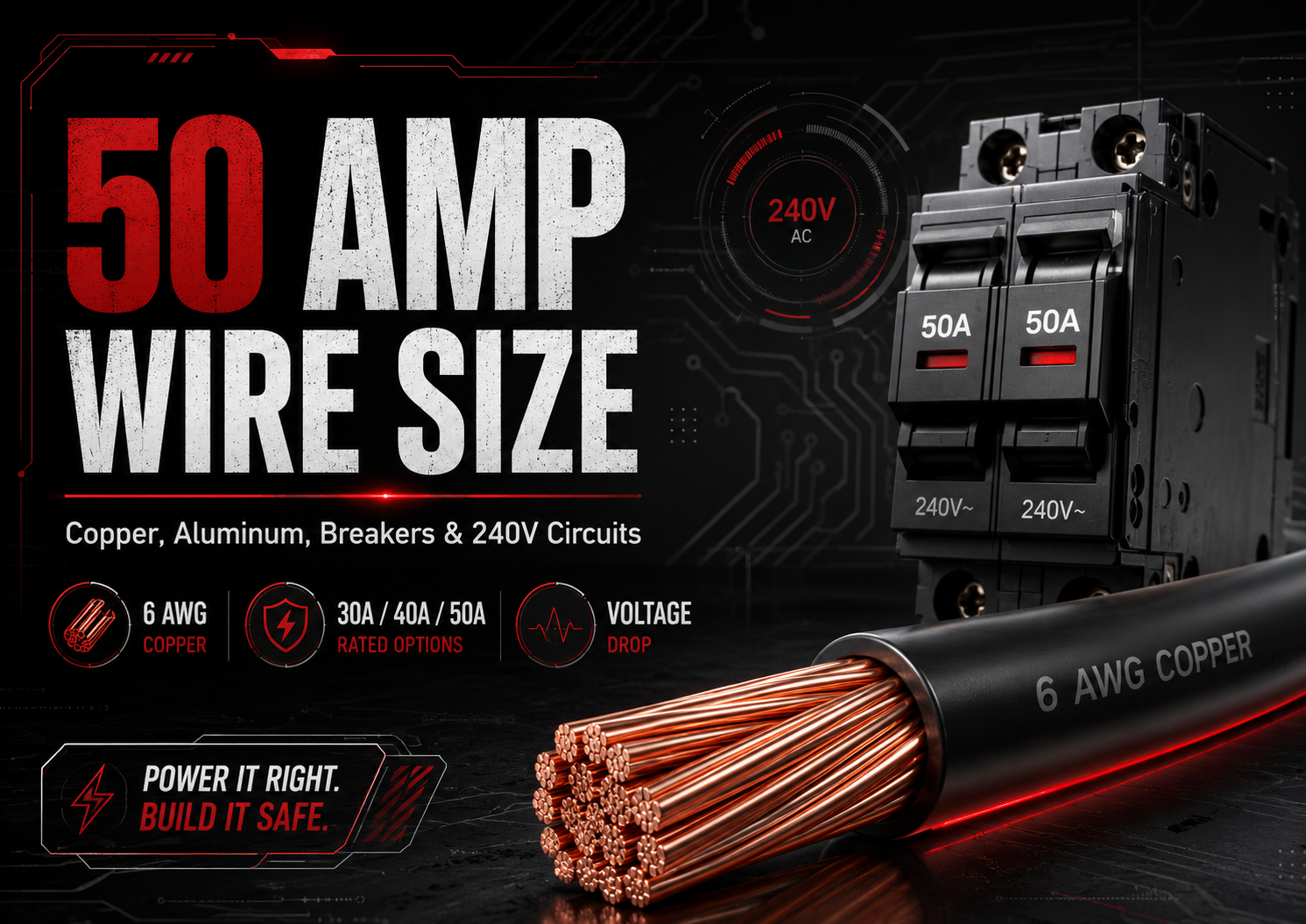
The following table gives a practical overview of common U.S. wire-size considerations for a 50A circuit. It is intended as a design and comparison guide rather than a substitute for a site-specific electrical calculation.
| Parameter | Typical Specification | Practical Meaning |
|---|---|---|
| Common 50A Copper NM-B | 6 AWG copper | A common residential choice because NM-B ampacity is limited by the 60°C conductor column. It provides useful thermal margin for many standard 50A branch circuits. |
| Copper THHN / THWN | 8 AWG may be 50A at 75°C | Individual conductors in conduit can have different allowable ampacity from NM-B. Terminal ratings and all applicable adjustment rules must still be checked. |
| Aluminum Conductor | 6 AWG may be 50A at 75°C | Aluminum normally requires a larger conductor than copper for comparable ampacity and must be used only with compatible terminals and installation methods. |
| Typical Breaker | 50A circuit breaker | The breaker protects the circuit conductors. The load, wire, terminals, and equipment must all be suitable for the circuit design. |
| 240V Circuit | Two-pole 240V configuration | A 50A conductor does not become smaller simply because the system is 240V. Voltage and current perform different roles in wire sizing. |
| Continuous Load | Often lower than breaker rating | Many continuous-load applications are designed so the normal continuous current is below the breaker nameplate value. |
| Long Circuit | Larger wire may be desirable | Ampacity may be acceptable while voltage drop becomes the reason to increase conductor size. |
| Final Selection | Depends on installation | Wire type, material, temperature rating, terminations, ambient heat, conductor count, distance, load, and local code must be considered together. |
Why 6 AWG Copper Is Common for a 50 Amp Circuit
When homeowners ask what size wire for a 50 amp breaker, they are often thinking about a residential appliance, workshop circuit, RV outlet, range, subpanel, welder, or similar dedicated load.
In many residential installations, the wiring method is copper NM-B cable. NM-B is widely used inside dry residential spaces, but its allowable ampacity is treated differently from individual THHN or THWN conductors installed in conduit.
For common copper ampacity tables, 6 AWG copper has an ampacity of 55A in the 60°C column. That makes it a natural fit for many 50A circuits where the cable must be evaluated using the 60°C rating.
This is one reason the simple answer "6 AWG copper" appears so frequently when people search for 50 amp wire. It is easy to understand, commonly available, and appropriate for many residential applications.
However, this does not mean that every 50A installation anywhere in the world should automatically use 6 AWG copper. The wiring method matters just as much as the breaker number.
Can 8 AWG Copper Be Used for 50 Amps?
This is where 50 amp wire size becomes more interesting.
Copper 8 AWG can have a 50A ampacity in a 75°C ampacity column. This can make it suitable in some installations that use correctly rated individual conductors, suitable equipment terminals, and an installation method that permits that ampacity.
But an 8 AWG cable should never be assumed to be suitable simply because another 8 AWG conductor is rated for 50A. Wire gauge alone does not tell you the full ampacity.
A conductor marked THHN/THWN-2 installed in conduit is not electrically identical, from a code-selection point of view, to 8 AWG NM-B cable installed through a residential wall. The conductor temperature limitations and wiring rules can produce different allowable current values.
This distinction is one of the most useful answers for anyone asking what size wire for 50 amps. The better question is:
What conductor material, cable type, insulation rating, terminal temperature rating, installation method, and load will be used on the 50A circuit?
Once those details are known, the gauge decision becomes much more reliable.
50 Amp Copper vs Aluminum Wire
Copper and aluminum are both used in electrical distribution, but they do not have identical conductivity, physical properties, or terminal requirements.
Copper is widely used for residential branch circuits because it offers high conductivity in a relatively small conductor. Aluminum is lighter and can be economical for larger feeders and distribution circuits, but it usually requires a larger conductor size for similar ampacity.
| Conductor | Typical Ampacity Reference | Practical Meaning |
|---|---|---|
| 6 AWG Copper | 55A at 60°C; higher in hotter columns | Frequently selected for a 50A residential circuit using copper NM-B or where extra conductor margin is desired. |
| 8 AWG Copper | 50A at 75°C | May work for certain individual-conductor installations when the complete system permits use of the 75°C rating. |
| 6 AWG Aluminum | 50A at 75°C | Can provide 50A ampacity under appropriate conditions, but terminals must be listed and suitable for aluminum conductors. |
| 4 AWG Aluminum | Higher capacity and lower voltage drop | May be chosen for longer runs, additional margin, or when installation conditions require a larger conductor. |
The important point is that choosing 50 amp wire is not only about finding the cheapest conductor with a 50A number beside it. Connection quality, conductor compatibility, voltage drop, physical installation, and equipment listing are equally important.
Wire Size for 50 Amps 240 Volts
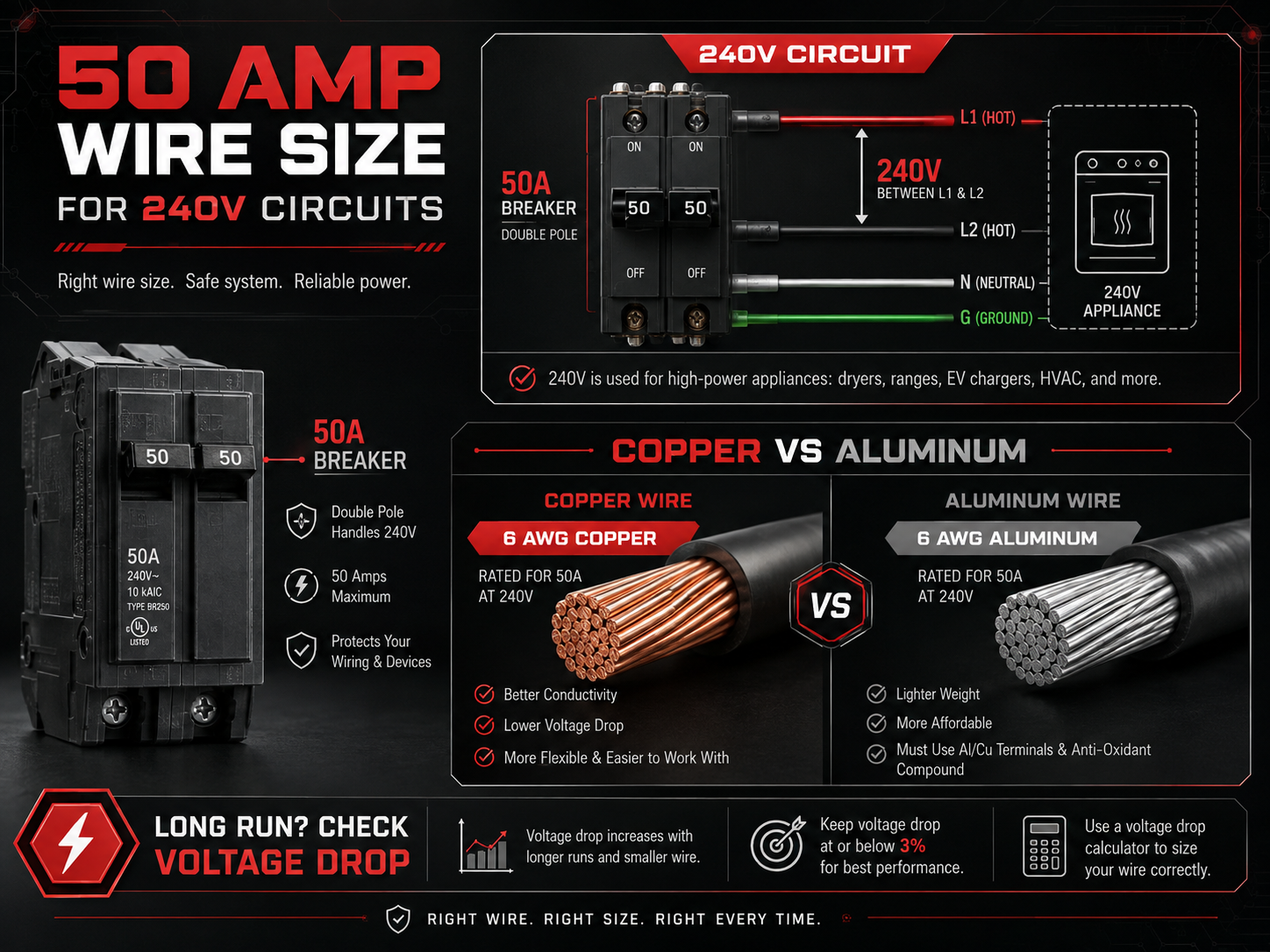

A common search is wire size for 50 amps 240 volts. Many people assume that a 240V circuit automatically requires a different wire gauge from a 120V circuit carrying the same current.
In general, conductor ampacity is primarily based on current, conductor material, insulation, installation method, and temperature conditions. If the circuit current is still 50A, changing from 120V to 240V does not by itself cut the required conductor ampacity in half.
What does change is the amount of power that can be delivered.
At a simple theoretical level:
120V × 50A = 6,000 watts
while:
240V × 50A = 12,000 watts
This is why many high-power appliances and equipment use 240V. The higher voltage allows more power to be delivered at a given current.
A typical 240 volt circuit breaker in a residential split-phase system is a two-pole breaker. Depending on the appliance, the circuit may need two hot conductors plus an equipment grounding conductor, or two hots, a neutral, and a grounding conductor.
The equipment instructions determine whether a neutral is needed. The wire count should never be guessed only from the breaker amperage.
50 Amp Breaker Does Not Always Mean a 50 Amp Continuous Load
One of the most important ideas missing from many 50 amp wire size guides is the difference between breaker rating and normal continuous operating current.
A circuit breaker marked 50A is not necessarily intended for equipment that draws a full 50 amps continuously for hours.
A good real-world example is EV charging. Some electric vehicle charging equipment configured on a 50A breaker is limited to approximately 40A continuous output.
This distinction matters because electrical systems are designed around heat. A conductor carrying a heavy current for a few seconds experiences different thermal stress from the same conductor carrying that current continuously for many hours.
Therefore, when someone asks what size wire for a 50 amp breaker, the breaker is only one part of the answer. The actual connected load and whether it operates continuously must also be identified.
50 Amp Wire Size for EV Chargers

EV charging is one of the most common modern reasons people search for 50 amp wire size.
Level 2 charging systems can operate for several hours at a time, which makes thermal performance particularly important. A charger configured for a 50A branch circuit may have a lower continuous charging output, such as 40A.
The correct conductor should be selected using the charger manufacturer's installation instructions together with the applicable electrical code.
Some EV chargers require copper conductors only at their terminals. Others may allow different conductor sizes depending on breaker rating, temperature rating, and maximum configured output.
For this reason, simply buying "50 amp wire" before selecting the charger can create problems. A better sequence is:
Choose the EVSE, determine its maximum configured current, determine the required breaker size, verify the terminal requirements, calculate the circuit distance, and only then choose the conductor.
This equipment-first method is more reliable than selecting cable based only on a generic ampacity chart.
50 Amp Wire Size for RV Outlets
Another major application is a 50A RV receptacle. A typical RV connection can use multiple conductors because it supplies more than a simple two-wire 240V load.
This is a good example of why what size is 50 amp wire is not the only question to ask. You also need to know the required number of insulated conductors, grounding conductor, receptacle type, breaker configuration, wiring method, and installation environment.
Outdoor RV installations may also introduce wet-location requirements. A cable or conductor that is suitable inside a dry wall is not automatically approved for underground conduit or other wet locations.
If the RV pedestal is far from the main panel, voltage drop becomes another important design factor.
Wire Size for 50 Amp Service or Subpanel
The keyword wire size for 50 amp service can mean several different things. Some people mean a 50A RV service. Others mean a feeder to a detached garage, workshop, shed, or subpanel.
A feeder deserves more attention than a simple branch-circuit answer because it may supply many different loads at the same time.
The conductor must be sized for the calculated load and protected correctly. The installation may also require separate neutral and equipment-grounding conductors, grounding electrodes at a detached structure, appropriate disconnecting means, and correctly isolated neutral and ground bars depending on the application.
A long feeder may also benefit from a larger conductor even when the minimum ampacity calculation appears acceptable.
This is why wire size for 50 amp service should be treated as a system-design question rather than only a gauge question.
Voltage Drop and Long 50 Amp Wire Runs
A wire can satisfy minimum ampacity rules and still perform poorly on a long circuit because of voltage drop.
Every conductor has resistance. As current passes through the wire, some voltage is lost and some energy becomes heat. The longer the conductor, the greater the resistance.
A 50A circuit running only a short distance may work well with the minimum properly selected conductor. A circuit running 150 or 200 feet may benefit from a larger wire size.
This is particularly important for motors, compressors, welders, EV chargers, and equipment that may be sensitive to low voltage.
| Run Condition | Typical Design Approach | Practical Meaning |
|---|---|---|
| Short 50A Run | Use code-compliant minimum sizing | Voltage drop is less likely to control conductor selection when the panel and load are close together. |
| Medium Run | Check voltage drop | Ampacity may still be acceptable, but conductor resistance starts to matter more. |
| Long 50A Run | Consider upsizing | Moving from 6 AWG to a larger conductor can reduce voltage drop and improve equipment performance. |
| High Starting Load | Evaluate startup voltage | Motors and compressors may experience greater voltage sag during startup than steady-state equipment. |
Upsizing wire for voltage drop does not mean increasing the breaker size automatically. The breaker is selected for the circuit and equipment, while a larger conductor can simply provide lower resistance and additional thermal margin.
30 Amp Wire Size vs 40 Amp Wire Size vs 50 Amp Wire Size
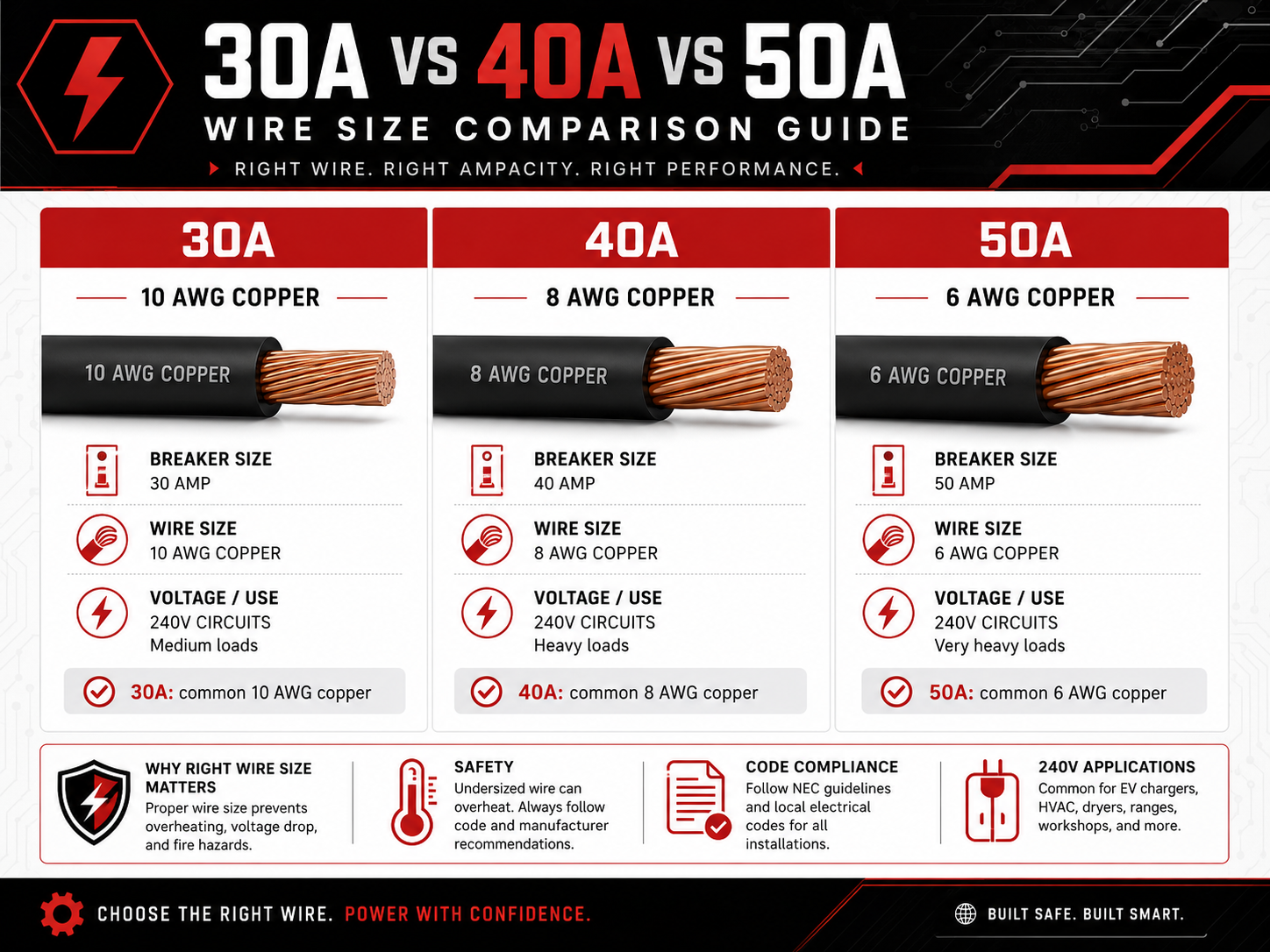

Comparing nearby circuit sizes is useful because it shows how quickly conductor requirements change as current increases.
| Circuit Rating | Common Copper NM-B Size | Practical Meaning |
|---|---|---|
| 20 Amp | 12 AWG copper | Common for general 20A residential circuits. A 240V circuit at 20A may still use 12 AWG when the installation conditions permit. |
| 30 Amp | 10 AWG copper | A common 30 amp wire size for residential circuits such as some dryers, water heaters, and equipment circuits. |
| 40 Amp | 8 AWG copper | A common 40 amp wire size using NM-B under typical residential conditions. |
| 50 Amp | 6 AWG copper | A common residential answer for 50 amp wire size, especially when using copper NM-B cable. |
This comparison also explains why 30 amp breaker wire size usually produces a different result from a 50A circuit. Increasing the breaker without increasing conductor capacity can allow the wire to overheat before the protective device trips.
30 Amp Wire Size Explained
For people comparing 30 amp wire size with a 50A installation, 10 AWG copper is a common residential answer for a 30A branch circuit.
The phrases wire size for 30 amp, 30 amp wire, and what size wire for 30 amps usually refer to this basic relationship.
However, the same principles still apply. Cable type, conductor material, terminals, environment, continuous load, and equipment instructions can affect the final design.
A 30 amp breaker wire size should never be selected just because a cable physically fits into the breaker terminal.
40 Amp Wire Size Explained
A common 40 amp wire size in residential copper NM-B applications is 8 AWG.
This creates an important point when comparing 40A and 50A circuits. In NM-B applications, the move from a 40A breaker to a 50A breaker often results in a move from 8 AWG to 6 AWG copper.
This is also why generic online charts sometimes create confusion. A chart showing 8 AWG copper at 50A may be referring to a 75°C conductor ampacity, while someone wiring with NM-B must evaluate the cable under different temperature limitations.
Therefore, when searching for 40 amp breaker wire size, always check what conductor and temperature column the chart is using.
Wire Size for a 20 Amp 240 Volt Circuit
Another related search is wire size for 20 amp 240 volt circuit.
For many typical copper residential branch circuits, 12 AWG copper is associated with a 20A circuit. The fact that the circuit operates at 240V does not automatically require a larger conductor if the current remains 20A.
The circuit configuration, however, may be different. A straight 240V load may use two hot conductors and an equipment grounding conductor, while equipment requiring both 120V and 240V functions may also need a neutral.
Always follow the equipment connection diagram rather than guessing based on voltage alone.
Understanding AWG: Why a Smaller Number Means a Bigger Wire
American Wire Gauge can seem backward at first.
In AWG sizing, a smaller gauge number represents a larger conductor. Therefore, 6 AWG is physically larger than 8 AWG, 8 AWG is larger than 10 AWG, and 10 AWG is larger than 12 AWG.
Larger conductors normally have lower electrical resistance and can carry more current under comparable installation conditions.
This is why moving from a 30 amp wire size to a 40 amp wire size and then to a 50 amp wire size usually means progressively larger conductors.
Temperature Ratings Matter More Than Many Buyers Realize
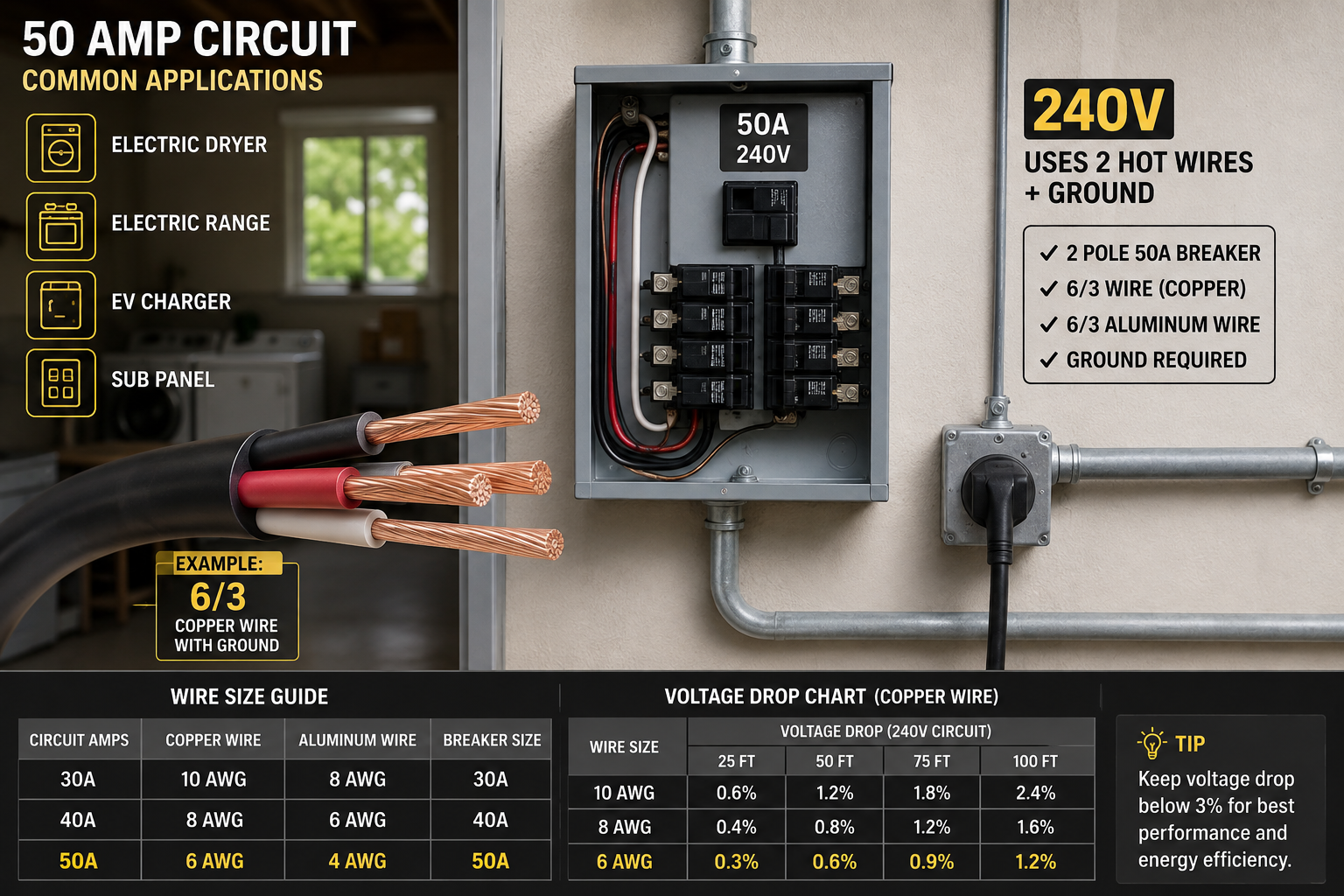
One of the most overlooked parts of wire selection is temperature.
Ampacity charts often contain columns such as 60°C, 75°C, and 90°C. A beginner may look at the highest number and assume that is the usable ampacity.
That can be a mistake.
The usable rating can be limited by the cable type, equipment terminal rating, breaker terminal rating, or other installation conditions.
NM-B is a good example. The internal conductor insulation can have a higher temperature rating, but the cable's allowable ampacity for normal application is limited to the appropriate 60°C values.
This explains how one 8 AWG copper product may appear in a table with a 50A value while an 8 AWG NM-B installation may be associated with a lower allowable ampacity.
The wire gauge did not change. The permitted operating conditions did.
Bundling and Ambient Temperature Can Change the Answer
Conductors cool themselves by transferring heat into the surrounding environment. When many current-carrying conductors are grouped together, or when wiring is installed in a hot location, heat can escape less effectively.
Electrical codes therefore include adjustment and correction rules for certain conductor-grouping and ambient-temperature conditions.
This means a wire that appears adequate from a basic 50 amp wire size table may need further evaluation in a crowded raceway or unusually hot environment.
This issue is especially important in commercial and industrial installations where many circuits can share the same raceway.
Do You Need a Neutral on a 50 Amp Circuit?
Not every 50A circuit needs a neutral.
A pure 240V load can sometimes operate using two ungrounded conductors and an equipment grounding conductor. Other equipment uses both 120V and 240V internally and therefore requires a neutral as well.
A range, RV connection, subpanel, EV charger, welder, or other 50A load should not be wired based only on what another 50A appliance uses.
Always check the equipment wiring diagram and installation instructions.
Ground Wire Size Is a Separate Question
The equipment grounding conductor is not automatically the same size as the current-carrying conductors.
Its job is different. It provides a low-impedance fault-current path so protective equipment can operate quickly if an energized conductor contacts conductive equipment parts.
Grounding conductor sizing is governed by separate rules, and conductor upsizing for voltage drop can also affect grounding-conductor considerations.
For this reason, a search for 50 amp wire size should not be interpreted as giving every conductor size needed for the entire cable assembly.
Common Mistakes When Choosing 50 Amp Wire
Using Gauge Alone
"8 AWG" or "6 AWG" does not provide enough information. Material, insulation, cable type, and installation conditions matter.
Using the Highest Ampacity Column Automatically
A 90°C insulation rating does not automatically mean the entire circuit can be designed using the 90°C ampacity value.
Ignoring Voltage Drop
A minimum conductor can satisfy basic ampacity requirements but still produce excessive voltage drop on a long run.
Assuming Every 50A Breaker Supplies a Continuous 50A Load
Some equipment operates below the breaker rating during continuous use.
Using Indoor Cable in Wet Locations
Wiring installed outdoors or underground can require conductors specifically listed for wet locations.
Ignoring Manufacturer Instructions
Equipment may specify copper-only terminals, minimum conductor sizes, maximum breaker ratings, or special connection requirements.
How to Choose the Correct 50 Amp Wire Size Step by Step
1. Identify the Actual Load
Determine what equipment the circuit will supply and read its nameplate and installation manual.
2. Determine the Required Breaker
Do not choose a breaker simply because the equipment can physically connect to it. Use the manufacturer's instructions and applicable electrical rules.
3. Identify Whether the Load Is Continuous
EV charging and other long-duration loads may require different design treatment from short-duration equipment.
4. Choose Copper or Aluminum
Verify that all terminals are approved for the conductor material.
5. Select the Wiring Method
Determine whether the project uses NM-B, THHN/THWN in conduit, MC cable, service-entrance cable, or another approved wiring method.
6. Check Temperature Limitations
Compare conductor insulation, cable restrictions, and equipment termination ratings.
7. Check Distance
Calculate voltage drop. Increase conductor size if the run is long enough to affect equipment performance.
8. Check Installation Conditions
Consider ambient temperature, number of current-carrying conductors, conduit fill, wet locations, and other environmental factors.
9. Confirm Local Code Requirements
Electrical requirements can vary by jurisdiction and adopted code edition.
50 Amp Wire Size FAQ
What Size Wire for 50 Amps?
For many typical U.S. residential installations using copper NM-B cable, 6 AWG copper is a common 50 amp wire size. Other conductor types and installation conditions may permit different sizes.
What Size Wire for a 50 Amp Breaker?
A common answer is 6 AWG copper NM-B. Individual 8 AWG copper conductors may have a 50A ampacity under suitable 75°C conditions, so the wiring method and terminal ratings must be checked.
Can I Use 8 Gauge Wire on a 50 Amp Breaker?
Sometimes, but not universally. 8 AWG copper can be rated for 50A in the 75°C ampacity column, while 8 AWG copper NM-B is subject to different limitations. Do not select it without checking the complete installation.
Is 6 Gauge Wire Good for 50 Amps?
In many common residential copper applications, yes. 6 AWG copper is widely used for 50A circuits and provides more ampacity than 8 AWG copper in the 60°C column.
What Size Wire for 50 Amps 240 Volts?
For many residential copper NM-B installations, 6 AWG remains a common choice. A circuit being 240V does not by itself reduce the required ampacity when current remains 50A.
What Is the Common 30 Amp Wire Size?
10 AWG copper is commonly used for a 30A residential branch circuit. The final selection still depends on conductor type and installation conditions.
What Is the Common 40 Amp Wire Size?
8 AWG copper is a common choice for a 40A circuit using residential NM-B cable.
What Size Wire Is Common for a 20 Amp 240 Volt Circuit?
12 AWG copper is commonly associated with a 20A residential circuit. The required number of conductors depends on the equipment.
Does a Longer 50 Amp Circuit Need Bigger Wire?
It may. Even when the minimum conductor has sufficient ampacity, a larger conductor can reduce voltage drop on a long circuit.
Is 50 Amp Wire Size the Same for Copper and Aluminum?
No. Aluminum generally requires a larger conductor than copper for comparable ampacity, and the equipment terminals must be approved for aluminum.
Final Guide to Choosing 50 Amp Wire
The most useful answer to 50 amp wire size is not one number without context.
For many common U.S. residential projects using NM-B cable, 6 AWG copper is the practical starting point for a 50A circuit. It is also why 6 gauge copper is so commonly recommended when people ask what size wire for 50 amps or what size wire for a 50 amp breaker.
However, individual copper conductors operating under appropriate 75°C conditions can produce a different answer. Copper 8 AWG can have a 50A ampacity in that environment, while 6 AWG aluminum may also be rated at 50A under suitable conditions.
The bigger lesson is that electrical wire should be treated as part of a complete system. Breaker rating, conductor material, cable type, insulation, terminals, circuit distance, ambient temperature, number of current-carrying conductors, continuous-load behavior, equipment instructions, and local code all affect the final decision.
The same approach applies when comparing 30 amp wire size, 40 amp wire size, 30 amp breaker wire size, 40 amp breaker wire size, or wire size for 50 amp service.
Instead of asking only "what gauge is 50 amp wire?", ask what conductor is suitable for the complete electrical installation. That question leads to safer wiring, lower voltage drop, better equipment performance, and a more reliable system over the long term.
Safety note: This guide is educational and based on common U.S. wiring practices. Electrical installations can involve shock, fire, and arc-flash hazards. Final conductor and breaker selection should follow the equipment instructions, the locally adopted electrical code, and inspection requirements. For permanent high-current wiring, use a qualified electrician when required