The LR44 battery is one of the most widely used small button batteries in the world. It powers toys, calculators, thermometers, digital calipers, small clocks, laser pointers, medical devices, LED lights, and many other compact electronic products.
However, buying an LR44 replacement is not always simple. The same physical battery may be sold under names such as A76, AG13, LR1154, L1154, 157, or V13GA. You may also see silver oxide batteries such as 357, 303, and SR44 listed as possible replacements.
Some of these batteries are nearly identical in size, but they do not always use the same chemistry or provide the same discharge performance. Others, including LR41, 337, and CR2032, are completely different sizes and should not be treated as direct replacements.
This guide explains the most common LR44 battery equivalent options, LR44 battery voltage, dimensions, uses, chemistry, price factors, and replacement rules. It also compares LR44 with 357, SR44, AG13, LR41, 337, and CR2032 so that you can choose a battery based on real compatibility instead of a similar-looking name.
What Is an LR44 Battery?
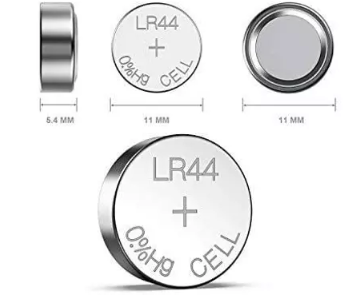
An LR44 is a small, round, non-rechargeable alkaline button cell. Its nominal voltage is 1.5 volts, and its standard physical size is approximately 11.6 mm in diameter and 5.4 mm in height.
| LR44 Battery Feature | Typical Specification |
|---|---|
| Battery type | Alkaline button cell |
| Nominal voltage | 1.5V |
| Diameter | Approximately 11.6 mm |
| Height | Approximately 5.4 mm |
| IEC designation | LR44 |
| Common alternative names | A76, AG13, LR1154, L1154, V13GA |
| Common silver oxide alternatives | 357, 303, SR44, SR44W, SR44SW |
| Rechargeable | No |
The letter "L" generally identifies an alkaline chemistry, while "R" indicates a round cell. The number relates to the battery's standardized size category. This naming system helps distinguish an LR44 alkaline cell from a same-size silver oxide SR44 cell.
What Is the LR44 Battery Voltage?
The nominal LR44 battery voltage is 1.5 volts. A new battery may show a slightly higher open-circuit reading when tested without a load. This does not mean the battery is defective or overcharged.
As an alkaline LR44 discharges, its voltage usually falls gradually. The exact operating voltage depends on the device, current demand, temperature, battery quality, storage conditions, and remaining capacity.
This gradual decline is important because some devices are more voltage-sensitive than others. A simple toy may continue working as the voltage drops, while a digital measuring instrument may show a low-battery warning or become less stable.
What Is the LR44 Watch Battery Voltage?
The typical LR44 watch battery voltage is 1.5V because LR44 is an alkaline battery. However, many watches that appear to use an LR44-size battery are designed for a silver oxide SR44, 357, or 303 battery with a nominal voltage of 1.55V.
The difference between 1.5V and 1.55V looks small, but chemistry matters as much as the starting voltage. Silver oxide batteries normally maintain a flatter voltage during discharge. This makes them a better choice for watches and precision instruments that need stable power.
Before installing an LR44 in a watch, check the number printed on the original battery or review the device manual. If the original battery says SR44SW, SR44W, 303, or 357, a silver oxide replacement is usually the more suitable option.
What Is the Best LR44 Battery Equivalent?
The most common LR44 battery equivalent names include A76, AG13, LR1154, L1154, V13GA, G13A, and KA76. These names normally refer to an alkaline button cell in the same general 11.6 × 5.4 mm size.
Common silver oxide alternatives include 357, 303, SR44, SR44W, and SR44SW. These batteries usually fit the same compartment, but their chemistry and discharge behavior differ from LR44.
| Battery Code | Chemistry | Nominal Voltage | Physical Fit | Replacement Comment |
|---|---|---|---|---|
| LR44 | Alkaline | 1.5V | Exact | Original standard type |
| A76 | Alkaline | 1.5V | Usually exact | One of the most common LR44 equivalents |
| AG13 | Usually alkaline | 1.5V | Usually exact | Common commercial equivalent |
| LR1154 | Alkaline | 1.5V | Usually exact | Size-based designation for LR44 |
| V13GA | Alkaline | 1.5V | Usually exact | Brand-specific cross-reference |
| 357 | Silver oxide | 1.55V | Usually exact | Better voltage stability in many devices |
| 303 | Silver oxide | 1.55V | Usually exact | Often designed for lower-drain applications |
| SR44 | Silver oxide | 1.55V | Usually exact | Same size class with different chemistry |
If you are searching for a battery LR44 equivalent or an equivalent battery LR44, begin with A76, AG13, or LR1154 when you need an alkaline replacement. Consider 357 or SR44 when you want more stable voltage and the device supports a silver oxide cell.
Some searches contain phrases such as "battery LR44 equivalentm." The final "m" is usually a typing error. The intended search is normally "battery LR44 equivalent," which refers to same-size options such as A76, AG13, LR1154, 357, and SR44.
LR44 Button Battery Equivalent Explained
The phrase LR44 button battery equivalent usually means a battery that has the same diameter, height, terminal arrangement, and suitable voltage.
A battery is not truly compatible only because it is round. Proper compatibility has three layers:
- Mechanical compatibility: The diameter and height must fit the battery compartment.
- Electrical compatibility: The voltage and terminal direction must match the device.
- Performance compatibility: The chemistry must support the device's current demand and required voltage stability.
This three-layer method is more reliable than choosing a battery because its package says "button cell" or because it looks similar in a photograph.
For example, an SR44 normally passes all three compatibility checks for many LR44 devices. A CR2032 fails the size and voltage checks. An LR41 may have the same 1.5V rating but fails the physical-size check.
LR44 Cell Battery Equivalent and Coin Cell Terminology
Consumers often search for an LR44 cell battery equivalent, LR44 coin battery, or LR44 coin cell battery. In everyday product listings, the terms "button battery" and "coin battery" are sometimes used loosely.
Technically, LR44 is more accurately described as a button cell because it is relatively small and thick compared with wider, flatter coin cells such as CR2032.
The terminology itself does not determine compatibility. The battery code, chemistry, dimensions, and voltage provide more useful information than whether a seller calls it a coin battery or button battery.
When comparing products, always check the printed model number. A listing that only says "1.5V coin cell" is not specific enough to confirm that the battery is LR44 compatible.
LR44 vs 357 Battery
The LR44 vs 357 battery comparison is one of the most common sources of confusion. Both batteries are normally about 11.6 mm in diameter and 5.4 mm high, so they usually fit the same compartment.
The main difference is chemistry:
- LR44 uses alkaline chemistry and has a nominal voltage of 1.5V.
- 357 uses silver oxide chemistry and has a nominal voltage of 1.55V.
A 357 battery usually maintains its operating voltage more consistently during discharge. An LR44 normally experiences a more gradual voltage decline. As a result, the 357 may provide more stable performance in watches, digital calipers, medical instruments, and other voltage-sensitive electronics.
An LR44 is often sufficient for toys, novelty products, simple lights, and other devices where cost is more important than precision. The 357 is generally more expensive, but it may offer better performance in devices that require steady voltage.
What Is the Difference Between LR44 and 357 Battery?
The core difference between LR44 and 357 battery is not size. It is the internal chemistry and discharge curve. They commonly share the same physical dimensions, but the 357 is a 1.55V silver oxide battery while LR44 is a 1.5V alkaline battery.
In many devices, a 357 can replace an LR44. The reverse replacement may also operate, but the device may not run as long or as consistently if it was designed for silver oxide power.
For a low-cost toy, either battery may work. For a watch, digital gauge, medical product, or precision instrument, matching the original chemistry is the safer decision.
Is a 337 Battery the Same as LR44?
No. A 337 battery is not an LR44 equivalent.
The 337 is normally an SR416SW silver oxide watch battery. It is approximately 4.8 mm in diameter and 1.65 mm high. An LR44 is approximately 11.6 mm in diameter and 5.4 mm high.
This makes the 337 much smaller than the LR44. It will not fit correctly in an LR44 battery holder and cannot provide a reliable physical connection.
The numbers 337 and 357 are easy to confuse. If you intended to search for the difference between LR44 and 357 battery, the 357 is the same general size as LR44. The 337 is not.
SR44 vs LR44 Battery
In the SR44 battery vs LR44 comparison, both batteries share the same general physical size, but they use different chemistries.
| Feature | LR44 | SR44 |
|---|---|---|
| Chemistry | Alkaline manganese dioxide | Silver oxide |
| Nominal voltage | 1.5V | 1.55V |
| Typical dimensions | 11.6 × 5.4 mm | 11.6 × 5.4 mm |
| Voltage behavior | Gradually declines | Usually remains flatter |
| Typical price | Lower | Higher |
| Best suited for | Toys, simple electronics and general use | Watches, meters and precision devices |
An SR44 can often serve as a premium replacement battery for LR44. It may not always produce a dramatic increase in runtime because actual battery life depends on load and cutoff voltage. Its main benefit is often a more stable output over the useful discharge period.
There are also SR44W and SR44SW versions. The "W" type is commonly associated with higher-drain or pulse-demand applications, while the "SW" type is commonly associated with lower, steadier drain. Many modern cross-reference packages combine 357 and 303 applications, but the original battery marking remains the best guide.
LR44 vs AG13 Battery
For most consumer applications, the LR44 battery vs AG13 comparison is simple: AG13 is generally used as a commercial name for an alkaline battery with the same basic size and voltage as LR44.
Both are commonly rated at 1.5V and measure approximately 11.6 × 5.4 mm. In many toys, calculators, thermometers, laser pointers, and small LED devices, AG13 and LR44 can be used interchangeably.
However, AG-series markings are often used in general retail and low-cost battery packs rather than as precise IEC designations. Product quality, capacity, leakage resistance, storage life, and manufacturing consistency can vary between suppliers.
Therefore, AG13 is normally an LR44-compatible size, but the name alone does not guarantee equal quality. For equipment where battery failure could affect important measurements, choose a recognized manufacturer and verify the full specification.
Difference Between LR41 and LR44 Battery
The difference between LR41 and LR44 battery is mainly physical size and available energy.
- LR41 is approximately 7.9 mm in diameter and 3.6 mm high.
- LR44 is approximately 11.6 mm in diameter and 5.4 mm high.
- Both are typically rated at 1.5V.
Even though both batteries have the same nominal voltage, they are not direct replacements. An LR41 is too small for an LR44 compartment. An LR44 is too large for an LR41 holder.
Trying to fill the extra space with metal, foil, springs, or other improvised materials can cause poor contact, unstable operation, overheating, or a short circuit. Always use the size specified by the device manufacturer.
The larger LR44 also normally stores more energy than LR41, although exact capacity depends on the battery design and test conditions.
LR44 vs CR2032 Battery
An LR44 battery vs CR2032 comparison shows two very different battery types. They should not be considered direct replacements.
| Feature | LR44 | CR2032 |
|---|---|---|
| Typical chemistry | Alkaline | Lithium manganese dioxide |
| Nominal voltage | 1.5V | 3V |
| Diameter | Approximately 11.6 mm | Approximately 20 mm |
| Height | Approximately 5.4 mm | Approximately 3.2 mm |
| Directly interchangeable | No | |
A CR2032 is wider, thinner, and provides twice the nominal voltage of one LR44. Installing a CR2032 in a device designed for one LR44 could damage the circuit if an electrical connection were somehow forced.
Two LR44 batteries connected in series can provide approximately 3V, but they still do not automatically become a CR2032 replacement. Their shape, thickness, capacity, contact arrangement, internal resistance, and discharge behavior are different.
Only use multiple LR44 cells in a product specifically designed for them. Do not modify a battery compartment to make unrelated batteries fit.
Is There an LR44 Lithium Battery?
The term LR44 lithium battery is often used incorrectly. A standard LR44 is an alkaline battery, not a lithium battery. The "L" in LR44 does not mean lithium.
Battery codes beginning with "CR," such as CR2032, normally identify lithium manganese dioxide coin cells. These commonly provide 3V. An LR44 provides 1.5V and uses alkaline chemistry.
Some online listings may describe a same-size cell as lithium without providing a recognized model number or technical data. Such claims should be treated carefully. A true 3V lithium cell cannot be assumed to be electrically compatible with equipment designed for one 1.5V LR44.
Is There a Lithium Battery LR44 Equivalent?
A direct lithium battery LR44 equivalent is not a normal drop-in choice for most LR44 devices. Even when a lithium battery appears physically similar, its voltage may be different.
If your goal is longer life or more stable performance, an SR44, 357, or 303 silver oxide battery is usually a more practical same-size alternative than an unknown lithium replacement.
Always compare the following information before using any claimed lithium substitute:
- Nominal and maximum voltage
- Diameter and height
- Terminal arrangement
- Recommended discharge current
- Device manufacturer approval
Which Batteries Are LR44 Battery Compatible?
The following batteries are commonly described as LR44 battery compatible:
- A76
- AG13
- G13A
- KA76
- LR1154
- L1154
- V13GA
- RW82
- 157
- 357
- 303
- SR44
- SR44W
- SR44SW
Not every name in this list represents identical chemistry. A76, AG13, and LR1154 are generally alkaline equivalents. SR44, 357, and 303 are normally silver oxide alternatives.
The safest rule is to match the exact original number first. If that number is unavailable, choose a cross-reference with the same dimensions and approved voltage. Then consider whether the device needs alkaline or silver oxide discharge characteristics.
What Is an LR44 Battery Used For?
People often ask what an LR44 battery is used for because the battery appears in many unrelated products. Its small size and 1.5V output make it useful in compact, low-voltage electronics.
Common LR44 battery uses include:
- Children's electronic toys
- Talking books and musical cards
- Small LED lights
- Laser pointers
- Pocket calculators
- Digital thermometers
- Digital calipers
- Small clocks and watches
- Miniature game devices
- Pet collars and small accessories
- Glucose meters and selected medical products
- Small remote controls
- Electronic test equipment
- Decorative lights
- Novelty products
Some devices use a single LR44 battery, while others use two, three, or four cells in series. For example, three LR44 batteries in series provide a nominal total of approximately 4.5V.
When replacing multiple cells, replace the entire set at the same time. Mixing new and partly discharged batteries can cause uneven discharge and reduce performance.
How to Choose LR44 Battery Replacement
A good LR44 battery replacement should fit correctly, provide the correct voltage, and match the performance needs of the device.
Use the following process when selecting a replacement battery for LR44:
- Read the original battery code. Look for LR44, A76, AG13, 357, 303, SR44, or another marking.
- Check the device manual. The manual may list several approved battery types.
- Confirm the dimensions. An LR44-size battery should be approximately 11.6 mm in diameter and 5.4 mm high.
- Confirm the voltage. LR44 is 1.5V, while SR44 and 357 are generally 1.55V.
- Consider the application. Toys may work well with alkaline cells, while watches and precision devices may benefit from silver oxide.
- Check the battery direction. Install the positive and negative terminals exactly as shown in the compartment.
- Replace the full set. Do not combine old and new cells in a multi-battery device.
If the original battery is missing, do not guess based only on the holder's appearance. Search the device model number, inspect the manual, or contact the manufacturer.
LR44 1.5V Battery Performance
An LR44 1.5V battery is designed for small electronic loads. Its actual service life cannot be predicted from voltage alone.
Battery life depends on:
- The current used by the device
- Continuous use versus short pulses
- The device's low-voltage cutoff
- Operating temperature
- Battery age and storage history
- Manufacturing quality
- Contact cleanliness
- Whether several batteries are used together
A device that draws power only for a few seconds each day may operate for a long time. A light, motorized toy, or sound-producing device may drain the same battery much faster.
Capacity values on technical data sheets are measured under specific laboratory loads and cutoff voltages. They should be used for comparison, not treated as a guaranteed runtime for every device.
LR44 Battery Price: What Affects the Cost?
The LR44 battery price varies by chemistry, brand, packaging, quantity, shelf life, and seller. Alkaline LR44 and AG13 batteries are usually less expensive than silver oxide 357 or SR44 batteries.
A very low price is not always the best value. Batteries with poor seals, uncertain storage history, inconsistent capacity, or misleading labels may discharge early or leak during long-term use.
For inexpensive toys, a basic alkaline LR44 may be practical. For watches, instruments, medical devices, or products that are difficult to open, paying more for a trusted silver oxide or high-quality alkaline battery may reduce replacement frequency and reliability problems.
When comparing prices, calculate the cost per battery and check whether the package clearly shows the battery code, chemistry, manufacturer, production information, and expiration or best-before date.
Choosing an LR44 Battery Pack
An LR44 battery pack can be more economical when you have several devices that use the same cell. Common packages may contain two, three, six, ten, or more batteries.
An LR44 battery 3 pack is especially useful for devices that require three cells at the same time. Replacing all three batteries from the same pack helps keep their age, brand, chemistry, and state of charge consistent.
Before buying a large pack, consider how quickly you will use it. A lower cost per cell provides little benefit if most batteries remain unused for years or are stored in hot and humid conditions.
Keep unopened batteries in their original packaging in a cool, dry location. Do not store them loose with coins, screws, tools, or other metal objects that could connect the terminals.
Can You Mix LR44, AG13, and 357 Batteries?
Even when LR44, AG13, and 357 batteries fit the same compartment, mixing them in one device is not recommended.
Different chemistries can have different starting voltages, internal resistance, capacity, and discharge curves. One cell may become depleted earlier than the others. This can reduce operating time and increase the risk of leakage or reverse charging in a series battery pack.
For best results, all batteries installed together should have the same:
- Battery code
- Chemistry
- Brand and product series
- Age
- State of charge
If one battery in a set has failed, replace the full set rather than replacing only the visibly weak cell.
How to Test LR44 Battery
You can perform a basic LR44 test with a digital multimeter:
- Set the meter to DC voltage.
- Place the red probe on the positive flat face.
- Place the black probe on the negative side or lower surface.
- Read the voltage without allowing the probes to touch each other.
A new LR44 may measure close to or slightly above its nominal rating without a load. However, an open-circuit voltage test does not show the full condition of the battery. A weak battery may display a reasonable voltage when unloaded but drop sharply when the device draws current.
The best practical test is often to install a known-good battery of the correct type. For professional evaluation, a controlled load test gives more useful information than an unloaded voltage reading.
LR44 Battery Safety and Storage
LR44 batteries are small enough to be swallowed. Keep them away from children and pets. A swallowed button battery can cause serious internal injury and requires immediate emergency medical attention.
Follow these basic safety rules:
- Do not recharge a disposable LR44 battery.
- Do not heat, burn, crush, or puncture the battery.
- Do not connect the positive and negative terminals with metal.
- Do not mix old and new batteries.
- Do not mix alkaline and silver oxide batteries in one set.
- Remove discharged batteries from equipment promptly.
- Remove batteries from products that will be stored for a long time.
- Keep batteries in their original packaging until needed.
- Follow local battery disposal and recycling rules.
If a battery leaks, avoid touching the material with bare skin. Ventilate the area, protect your hands, and follow the device manufacturer's cleaning guidance.
Faq for LR44 Batteries
What battery can replace an LR44?
A76, AG13, LR1154, L1154, and V13GA are common alkaline replacements. SR44, 357, and 303 are same-size silver oxide alternatives that may provide more stable voltage.
Are LR44 and AG13 the same?
They are generally the same physical size and nominal voltage. Both are commonly alkaline 1.5V button cells. However, product quality and exact performance can vary by manufacturer.
Can a 357 replace an LR44?
Yes, in many devices. A 357 is usually the same size as LR44 but uses silver oxide chemistry and has a nominal voltage of 1.55V. It is often a good choice for watches and precision electronics.
Can an LR44 replace a 357 battery?
It may operate in many devices because the size is normally the same. However, LR44 has a less stable alkaline discharge curve, so it may not perform as consistently in equipment designed for a 357 silver oxide battery.
Is SR44 the same as LR44?
They have the same general dimensions but different chemistry. LR44 is alkaline and rated at 1.5V. SR44 is silver oxide and rated at 1.55V.
Is LR44 the same as LR41?
No. Both may be 1.5V alkaline cells, but LR41 is much smaller. LR41 is approximately 7.9 × 3.6 mm, while LR44 is approximately 11.6 × 5.4 mm.
Is a 337 battery equivalent to LR44?
No. A 337 battery is much smaller and is normally identified as SR416SW. Do not confuse battery number 337 with 357.
Is LR44 the same as CR2032?
No. CR2032 is a 3V lithium coin cell measuring approximately 20 × 3.2 mm. LR44 is a 1.5V alkaline button cell measuring approximately 11.6 × 5.4 mm.
Is LR44 a lithium battery?
No. A standard LR44 uses alkaline chemistry. The letter "L" in the LR44 code does not mean lithium.
How many volts does an LR44 battery have?
The nominal LR44 battery voltage is 1.5V. Silver oxide batteries in the same size, such as SR44 and 357, are normally rated at 1.55V.
How long does an LR44 battery last?
Runtime depends on current draw, operating temperature, cutoff voltage, battery quality, storage history, and how often the device is used. There is no single runtime that applies to every LR44-powered product.
Can I recharge an LR44 battery?
No. Standard LR44 batteries are disposable primary cells and should not be recharged.
Which side of an LR44 is positive?
The broad, flat face marked with a plus sign is normally the positive terminal. Always follow the polarity diagram inside the device.
Why does my device use several LR44 batteries?
Multiple cells may be connected in series to increase voltage. Two LR44 batteries provide approximately 3V, while three provide approximately 4.5V.
Final LR44 Replacement Recommendation
Choose A76, AG13, LR1154, or another clearly marked alkaline equivalent when you need a basic, affordable replacement for an LR44 battery.
Choose 357, 303, or SR44 when the battery compartment is the same size and the device benefits from stable silver oxide voltage. Watches, digital measuring tools, and precision electronics are common examples.
Do not use LR41, 337, or CR2032 as direct LR44 replacements. Their dimensions, voltage, or both are different.
The most reliable replacement decision is based on four facts: the original battery number, physical dimensions, voltage, and chemistry. Matching all four is safer than relying on appearance or a broad online compatibility list.